Thank you for visiting SNEWPapers!
Sign up free
Gazette Of The United States And Daily Evening Advertiser
Philadelphia, Philadelphia County, Pennsylvania
What is this article about?
Captain Barre of the French sloop of war Perdrix resigns his command in a letter to French Minister Fauchet, explaining motives due to unfounded suspicions of aristocracy, mistreatment by Rear Admiral Vaintable and Lieut. Mahe, and incidents during a convoy from New York to Delaware. He reaffirms loyalty to the Republic and intends to submit a memorial to the National Convention to clear his name.
Clipping
OCR Quality
Full Text
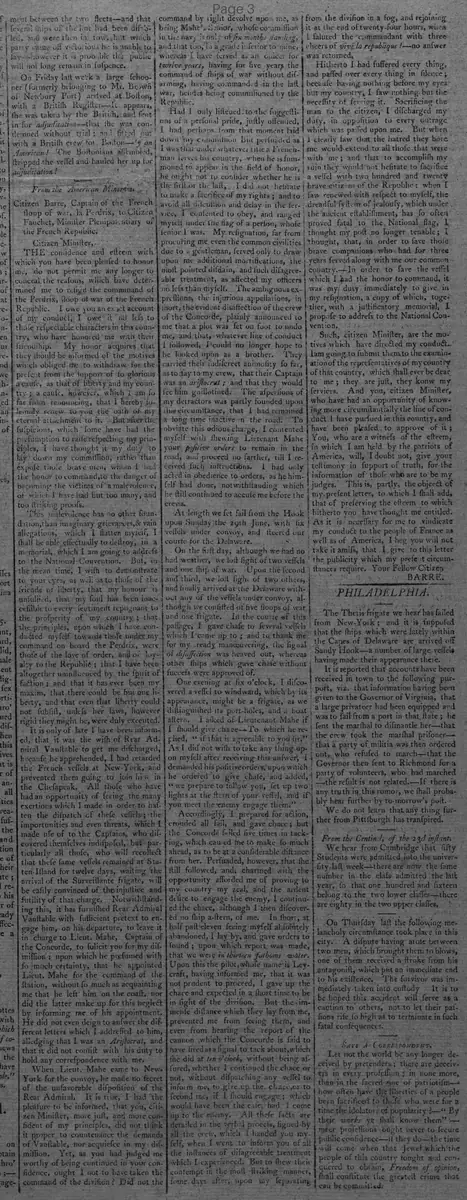
Citizen Barre, Captain of the French loop of war, la Perdrix, to Citizen Fauchet, Minister Plenipotentiary of the French Republic.
Citizen Minister,
THE confidence and esteem with which you have been pleased to honor me, do not permit me any longer to conceal the reasons, which have determined me to resign the command of the Perdrix, sloop of war of the French Republic. I owe you an exact account of my conduct; I owe it no less to those respectable characters in this country, who have honored me with their friendship. My honor requires that they should be informed of the motives which obliged me to withdraw for the present from the support of so glorious a cause, as that of liberty and my country; a cause, however, which I am so far from renouncing, that I hereby solemnly renew to you the oath of my eternal attachment to it. But after the suspicions, which some have had the presumption to raise respecting my principles, I have thought it my duty to lay down my commission, rather than expose those brave men, whom I have the honor to command, to the danger of becoming the victims of a malevolence, of which I have had but too many, and too striking proofs.
This malevolence has no other foundation, than imaginary grievances, & vain allegations, which I flatter myself, I shall be able effectually to destroy, in a memorial, which I am going to address to the National Convention. But, in the mean time, I wish to demonstrate to your eyes, as well as to those of the friends of liberty, that my honour is unspotted, that my soul has been inaccessible to every sentiment repugnant to the prosperity of my country; that the principles, upon which I have conducted myself towards those under my command on board the Perdrix, were those of the love of order, and of loyalty to the Republic; that I have been altogether uninfluenced by the spirit of faction; and that it has ever been my maxim, that there could be but one liberty, and that even that liberty could not subsist, unless her laws, however rigid they might be, were duly executed.
It is only of late I have been informed, that it was the wish of Rear Admiral Vaintable to get me discharged, because he apprehended, I had retarded the French vessels at New-York, and prevented them going to join him in the Chesapeake. All those who have had an opportunity of seeing the many exertions which I made in order to hasten the dispatch of these vessels; the importunities and even threats, which I made use of to the Captains, who discovered themselves indisposed, but particularly all those, who will recollect that these same vessels remained at Staten-Island for twelve days, waiting the arrival of the Surveillante frigate, will be easily convinced of the injustice and futility of that charge. Notwithstanding this, it has furnished Rear Admiral Vaintable with sufficient pretext to engage him, on his departure, to leave it in charge to Lieut. Mahe, Captain of the Concorde, to solicit you for my dismission: upon which he presumed with so much certainty, that he appointed Lieut. Mahe for the command of the station, without so much as acquainting me that he left him on the coast, nor did the latter make up for this neglect by informing me of his appointment. He did not even deign to answer the different letters which I addressed to him, alleging that I was an Aristocrat, and that it did not consist with his duty to hold any correspondence with me.
When Lieut. Mahe came to New-York for the convoy, he made no secret of the unfavorable disposition of the Rear Admiral, It is true, I had the pleasure to be informed, that you, citizen Minister, more just, and more confident of my principles, did not think it proper to countenance the demands of Vantable, nor acquiesce in my-dismiss ion. Yet, as you had judged me worthy of being continued in your confidence, ought I not to have taken the command of the division? Did not the command by right devolve upon me, as being Mahe's Senior, whose commission in the navy is only of six months standing, and that too, in a grade inferior to mine, whereas I have served as an Officer for twelve years, leaving for five years the command of ships of war without disarming, having commanded in the last war, besides being commissioned by the Republic.
Had I only listened to the suggestions of a personal pride, justly offended, I had perhaps from that moment laid down my commission But persuaded as I was that under whatever title a Frenchman serves his country, when he is summoned to appear in the field of honor, he ought not to consider whether he is the first or the last, I did not hesitate to make a sacrifice of my rights; and to avoid all discussion and delay in the service, I consented to obey, and ranged myself under the flag of a person, whose senior I was. My resignation, far from procuring me even the common civilities due to a gentleman, served only to draw upon me additional mortifications, the most pointed disdain, and such disagreeable treatment, as affected my officers no less than myself. The ambiguous expressions, the injurious appellations, in short, the evident disaffection of the crew of the Concorde, plainly announced to me that a plot was set on foot to undo me, and that, whatever line of conduct I followed, I could no longer hope to be looked upon as a brother. They carried their indirect animosity so far, as to say to my crew, that their Captain was an aristocrat; and that they would see him guillotined. The aspersions of my detractors was partly founded upon this circumstance, that I had remained a long time inactive in the road. To obviate this odious charge, I contented myself with showing Lieutenant Mahe your positive orders to remain in the road, and proceed no farther, till I received such instructions. I had only acted in obedience to orders, as he himself had done, notwithstanding which he still continued to accuse me before the crews.
At length we set sail from the Hook upon Sunday the 29th June, with six vessels under convoy, and steered our course for the Delaware. On the first day, although we had no bad weather, we lost sight of two vessels and one ship of war.—Upon the second and third, we lost sight of two others. and finally arrived at the Delaware without any of the vessels under convoy, although we consisted of five sloops of war and one frigate. In the course of this passage, I gave chase to several vessels which I came up to; and to thank me for my ready maneuvering, the signal of disaffection was heaved out, whereas other ships which gave chase without success were approved of.
One evening at six o'clock, I discovered a vessel to windward, which by its appearance, might be a frigate, as we distinguished its port-holes, and a boat astern. I asked of Lieutenant Mahe if I should give chase—To which he replied, "if that is agreeable to you sir." As I did not wish to take any thing upon myself after receiving this answer, I demanded his positive orders, upon which he ordered to give chase, and added, "we prepare to follow you, set up two lights at the stern of your vessel, and if you meet the enemy engage them."
Accordingly, I prepared for action, crowded all sail, and gave chase; but the Concorde failed five times in tacking, which caused me to make so much ahead, as to be at a considerable distance from her. Persuaded, however, that she still followed, and, charmed with the opportunity afforded me of proving to my country my zeal, and the ardent desire to engage the enemy, I continued the chase, although I then discovered no ship astern of me. In short, at half past eleven seeing myself absolutely abandoned, I lay by, and gave orders to sound; upon which report, was made, that we were in thirteen fathoms water. Upon this the pilot, whose name is Leycraft, having informed me, that it was not prudent to proceed, I gave up the chase and expected in a short time to be in sight of the division. But the immense distance which they lay from the, prevented me from seeing them, and even from hearing the report of the cannon which the Concorde is said to have fired as a signal to tack about, which she did at ten o'clock, without being assured, whether I continued the chase or not, without dispatching any vessel to inform me, to give up the chase, or to second me, if I should engage; which would have been the case, had I come up to the enemy. All these facts are detailed in the verbal process, signed by all the crew, which I handed you myself, when I went to inform you of all the instances of disagreeable treatment which I experienced. But to shew their contempt in the most striking manner, some days after, upon my separating from the division in a fog, and rejoining it at the end of twenty-four hours, when I saluted the commandant with three cheers of vive la republique!—no answer was returned
Hitherto I had suffered every thing, and passed over every thing in silence; because having nothing before my eyes but my country, I saw nothing but the necessity of serving it. Sacrificing the man to the citizen, I discharged my duty, in opposition to every outrage which was passed upon me. But when I clearly saw that the hatred they bore me would extend to all those that were with me; and that to accomplish my ruin they would not hesitate to sacrifice a vessel with two hundred and twenty brave citizens of the Republic; when I saw renewed with respect to myself, the dreadful system of jealousy, which under the ancient establishment, has so often proved fatal to the National flag, I thought my post no longer tenable; I thought, that, in order to save those brave companions who had for three years served along with me our common country.—In order to save the vessel which I had the honor to command, it was my duty immediately to give in my resignation, a copy of which, together, with a justificatory memorial, I propose to address to the National Convention.
Such, citizen Minister, are the motives which have directed my conduct. I am going to submit them to the examination of the representatives of my country of that country, which shall ever be dear to me; they are just, they know my services. And you, citizen Minister, who have had an opportunity of knowing more circumstantially the line of conduct I have pursued in this country, and have been pleased, to approve of it; You, who are a witness of the esteem, in which I am held by the patriots of America, will, I doubt not, give your testimony in support of truth, for the information of those who are to be my judges. This is, partly, the object of my present letter, to which I shall add, that of preserving the esteem to which hitherto you have thought me entitled. As it is necessary for me to vindicate my conduct to the people of France as well as of America, I beg you will not take it amiss, that I give to this letter the publicity which my present circumstances require.
Your Fellow Citizen
BARRE.
What sub-type of article is it?
What themes does it cover?
What keywords are associated?
What entities or persons were involved?
Letter to Editor Details
Author
Barre
Recipient
Citizen Fauchet, Minister Plenipotentiary Of The French Republic
Main Argument
captain barre resigns his command due to unfounded suspicions of his republican principles, mistreatment and disdain from superiors like rear admiral vaintable and lieut. mahe, and risks to his crew, while reaffirming his loyalty to the french republic and intending to submit a memorial to the national convention to vindicate his honor.
Notable Details