Thank you for visiting SNEWPapers!
Sign up free
The New Hampshire Gazette And Historical Chronicle
Portsmouth, Greenland, Rockingham County, New Hampshire
What is this article about?
Portsmouth article on optimal methods for raising wheat, preferring new cleared land but advising on sward ground preparation, soil suitability for peas/clover/corn, plowing in June, sowing in late August/September, drainage, avoiding feeding, and weed control through alternate plowing/harrowing.
Clipping
OCR Quality
Full Text
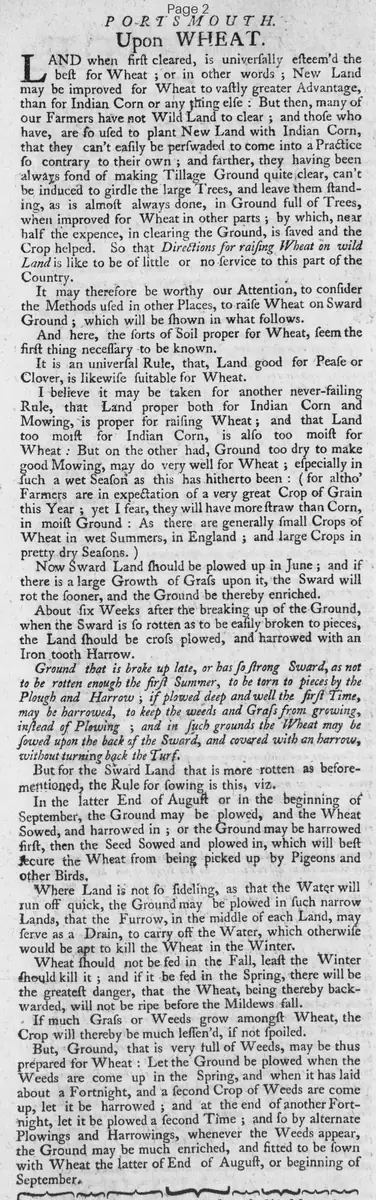
Upon WHEAT.
AND when first cleared, is universally esteemed the best for Wheat; or in other words, New Land may be improved for Wheat to vastly greater Advantage, than for Indian Corn or any thing else: But then, many of Our Farmers have not Wild Land to clear; and those who have, are so used to plant New Land with Indian Corn, that they can't easily be persuaded to come into a Practice so contrary to their own; and farther, they having been always fond of making Tillage Ground quite clear, can't be induced to girdle the large Trees, and leave them standing, as is almost always done, in Ground full of Trees, when improved for Wheat in other parts; by which, near half the expence, in clearing the Ground, is saved and the Crop helped. So that Directions for raising Wheat on wild Land is like to be of little or no service to this part of the Country.
It may therefore be worthy our Attention, to consider the Methods used in other Places, to raise Wheat on Sward Ground: which will be shown in what follows.
And here, the sorts of Soil proper for Wheat, seem the first thing necessary to be known.
It is an universal Rule, that, Land good for Peas or Clover, is likewise suitable for Wheat.
I believe it may be taken for another never-failing Rule, that Land proper both for Indian Corn and Mowing, is proper for raising Wheat; and that Land too moist for Indian Corn, is also too moist for Wheat: But on the other hand, Ground too dry to make good Mowing, may do very well for Wheat; especially in such a wet Season as this has hitherto been: (for altho' Farmers are in expectation of a very great Crop of Grain this Year: yet I fear, they will have more straw than Corn, in moist Ground: As there are generally small Crops of Wheat in wet Summers, in England; and large Crops in pretty dry Seasons.)
Now Sward Land should be plowed up in June: and if there is a large Growth of Grass upon it, the Sward will rot the sooner, and the Ground be thereby enriched.
About six Weeks after the breaking up of the Ground, when the Sward is so rotten as to be easily broken to pieces, the Land should be cross plowed, and harrowed with an Iron tooth Harrow.
Ground that is broke up late, or has so strong Sward, as not to be rotten enough the first Summer, to be torn to pieces by the Plough and Harrow; if plowed deep and well the first Time, may be harrowed, to keep the weeds and Grass from growing, instead of Plowing; and in such grounds the Wheat may be sowed upon the back of the Sward, and covered with an harrow, without turning back the Turf.
But for the Sward Land that is more rotten as before mentioned, the Rule for sowing is this, viz.
In the latter End of August or in the beginning of September, the Ground may be plowed, and the Wheat Sowed, and harrowed in; or the Ground may be harrowed first, then the Seed Sowed and plowed in, which will best secure the Wheat from being picked up by Pigeons and other Birds.
Where Land is not so sideling, as that the Water will run off quick, the Ground may be plowed in such narrow Lands, that the Furrow, in the middle of each Land, may serve as a Drain, to carry off the Water, which otherwise would be apt to kill the Wheat in the Winter.
Wheat should not be fed in the Fall, lest the Winter should kill it; and if it be fed in the Spring, there will be the greatest danger, that the Wheat, being thereby backwarded, will not be ripe before the Mildews fall.
If much Grass or Weeds grow amongst Wheat, the Crop will thereby be much lessen'd, if not spoiled.
But, Ground, that is very full of Weeds, may be thus prepared for Wheat: Let the Ground be plowed when the Weeds are come up in the Spring, and when it has laid about a Fortnight, and a second Crop of Weeds are come up, let it be harrowed; and at the end of another Fortnight, let it be plowed a second Time; and so by alternate Plowings and Harrowings, whenever the Weeds appear, the Ground may be much enriched, and fitted to be sown with Wheat the latter End of August, or beginning of September.
What sub-type of article is it?
What keywords are associated?
Where did it happen?
Story Details
Location
Portsmouth
Story Details
Discusses advantages of clearing wild land for wheat over corn, but focuses on methods for sward ground: soil suitability for peas, clover, corn, mowing; plowing in June, cross-plowing after six weeks, sowing late August/September, drainage furrows, avoiding fall feeding, weed control via repeated plowing/harrowing.