Thank you for visiting SNEWPapers!
Sign up free
Literary
August 27, 1799
The New Hampshire Gazette
Portsmouth, Rockingham County, New Hampshire
What is this article about?
An essay denouncing male coquetry as a grave moral crime, where men feign passion to deceive unsuspecting women, leading to profound emotional harm, lasting resentment, and contributing to bitterness among older unmarried women toward men.
Clipping
OCR Quality
95%
Excellent
Full Text
MALE COQUETRY.
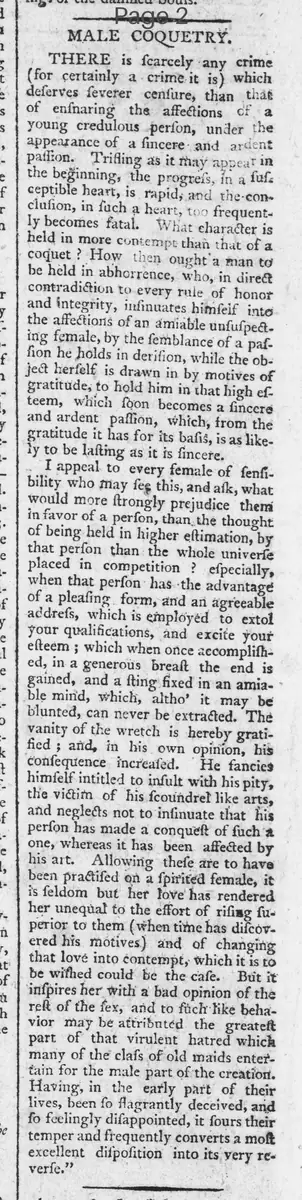
THERE is scarcely any crime (for certainly a crime it is) which deserves severer censure, than that of ensnaring the affections of a young credulous person, under the appearance of a sincere and ardent passion. Trifling as it may appear in the beginning, the progress, in a susceptible heart, is rapid; and the conclusion, in such a heart, too frequently becomes fatal. What character is held in more contempt than that of a coquet ? How then ought a man to be held in abhorrence, who, in direct contradiction to every rule of honor and integrity, insinuates himself into the affections of an amiable unsuspicious female, by the semblance of a passion he holds in derision, while the object herself is drawn in by motives of gratitude, to hold him in that high esteem, which soon becomes a sincere and ardent passion, which, from the gratitude it has for its basis, is as likely to be lasting as it is sincere.
I appeal to every female of sensibility who may see this, and ask, what would more strongly prejudice them in favor of a person, than the thought of being held in higher estimation, by that person than the whole universe placed in competition ? especially. when that person has the advantage of a pleasing form, and an agreeable address, which is employed to extol your qualifications, and excite your esteem ; which when once accomplished, in a generous breast the end is gained, and a sting fixed in an amiable mind, which, altho' it may be blunted, can never be extracted. The vanity of the wretch is hereby gratified ; and, in his own opinion, his consequence increased. He fancies himself entitled to insult with his pity, this victim of his scoundrel like arts, and neglects not to insinuate that his person has made a conquest of such a one, whereas it has been affected by his art. Allowing these are to have been practiced on a spirited female, it is seldom but her love has rendered her unequal to the effort of rising superior to them (when time has discovered his motives) and of changing that love into contempt, which it is to be wished could be the case. But it inspires her with a bad opinion of the rest of the sex, and to such like behavior may be attributed the greatest part of that virulent hatred which many of the class of old maids entertain for the male part of the creation. Having, in the early part of their lives, been so flagrantly deceived, and so feelingly disappointed, it sours their temper and frequently converts a most excellent disposition into its very reverse.
THERE is scarcely any crime (for certainly a crime it is) which deserves severer censure, than that of ensnaring the affections of a young credulous person, under the appearance of a sincere and ardent passion. Trifling as it may appear in the beginning, the progress, in a susceptible heart, is rapid; and the conclusion, in such a heart, too frequently becomes fatal. What character is held in more contempt than that of a coquet ? How then ought a man to be held in abhorrence, who, in direct contradiction to every rule of honor and integrity, insinuates himself into the affections of an amiable unsuspicious female, by the semblance of a passion he holds in derision, while the object herself is drawn in by motives of gratitude, to hold him in that high esteem, which soon becomes a sincere and ardent passion, which, from the gratitude it has for its basis, is as likely to be lasting as it is sincere.
I appeal to every female of sensibility who may see this, and ask, what would more strongly prejudice them in favor of a person, than the thought of being held in higher estimation, by that person than the whole universe placed in competition ? especially. when that person has the advantage of a pleasing form, and an agreeable address, which is employed to extol your qualifications, and excite your esteem ; which when once accomplished, in a generous breast the end is gained, and a sting fixed in an amiable mind, which, altho' it may be blunted, can never be extracted. The vanity of the wretch is hereby gratified ; and, in his own opinion, his consequence increased. He fancies himself entitled to insult with his pity, this victim of his scoundrel like arts, and neglects not to insinuate that his person has made a conquest of such a one, whereas it has been affected by his art. Allowing these are to have been practiced on a spirited female, it is seldom but her love has rendered her unequal to the effort of rising superior to them (when time has discovered his motives) and of changing that love into contempt, which it is to be wished could be the case. But it inspires her with a bad opinion of the rest of the sex, and to such like behavior may be attributed the greatest part of that virulent hatred which many of the class of old maids entertain for the male part of the creation. Having, in the early part of their lives, been so flagrantly deceived, and so feelingly disappointed, it sours their temper and frequently converts a most excellent disposition into its very reverse.
What sub-type of article is it?
Essay
Satire
What themes does it cover?
Moral Virtue
Social Manners
Love Romance
What keywords are associated?
Male Coquetry
Deception In Love
Female Affections
Moral Censure
Social Deception
Literary Details
Title
Male Coquetry.
Key Lines
There Is Scarcely Any Crime (For Certainly A Crime It Is) Which Deserves Severer Censure, Than That Of Ensnaring The Affections Of A Young Credulous Person, Under The Appearance Of A Sincere And Ardent Passion.
What Character Is Held In More Contempt Than That Of A Coquet ? How Then Ought A Man To Be Held In Abhorrence, Who, In Direct Contradiction To Every Rule Of Honor And Integrity, Insinuates Himself Into The Affections Of An Amiable Unsuspicious Female, By The Semblance Of A Passion He Holds In Derision
The Vanity Of The Wretch Is Hereby Gratified ; And, In His Own Opinion, His Consequence Increased.
Having, In The Early Part Of Their Lives, Been So Flagrantly Deceived, And So Feelingly Disappointed, It Sours Their Temper And Frequently Converts A Most Excellent Disposition Into Its Very Reverse.