Thank you for visiting SNEWPapers!
Sign up free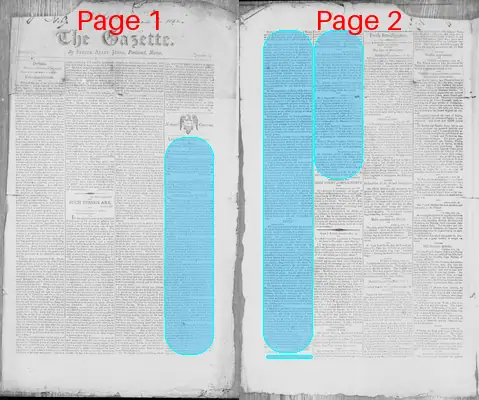
The Gazette
Portland, Cumberland County, Maine
What is this article about?
Proceedings of the U.S. House of Representatives from December 13-19, 1798, covering appointments, impeachment summons, motions on Alien and Sedition laws, response to President's speech on health, finances, foreign relations, and defense preparations, plus committee formations and reports.
Merged-components note: Sequential components detailing House of Representatives proceedings, including the response to the President's speech and subsequent committee actions, forming one cohesive legislative report.
Clippings
1 of 2
OCR Quality
Full Text
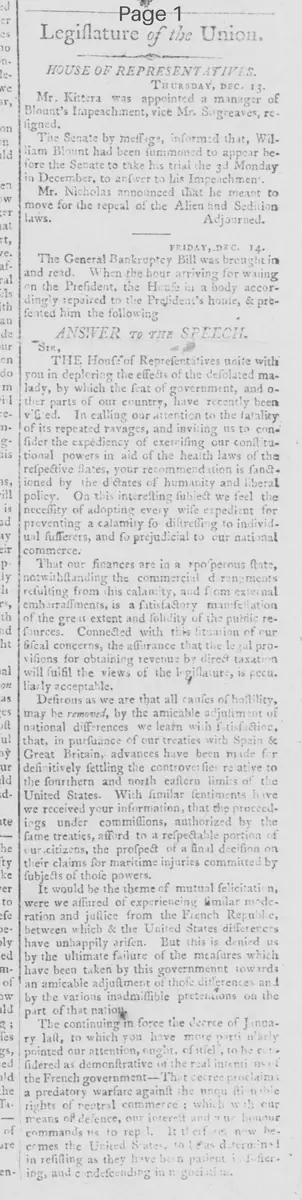
HOUSE OF REPRESENTATIVES.
THURSDAY, DEC. 13.
Mr. Kittera was appointed a manager of Blount's Impeachment, vice Mr. Sigourney, resigned.
The Senate by message, informed that William Blount had been summoned to appear before the Senate to take his trial the 3d Monday in December. to answer to his Impeachment.
Mr. Nicholas announced that he meant to move for the repeal of the Alien and Sedition laws.
Adjourned.
FRIDAY, DEC. 14.
The General Bankruptcy Bill was brought in and read. When the hour arriving for waiting on the President. the House in a body accordingly repaired to the President's house, & presented him the following
ANSWER TO THE SPEECH
SIR,
THE House of Representatives unite with you in deploring the effects of the desolated malady, by which the seat of government, and other parts of our country, have recently been visited. In calling our attention to the fatality of its repeated ravages, and inviting us to consider the expediency of exercising our constitutional powers in aid of the health laws of the respective states. your recommendation is sanctioned by the dictates of humanity and liberal policy. On this interesting subject we feel the necessity of adopting every wise expedient for preventing a calamity so distressing to individual sufferers, and so prejudicial to our national commerce.
That our finances are in a more prosperous state, notwithstanding the commercial derangements resulting from this calamity, and from external embarrassments, is a satisfactory manifestation of the great extent and solidity of the public resources. Connected with this situation of our fiscal concerns, the assurance that the legal provisions for obtaining revenue by direct taxation will fulfill the views of the Legislature, is peculiarly acceptable.
Desirous as we are that all causes of hostility. may be removed, by the amicable adjustment of national differences we learn with satisfaction. that. in pursuance of our treaties with Spain & Great Britain, advances have been made for definitively settling the controversies relative to the southern and northeastern limits of the United States. With similar sentiments have we received your information, that the proceedings under commissions, authorized by the same treaties, afford to a respectable portion of our citizens, the prospect of a final decision on their claims for maritime injuries committed by subjects of those powers.
It would be the theme of mutual felicitation. were we assured of experiencing similar moderation and justice from the French Republic. between which & the United States differences have unhappily arisen. But this is denied us by the ultimate failure of the measures which have been taken by this government towards an amicable adjustment of those differences and by the various inadmissible pretensions on the part of that nation.
The continuing in force the decree of January last, to which you have more particularly pointed our attention, ought carefully to be considered as demonstrative of the real intentions. the French government—That decree proclaims. a predatory warfare against the unquestionable rights of neutral commerce; which with our means of defence, our interest and our honor commands us to resist. It therefore becomes the United States, so independent- in resisting as they have been patient suffering, and condescending in negotiation.
While those who direct the affairs of France persist in the enforcement of decrees so hostile to our essential rights, their conduct forbids us to confide in any of their professions of amity.
As therefore the conduct of France hitherto exhibits nothing which ought to change or relax our measures of defence, the policy of extending and invigorating those measures demands our sedulous attention. The sudden and remarkable advantages which this country has experienced from a small naval armament sufficiently prove the utility of its establishment. As it repeals the guarding of our coast, the protection of our trade, and the facility of safely transporting the means of territorial defence to every part of our maritime frontier, an adequate naval force must be considered as an important object of national policy. Nor do we hesitate to adopt the opinion, that, whether negotiations with France are resumed or not, vigorous preparations for war will be alike indispensable.
In this conjuncture of affairs, while with you we recognize our abundant cause of gratitude to the Supreme Disposer of events for the ordinary blessings of Providence, we regard as of high national importance the manifestation in our country, of a magnanimous spirit of resistance to foreign domination. This spirit merits to be cherished and invigorated, by every branch of government, as the estimable pledge of national prosperity and glory.
Disdaining a reliance on foreign protection; wanting no foreign guarantee of our liberties; resolving to maintain our national independence against every attempt to despoil us of this inestimable treasure; we confide under Providence, in the patriotism and energies of these United States for defeating the hostile enterprises of any foreign power.
To adopt with prudent foresight such systematic measures as may be expedient for calling forth those energies wherever the national exigencies may require, whether on the ocean, or on our own territory—and to reconcile with the proper security of revenue, the convenience of mercantile enterprise, on which so great a proportion of the public resources depends—are objects of moment which shall be duly regarded in the course of our deliberations.
Fully as we accord with you in the opinion, that the United States ought not to submit to the humiliation of sending another minister to France, without previous assurances sufficiently determinate, that he will be duly accredited. We have heard, with cordial approbation, the declaration of your purpose, steadily to observe those maxims of humane and pacific policy by which the United States have hitherto been governed. While it is left with France to take the requisite steps for accommodation, it is worthy—the Chief Magistrate of a free people, to make known to the world, that justice on the part of France will annihilate every obstacle to the restoration of a friendly intercourse, & that the executive authority of this country will respect the sacred rights of embassy. At the same time, the wisdom and decision, which have characterized your past administration, assure us no illusory professions will seduce you into any abandonment of the rights which belong to the United States, as a free and independent nation.
REPLY:
GENTLEMEN,
My sincere acknowledgements are due to the House of Representatives of the United States, for this excellent Address, so consonant to the character of Representatives of a great and free people. The judgment and feelings of a nation I believe were never more truly expressed by their representatives, than those of our constituents, by your decided declaration, that with our means of defence, our interest and honor command us to repel a predatory warfare against the unquestionable rights of neutral commerce—That it becomes the United States to be as determined in resistance as they have been patient in suffering and condescending in negotiation—That while those who direct the affairs of France persist in the enforcement of decrees, so hostile to our essential right, their conduct forbids us to confide in any of their professions of amity; that an adequate naval force must be considered as an important object of national policy, and that whether negotiations with France are resumed or not, vigorous preparations for war, will be alike indispensable.
The generous disdain you so cooly and deliberately express, of a reliance on foreign protection, wanting no foreign guarantee of our liberties, resolving to maintain our National Independence against every attempt to despoil us of this inestimable treasure. will meet the full approbation of every sound understanding, and exciting applauses from the heart of every faithful American.
I thank you, gentlemen, for your candid approbation of my sentiments on the subject of the negotiation, and for the declaration of your opinion, that the policy of extending and invigorating our measures of defence. and the adoption with prudent foresight, of such systematic measures as may be expedient for calling forth the energies of our country, wherever the national exigences may require, whether on the ocean, or on our own territory, will demand your most sedulous attention.
At the same time: I take the liberty to assure you. it shall be my vigilant endeavour, that no illusory professions shall seduce me into an abandonment of the rights which belong to the United States, as a free and independent nation.
JOHN ADAMS.
United States, Dec. 14, 1798.
Committees were raised on various parts of
The President's Speech—A committee of Ways and Means was chosen—Mr. Dawson moved to amend the motion for printing 20,000 copies of the Sedition law, by adding certain parts of the Constitution supposed to be infringed by it. Negatived 41 to 35—Mr. Harper's motion for printing the laws passed 45 to 34.
MONDAY, DEC. 17.
The Speaker laid before the House a report received from the Commissioners of the sinking Fund, containing the accounts for the last year which were ordered to be printed.
Mr. Nicholas moved a resolution, that the Secretary of the navy be directed to lay before the house an account of all the armed vessels employed in the service of the United States. and of all those preparing, their expense, and annual support. This was postponed till to-morrow.
Mr. Dawson moved that the committee of ways and means be instructed to bring in a bill providing for the enumeration of the inhabitants of the United States, which was carried.
TUESDAY, DEC. 18.
Mr. I. Parker wished his colleague (Mr. Nicholas) would withdraw his motion, in order that it might be renewed on an enlarged scale: Mr. N. consented and a motion for calling an estimate to be laid before the house, of all armed vessels employed by government, all preparing for the said purpose, where the said vessels were built, by what contracts, their respective sizes, force, and number of men, with the names of the commanders, &c. was made, and agreed to by the house.
Messrs Otis, Rutledge, Goodrich, S. Smith, Champlin, Spaight, & Dent are the committee appointed for considering that part of the President's Speech which relates to the extending and invigorating the measures of a national defence.
Messrs J. Parker, Pinckney, Sewall, Champlin, Baldwin, Griswold and Van Courtland, are the Committee for the naval establishment.
WEDNESDAY, DEC. 19.
Mr. Claiborne, moved a resolution to have printed and circulated a large edition of the Constitution of the United States; which was committed to a committee of three members the number of copies was fixed at 40,000.
Mr. Harper reported the enumeration act, which was twice read.
The house, on motion of Mr. D. Foster, decided against the petition of John Daniels.
Adjourned.
What sub-type of article is it?
What keywords are associated?
What entities or persons were involved?
Where did it happen?
Domestic News Details
Primary Location
United States
Event Date
December 13 19, 1798
Key Persons
Event Details
House of Representatives proceedings including appointment of impeachment manager, summons for Blount's trial, announcement of motion to repeal Alien and Sedition laws, introduction of Bankruptcy Bill, presentation of response to President's speech addressing health crisis, finances, foreign relations with Spain, Britain, France, defense preparations, naval force, and national independence; President's reply; committee appointments on defense and navy; motions on printing laws and Constitution, naval accounts, census enumeration, and petition decisions.