Thank you for visiting SNEWPapers!
Sign up free
Story
August 17, 1791
Gazette Of The United States
New York, New York County, New York
What is this article about?
Supreme Court justices debate the validity of a Writ of Error issued from the Circuit Court of Rhode-Island to review its own judgment, concluding it must issue from the Supreme Court's Clerk's Office. Reported from Philadelphia on August 17.
Clipping
OCR Quality
95%
Excellent
Full Text
PHILADELPHIA, AUGUST 17.
SUPREME COURT OF THE UNITED STATES.
WEDNESDAY, August 3d.
(CONCLUDED.)
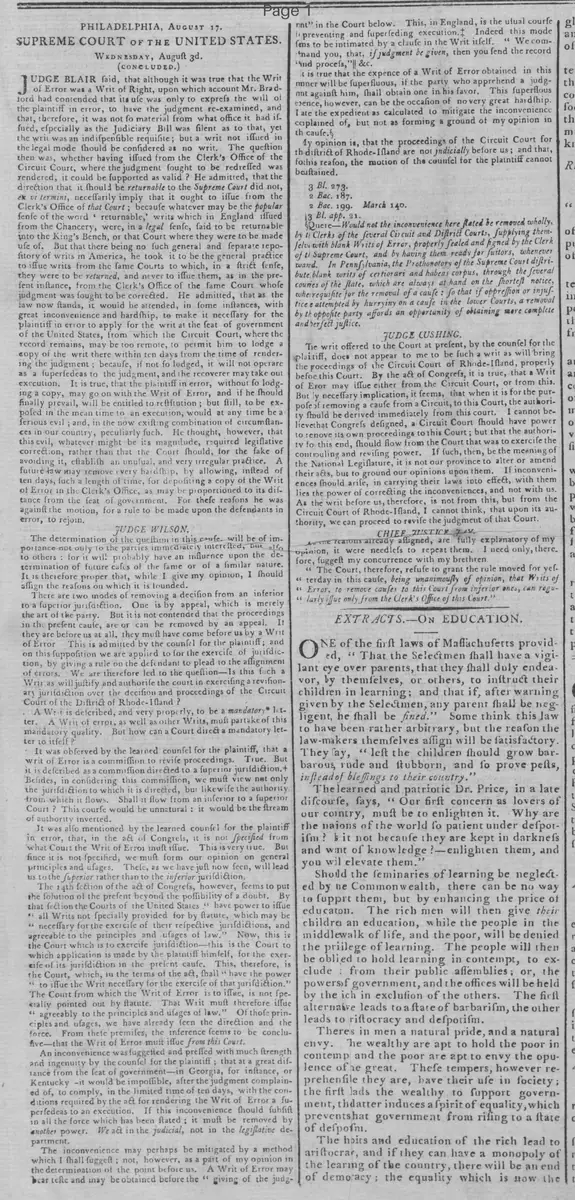
JUDGE BLAIR said, that although it was true that the Writ of Error was a Writ of Right, upon which account Mr. Bradford had contended that its use was only to express the will of the plaintiff in error, to have the judgment re-examined, and that, therefore, it was not so material from what office it had issued, especially as the Judiciary Bill was silent as to that, yet the writ was an indispensable requisite; but a writ not issued in the legal mode should be considered as no writ. The question then was, whether having issued from the Clerk's Office of the Circuit Court, where the judgment sought to be redressed was rendered, it could be supported as valid? He admitted, that the direction that it should be returnable to the Supreme Court did not, ex vi termini, necessarily imply that it ought to issue from the Clerk's Office of that Court; because whatever may be the popular sense of the word 'returnable.' writs which in England issued from the Chancery, were, in a legal sense, said to be returnable into the King's Bench, or that Court where they were to be made use of. But that there being no such general and separate repository of writs in America, he took it to be the general practice to issue writs from the same Courts to which, in a strict sense, they were to be returned, and never to issue them, as in the present instance, from the Clerk's Office of the same Court whose judgment was sought to be corrected. He admitted, that as the law now stands, it would be attended, in some instances, with great inconvenience and hardship, to make it necessary for the plaintiff in error to apply for the writ at the seat of government of the United States, from which the Circuit Court, where the record remains, may be too remote, to permit him to lodge a copy of the writ there within ten days from the time of rendering the judgment; because, if not so lodged, it will not operate as a supersedeas to the judgment, and the recoverer may take out execution. It is true, that the plaintiff in error, without so lodging a copy, may go on with the Writ of Error, and if he should finally prevail, will be entitled to restitution; but still, to be exposed in the mean time to an execution, would at any time be a serious evil; and, in the now existing combination of circumstances in our country, peculiarly such. He thought, however, that this evil, whatever might be its magnitude, required legislative correction, rather than that the Court should, for the sake of avoiding it, establish an unusual, and very irregular practice. A future law may remove every hardship, by allowing, instead of ten days, such a length of time, for depositing a copy of the Writ of Error in the Clerk's Office, as may be proportioned to its distance from the seat of government. For these reasons he was against the motion, for a rule to be made upon the defendants in error, to rejoin.
JUDGE WILSON.
The determination of the question in this cause, will be of importance not only to the parties immediately interested, but also to others: for it will probably have an influence upon the determination of future cases of the same or of a similar nature. It is therefore proper that, while I give my opinion, I should assign the reasons on which it is founded.
There are two modes of removing a decision from an inferior to a superior jurisdiction. One is by appeal, which is merely the act of the party. But it is not contended that the proceedings in the present cause, are or can be removed by an appeal. If they are before us at all, they must have come before us by a Writ of Error This is admitted by the counsel for the plaintiff; and on this supposition we are applied to for the exercise of jurisdiction, by giving a rule on the defendant to plead to the assignment of errors. We are therefore led to the question—Is this such a Writ as will justify and authorize the court in exercising a revisory jurisdiction over the decision and proceedings of the Circuit Court of the District of Rhode-Island?
A Writ is described, and very properly, to be a mandatory letter. A Writ of error, as well as other Writs, must partake of this mandatory quality. But how can a Court direct a mandatory letter to itself?
It was observed by the learned counsel for the plaintiff, that a writ of Error is a commission to review proceedings. True. But it is described as a commission directed to a superior jurisdiction.+ Besides, in considering this commission, we must view not only the jurisdiction to which it is directed, but likewise the authority from which it flows. Shall it flow from an inferior to a superior Court? This course would be unnatural: it would be the stream of authority inverted.
It was also mentioned by the learned counsel for the plaintiff in error, that, in the act of Congress, it is not specified from what Court the Writ of Error must issue. This is very true. But since it is not specified, we must form our opinion on general principles and usages. These, as we have just now seen, will lead us to the superior rather than to the inferior jurisdiction.
The 14th section of the act of Congress, however, seems to put the solution of the present beyond the possibility of a doubt. By that section the Courts of the United States " have power to issue all Writs not specially provided for by statute, which may be necessary for the exercise of their respective jurisdictions, and agreeable to the principles and usages of law." Now, this is the Court which is to exercise jurisdiction—this is the Court to which application is made by the plaintiff himself, for the exercise of its jurisdiction in the present cause. This, therefore, is the Court, which, in the terms of the act, shall " have the power to issue the Writ necessary for the exercise of that jurisdiction."
The Court from which the Writ of Error is to issue, is not peculiarly pointed out by statute. That Writ must therefore issue "agreeably to the principles and usages of law." Of those principles and usages, we have already seen the direction and the force. From these premises, the inference seems to be conclusive-that the Writ of Error must issue from this Court.
An inconvenience was suggested and pressed with much strength and ingenuity by the counsel for the plaintiff; that at a great distance from the seat of government—in Georgia, for instance, or Kentucky -it would be impossible, after the judgment complained of, to comply, in the limited time of ten days, with the conditions required by the act for rendering the Writ of Error a supersedeas to an execution. If this inconvenience should exist in all the force which has been stated; it must be removed by another power. We act in the judicial, not in the legislative department.
The inconvenience may perhaps be mitigated by a method which I shall suggest; not, however, as a part of my opinion in the determination of the point before us. A Writ of Error may bear teste and may be obtained before the " giving of the judgment" in the Court below. This, in England, is the usual course of preventing and superseding execution. Indeed this mode seems to be intimated by a clause in the Writ itself. " We command you, that, if judgment be given, then you send the record and process,"&c.
It is true that the expense of a Writ of Error obtained in this manner will be superfluous, if the party who apprehends a judgment against him, shall obtain one in his favor. This superfluous expense, however, can be the occasion of no very great hardship. I state the expedient as calculated to mitigate the inconvenience complained of, but not as forming a ground of my opinion in this cause.
My opinion is, that the proceedings of the Circuit Court for the district of Rhode-Island are not judicially before us; and that, for this reason, the motion of the counsel for the plaintiff cannot be sustained.
3 Bl. 273.
2 Bac. 187.
2 Bac. 199.
March 140.
13 Bl. app. 21.
Quere—Would not the inconvenience here stated be removed wholly, by the Clerks of the several Circuit and District Courts, supplying themselves with blank Writs of Error, properly sealed and signed by the Clerk of the Supreme Court, and by having them ready for suitors, whenever wanted. In Pennsylvania, the Prothonotary of the Supreme Court distributes, blank writs of certiorari and habeas corpus, through the several counties of the state, which are always at hand on the shortest notice. Where requisite for the removal of a cause: so that if oppression or injustice be attempted by hurrying on a cause in the lower Courts, a removal by the opposite party affords an opportunity of obtaining more complete and perfect justice.
JUDGE CUSHING.
The writ offered to the Court at present, by the counsel for the plaintiff, does not appear to me to be such a writ as will bring the proceedings of the Circuit Court of Rhode-Island, properly before this Court. By the act of Congress, it is true, that a Writ of Error may issue either from the Circuit Court, or from this. But by necessary implication, it seems, that when it is for the purpose of removing a cause from a Circuit, to this Court, the authority should be derived immediately from this court. I cannot believe that Congress designed, a Circuit Court should have power to remove its own proceedings to this Court; but that the authority for this end, should flow from the Court that was to exercise the controlling and revising power. If such, then, be the meaning of the National Legislature, it is not our province to alter or amend their acts, but to ground our opinions upon them. If inconveniences should arise, in carrying their laws into effect, with them lies the power of correcting the inconveniences, and not with us.
As the writ before us, therefore, is not from this, but from the Circuit Court of Rhode-Island, I cannot think, that upon its authority, we can proceed to revise the judgment of that Court.
CHIEF JUSTICE JAY.
As the reasons already assigned, are fully explanatory of my opinion, it were needless to repeat them. I need only, therefore, suggest my concurrence with my brethren
" The Court, therefore, refuse to grant the rule moved for yesterday in this cause, being unanimously of opinion, that Writs of
" Error, to remove causes to this Court from inferior ones, can regu-
" larly issue only from the Clerk's Office of this Court."
SUPREME COURT OF THE UNITED STATES.
WEDNESDAY, August 3d.
(CONCLUDED.)
JUDGE BLAIR said, that although it was true that the Writ of Error was a Writ of Right, upon which account Mr. Bradford had contended that its use was only to express the will of the plaintiff in error, to have the judgment re-examined, and that, therefore, it was not so material from what office it had issued, especially as the Judiciary Bill was silent as to that, yet the writ was an indispensable requisite; but a writ not issued in the legal mode should be considered as no writ. The question then was, whether having issued from the Clerk's Office of the Circuit Court, where the judgment sought to be redressed was rendered, it could be supported as valid? He admitted, that the direction that it should be returnable to the Supreme Court did not, ex vi termini, necessarily imply that it ought to issue from the Clerk's Office of that Court; because whatever may be the popular sense of the word 'returnable.' writs which in England issued from the Chancery, were, in a legal sense, said to be returnable into the King's Bench, or that Court where they were to be made use of. But that there being no such general and separate repository of writs in America, he took it to be the general practice to issue writs from the same Courts to which, in a strict sense, they were to be returned, and never to issue them, as in the present instance, from the Clerk's Office of the same Court whose judgment was sought to be corrected. He admitted, that as the law now stands, it would be attended, in some instances, with great inconvenience and hardship, to make it necessary for the plaintiff in error to apply for the writ at the seat of government of the United States, from which the Circuit Court, where the record remains, may be too remote, to permit him to lodge a copy of the writ there within ten days from the time of rendering the judgment; because, if not so lodged, it will not operate as a supersedeas to the judgment, and the recoverer may take out execution. It is true, that the plaintiff in error, without so lodging a copy, may go on with the Writ of Error, and if he should finally prevail, will be entitled to restitution; but still, to be exposed in the mean time to an execution, would at any time be a serious evil; and, in the now existing combination of circumstances in our country, peculiarly such. He thought, however, that this evil, whatever might be its magnitude, required legislative correction, rather than that the Court should, for the sake of avoiding it, establish an unusual, and very irregular practice. A future law may remove every hardship, by allowing, instead of ten days, such a length of time, for depositing a copy of the Writ of Error in the Clerk's Office, as may be proportioned to its distance from the seat of government. For these reasons he was against the motion, for a rule to be made upon the defendants in error, to rejoin.
JUDGE WILSON.
The determination of the question in this cause, will be of importance not only to the parties immediately interested, but also to others: for it will probably have an influence upon the determination of future cases of the same or of a similar nature. It is therefore proper that, while I give my opinion, I should assign the reasons on which it is founded.
There are two modes of removing a decision from an inferior to a superior jurisdiction. One is by appeal, which is merely the act of the party. But it is not contended that the proceedings in the present cause, are or can be removed by an appeal. If they are before us at all, they must have come before us by a Writ of Error This is admitted by the counsel for the plaintiff; and on this supposition we are applied to for the exercise of jurisdiction, by giving a rule on the defendant to plead to the assignment of errors. We are therefore led to the question—Is this such a Writ as will justify and authorize the court in exercising a revisory jurisdiction over the decision and proceedings of the Circuit Court of the District of Rhode-Island?
A Writ is described, and very properly, to be a mandatory letter. A Writ of error, as well as other Writs, must partake of this mandatory quality. But how can a Court direct a mandatory letter to itself?
It was observed by the learned counsel for the plaintiff, that a writ of Error is a commission to review proceedings. True. But it is described as a commission directed to a superior jurisdiction.+ Besides, in considering this commission, we must view not only the jurisdiction to which it is directed, but likewise the authority from which it flows. Shall it flow from an inferior to a superior Court? This course would be unnatural: it would be the stream of authority inverted.
It was also mentioned by the learned counsel for the plaintiff in error, that, in the act of Congress, it is not specified from what Court the Writ of Error must issue. This is very true. But since it is not specified, we must form our opinion on general principles and usages. These, as we have just now seen, will lead us to the superior rather than to the inferior jurisdiction.
The 14th section of the act of Congress, however, seems to put the solution of the present beyond the possibility of a doubt. By that section the Courts of the United States " have power to issue all Writs not specially provided for by statute, which may be necessary for the exercise of their respective jurisdictions, and agreeable to the principles and usages of law." Now, this is the Court which is to exercise jurisdiction—this is the Court to which application is made by the plaintiff himself, for the exercise of its jurisdiction in the present cause. This, therefore, is the Court, which, in the terms of the act, shall " have the power to issue the Writ necessary for the exercise of that jurisdiction."
The Court from which the Writ of Error is to issue, is not peculiarly pointed out by statute. That Writ must therefore issue "agreeably to the principles and usages of law." Of those principles and usages, we have already seen the direction and the force. From these premises, the inference seems to be conclusive-that the Writ of Error must issue from this Court.
An inconvenience was suggested and pressed with much strength and ingenuity by the counsel for the plaintiff; that at a great distance from the seat of government—in Georgia, for instance, or Kentucky -it would be impossible, after the judgment complained of, to comply, in the limited time of ten days, with the conditions required by the act for rendering the Writ of Error a supersedeas to an execution. If this inconvenience should exist in all the force which has been stated; it must be removed by another power. We act in the judicial, not in the legislative department.
The inconvenience may perhaps be mitigated by a method which I shall suggest; not, however, as a part of my opinion in the determination of the point before us. A Writ of Error may bear teste and may be obtained before the " giving of the judgment" in the Court below. This, in England, is the usual course of preventing and superseding execution. Indeed this mode seems to be intimated by a clause in the Writ itself. " We command you, that, if judgment be given, then you send the record and process,"&c.
It is true that the expense of a Writ of Error obtained in this manner will be superfluous, if the party who apprehends a judgment against him, shall obtain one in his favor. This superfluous expense, however, can be the occasion of no very great hardship. I state the expedient as calculated to mitigate the inconvenience complained of, but not as forming a ground of my opinion in this cause.
My opinion is, that the proceedings of the Circuit Court for the district of Rhode-Island are not judicially before us; and that, for this reason, the motion of the counsel for the plaintiff cannot be sustained.
3 Bl. 273.
2 Bac. 187.
2 Bac. 199.
March 140.
13 Bl. app. 21.
Quere—Would not the inconvenience here stated be removed wholly, by the Clerks of the several Circuit and District Courts, supplying themselves with blank Writs of Error, properly sealed and signed by the Clerk of the Supreme Court, and by having them ready for suitors, whenever wanted. In Pennsylvania, the Prothonotary of the Supreme Court distributes, blank writs of certiorari and habeas corpus, through the several counties of the state, which are always at hand on the shortest notice. Where requisite for the removal of a cause: so that if oppression or injustice be attempted by hurrying on a cause in the lower Courts, a removal by the opposite party affords an opportunity of obtaining more complete and perfect justice.
JUDGE CUSHING.
The writ offered to the Court at present, by the counsel for the plaintiff, does not appear to me to be such a writ as will bring the proceedings of the Circuit Court of Rhode-Island, properly before this Court. By the act of Congress, it is true, that a Writ of Error may issue either from the Circuit Court, or from this. But by necessary implication, it seems, that when it is for the purpose of removing a cause from a Circuit, to this Court, the authority should be derived immediately from this court. I cannot believe that Congress designed, a Circuit Court should have power to remove its own proceedings to this Court; but that the authority for this end, should flow from the Court that was to exercise the controlling and revising power. If such, then, be the meaning of the National Legislature, it is not our province to alter or amend their acts, but to ground our opinions upon them. If inconveniences should arise, in carrying their laws into effect, with them lies the power of correcting the inconveniences, and not with us.
As the writ before us, therefore, is not from this, but from the Circuit Court of Rhode-Island, I cannot think, that upon its authority, we can proceed to revise the judgment of that Court.
CHIEF JUSTICE JAY.
As the reasons already assigned, are fully explanatory of my opinion, it were needless to repeat them. I need only, therefore, suggest my concurrence with my brethren
" The Court, therefore, refuse to grant the rule moved for yesterday in this cause, being unanimously of opinion, that Writs of
" Error, to remove causes to this Court from inferior ones, can regu-
" larly issue only from the Clerk's Office of this Court."
What sub-type of article is it?
Historical Event
What themes does it cover?
Justice
What keywords are associated?
Supreme Court
Writ Of Error
Circuit Court
Rhode Island
Judiciary Act
Legal Procedure
What entities or persons were involved?
Judge Blair
Mr. Bradford
Judge Wilson
Judge Cushing
Chief Justice Jay
Where did it happen?
Supreme Court Of The United States
Story Details
Key Persons
Judge Blair
Mr. Bradford
Judge Wilson
Judge Cushing
Chief Justice Jay
Location
Supreme Court Of The United States
Event Date
August 3
Story Details
Judges Blair, Wilson, Cushing, and Chief Justice Jay opine that a Writ of Error to remove a case from the Circuit Court of Rhode-Island must issue from the Supreme Court's Clerk's Office, not the Circuit Court's, rejecting a motion due to improper issuance and noting legislative remedies for inconveniences.