Thank you for visiting SNEWPapers!
Sign up free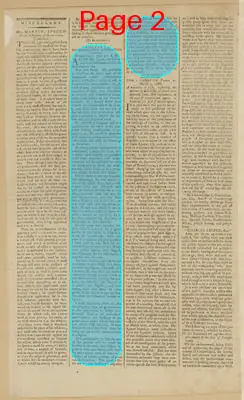
The New York Journal, And Daily Patriotic Register
New York, New York County, New York
What is this article about?
During the Massachusetts Convention on January 30, Rev. Mr. Shute delivers a speech opposing a religious test for federal offices, arguing it would unjustly exclude qualified individuals of various faiths and allow dishonest men to advance, favoring the Constitution's provision for equal access regardless of denomination.
Clipping
OCR Quality
Full Text
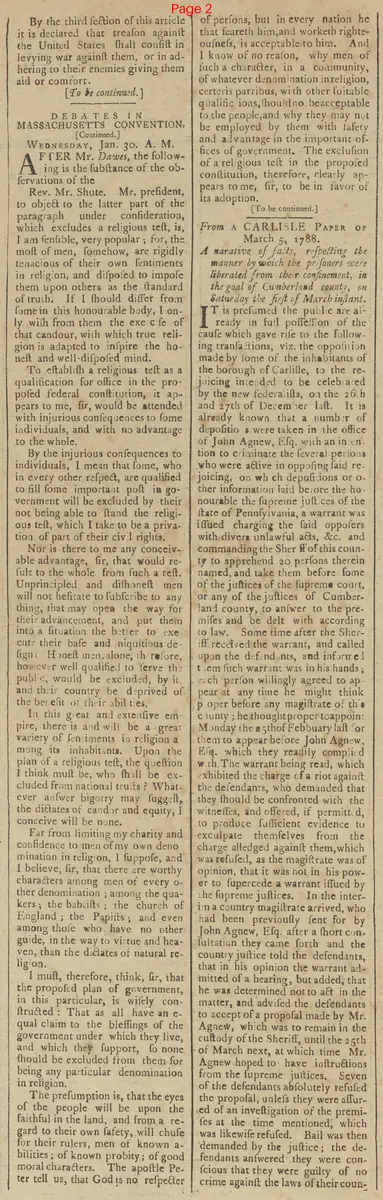
MASSACHUSETTS CONVENTION,
[Continued.]
WEDNESDAY, Jan. 30. A. M.
After Mr. Dawes, the following is the substance of the observations of the Rev. Mr. Shute. Mr. President, to object to the latter part of the paragraph under consideration, which excludes a religious test, is, I am sensible, very popular; for, the most of men, somehow, are rigidly tenacious of their own sentiments in religion, and disposed to impose them upon others as the standard of truth. If I should differ from some in this honourable body, I only wish from them the exercise of that candour, with which true religion is adapted to inspire the honest and well-disposed mind.
To establish a religious test as a qualification for office in the proposed federal constitution, it appears to me, Sir, would be attended with injurious consequences to some individuals, and with no advantage to the whole.
By the injurious consequences to individuals, I mean that some, who in every other respect, are qualified to fill some important post in government will be excluded by their not being able to stand the religious test, which I take to be a privation of part of their civil rights.
Nor is there to me any conceivable advantage, Sir, that would result to the whole from such a test. Unprincipled and dishonest men will not hesitate to subscribe to any thing, that may open the way for their advancement, and put them into a situation the better to execute their base and iniquitous designs; Honest men, alone, therefore, however well qualified to serve the public, would be excluded, by it, and their country be deprived of the benefit of their abilities.
In this great and extensive empire, there is and will be a great variety of sentiments in religion among its inhabitants. Upon the plan of a religious test, the question I think must be, who shall be excluded from national trusts? Whatever answer bigotry may suggest, the dictates of candor and equity, I conceive will be none.
Far from limiting my charity and confidence to men of my own denomination in religion, I suppose, and I believe, Sir, that there are worthy characters among men of every other denomination; among the Quakers: the Baptists: the church of England; the Papists; and even among those who have no other guide, in the way to virtue and heaven, than the dictates of natural religion.
I must, therefore, think, Sir, that the proposed plan of government, in this particular, is wisely constructed: That as all have an equal claim to the blessings of the government under which they live, and which they support, so none should be excluded from them for being any particular denomination in religion.
The presumption is, that the eyes of the people will be upon the faithful in the land, and from a regard to their own safety, will choose for their rulers, men of known abilities; of known probity; of good moral characters. The apostle Peter tells us, that God is no respecter of persons, but in every nation he that feareth him, and worketh righteousness, is acceptable to him. And I know of no reason, why men of such a character, in a community, of whatever denomination in religion, ceteris paribus, with other suitable qualifications, should not be acceptable to the people, and why they may not be employed by them with safety and advantage in the important offices of government. The exclusion of a religious test in the proposed constitution, therefore, clearly appears to me, Sir, to be in favor of its adoption.
[To be continued.]
What sub-type of article is it?
What keywords are associated?
What entities or persons were involved?
Where did it happen?
Domestic News Details
Primary Location
Massachusetts
Event Date
Wednesday, Jan. 30
Key Persons
Outcome
argument in favor of excluding a religious test from the proposed federal constitution to ensure equal access to offices regardless of religious denomination.
Event Details
Rev. Mr. Shute addresses the Massachusetts Convention, arguing against establishing a religious test for office in the proposed federal constitution. He contends it would exclude qualified honest individuals of various faiths without benefiting the nation, as dishonest men would evade it, while emphasizing the diversity of religious sentiments and the importance of selecting rulers based on abilities, probity, and moral character rather than religious affiliation.