Thank you for visiting SNEWPapers!
Sign up free
The New Hampshire Gazette And Historical Chronicle
Portsmouth, Greenland, Rockingham County, New Hampshire
What is this article about?
Letter from London details British political instability: Lord Chatham's poor health amid opposition from Grenville; land tax cut to 3 shillings despite unpopularity; East India revenue sharing debates; royal allowances; party maneuvers; and a House of Lords debate rejecting a Massachusetts act pardoning stamp-act rioters, motion defeated.
Clipping
OCR Quality
Full Text
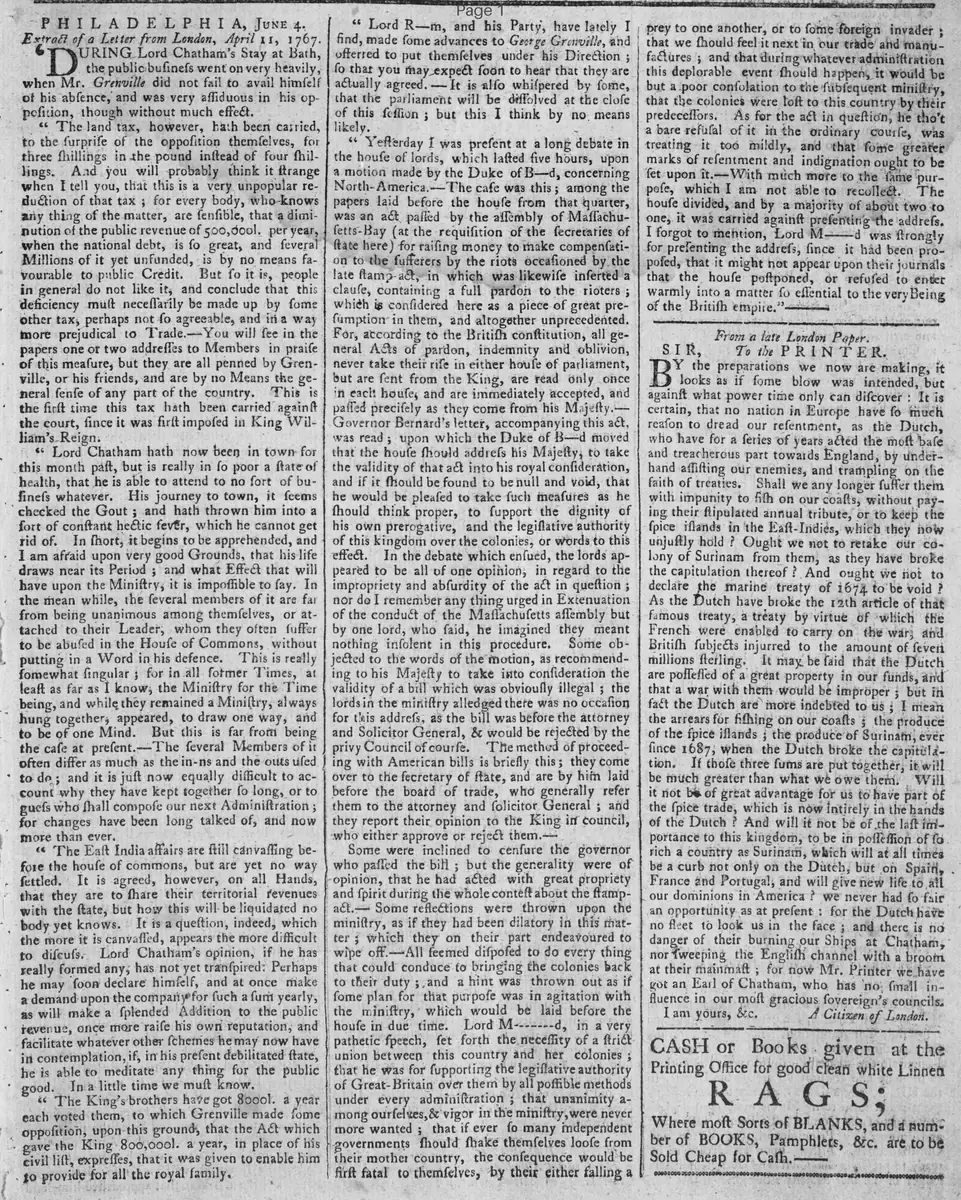
Extract of a Letter from London, April 11, 1767.
DURING Lord Chatham's Stay at Bath, the public business went on very heavily, when Mr. Grenville did not fail to avail himself of his absence, and was very assiduous in his opposition, though without much effect.
The land tax, however, has been carried to the surprise of the opposition themselves, for three shillings in the pound instead of four shillings. And you will probably think it strange when I tell you, that this is a very unpopular reduction of that tax; for every body, who knows any thing of the matter, are sensible, that a diminution of the public revenue of 500,000l. per year, when the national debt, is so great, and several Millions of it yet unfunded, is by no means favourable to public Credit. But so it is, people in general do not like it; and conclude that this deficiency must necessarily be made up by some other tax, perhaps not so agreeable, and in a way more prejudicial to Trade. You will see in the papers one or two addresses to Members in praise of this measure. but they are all penned by Grenville, or his friends, and are by no Means the general sense of any part of the country. This is the first time this tax has been carried against the court, since it was first imposed in King William's Reign.
Lord Chatham has now been in town for this month past, but is really in so poor a state of health, that he is able to attend to no sort of business whatever. His journey to town, it seems checked the Gout: and has thrown him into a sort of constant hectic fever, which he cannot get rid of. In short, it begins to be apprehended, and I am afraid upon very good Grounds, that his life draws near its Period; and what Effect that will have upon the Ministry, it is impossible to say. In the mean while, the several members of it are far from being unanimous among themselves, or attached to their Leader, whom they often suffer to be abused in the House of Commons, without putting in a Word in his defence. This is really somewhat singular; for in all other Times, at least as far as I know, the Ministry for the Time being, and while they remained a Ministry, always hung together, appeared, to draw one way, and to be of one Mind. But this is far from being the case at present. The several Members of it often differ as much as the ins and the outs used to do; and it is just now equally difficult to account why they have kept together so long, or to guess who shall compose our next Administration; for changes have been long talked of, and now more than ever.
The East India affairs are still canvassing before the house of commons, but are yet no way settled. It is agreed, however, on all Hands, that they are to share their territorial revenues with the state, but how this will be liquidated no body yet knows. It is a question, indeed, which the more it is canvassed, appears the more difficult to discuss. Lord Chatham's opinion, if he has really formed any; has not yet transpired: Perhaps he may soon declare himself, and at once make a demand upon the company for such a sum yearly, as will make a splendid Addition to the public revenue, once more raise his own reputation; and facilitate whatever other schemes he may now have in contemplation, if, in his present debilitated state, he is able to meditate any thing for the public good. In a little time we must know.
The King's brothers have got 80,000l. a year each voted them, to which Grenville made some opposition, upon this ground, that the Act which gave the King 800,000l. a year, in place of his civil list, expresses, that it was given to enable him to provide for all the royal family.
Lord R-m, and his Party, have lately I find, made some advances to George Grenville, and offered to put themselves under his Direction; so that you may expect soon to hear that they are actually agreed. It is also whispered by some, that the parliament will be dissolved at the close of this session: but this I think by no means likely.
Yesterday I was present at a long debate in the house of lords, which lasted five hours, upon a motion made by the Duke of B-d, concerning North-America. The case was this; among the papers laid before the house from that quarter, was an Act passed by the assembly of Massachusetts-Bay (at the requisition of the secretaries of state here) for raising money to make compensation to the sufferers by the riots occasioned by the late stamp-Act. in which was likewise inserted a clause, containing a full pardon to the rioters; which is considered here as a piece of great presumption in them, and altogether unprecedented. For, according to the British constitution, all general Acts of pardon, indemnity and oblivion, never take their rise in either house of parliament, but are sent from the King, are read only once in each house, and are immediately accepted, and passed precisely as they come from his Majesty.
Governor Bernard's letter, accompanying this act, was read; upon which the Duke of B-d moved that the house should address his Majesty, to take the validity of that act into his royal consideration, and if it should be found to be null and void, that he would be pleased to take such measures as he should think proper, to support the dignity of his own prerogative, and the legislative authority of this kingdom over the colonies. or words to this effect. In the debate which ensued, the lords appeared to be all of one opinion, in regard to the impropriety and absurdity of the act in question; nor do I remember any thing urged in Extenuation of the conduct of the Massachusetts assembly but by one lord, who said. he imagined they meant nothing insolent in this procedure. Some objected to the words of the motion, as recommending to his Majesty to take into consideration the validity of a bill which was obviously illegal; the lords in the ministry alleged there was no occasion for this address. as the bill was before the attorney and Solicitor General, & would be rejected by the privy Council of course. The method of proceeding with American bills is briefly this; they come over to the secretary of state. and are by him laid before the board of trade. who generally refer them to the attorney and solicitor General : and they report their opinion to the King in council, who either approve or reject them.
Some were inclined to censure the governor who passed the bill : but the generality were of opinion, that he had acted with great propriety and spirit during the whole contest about the stamp-Act. Some reflections were thrown upon the ministry, as if they had been dilatory in this matter : which they on their part endeavoured to wipe off. All seemed disposed to do every thing that could conduce to bringing the colonies back to their duty : and a hint was thrown out as if some plan for that purpose was in agitation with the ministry. which would be laid before the house in due time. Lord M-------d, in a very pathetic speech, set forth the necessity of a strict union between this country and her colonies : that he was for supporting the legislative authority of Great-Britain over them by all possible methods under every administration ; that unanimity among ourselves, & vigor in the ministry, were never La more wanted ; that if ever so many independent governments should shake themselves loose from their mother country, the consequence would be first fatal to themselves, by their either falling a prey to one another, or to some foreign invader : that we should feel it next in our trade and manufactures ; and that during whatever administration this deplorable event should happen, it would be but a poor consolation to the subsequent ministry, that the colonies were lost to this country by their predecessors. As for the act in question, he tho't a bare refusal of it in the ordinary course, was treating it too mildly, and that some greater marks of resentment and indignation ought to be set upon it. With much more to the same purpose, which I am not able to recollect. The house divided, and by a majority of about two to one. it was carried against presenting the address. I forgot to mention, Lord M--z-d was strongly for presenting the address, since it had been proposed, that it might not appear upon their journals that the house postponed, or refused to enter warmly into a matter so essential to the very Being of the British empire.
What sub-type of article is it?
What keywords are associated?
What entities or persons were involved?
Where did it happen?
Foreign News Details
Primary Location
London
Event Date
April 11, 1767
Key Persons
Outcome
land tax reduced to three shillings in the pound, unpopular due to revenue loss; east india company to share territorial revenues, details unsettled; king's brothers granted 80,000l. yearly each; house of lords motion for address on massachusetts act defeated by majority of about two to one.
Event Details
Extract from London letter reports on political opposition during Lord Chatham's absence and illness, which weakens the ministry; surprise passage of reduced land tax against court wishes; ongoing debates on East India territorial revenues; opposition to royal allowances; party advances between Lord R-m and Grenville; five-hour House of Lords debate on Massachusetts-Bay assembly's act compensating stamp-act riot victims and pardoning rioters, viewed as presumptuous; motion by Duke of B-d for royal address on act's validity rejected, with lords criticizing colonial overreach and emphasizing need for union and authority.