Thank you for visiting SNEWPapers!
Sign up free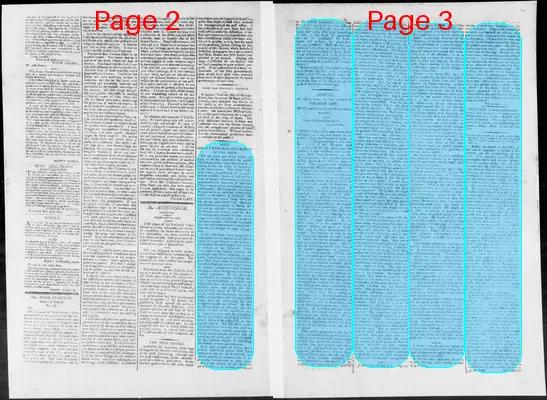
The Recorder
Richmond, Virginia
What is this article about?
This editorial from the Recorder defends press freedom against physical threats and legal challenges by Republicans, reflects on historical views of newspapers, criticizes the 'bludgeon system,' and responds sharply to George Hay's speech in a trial involving assault on James Callender, including an excerpt from the Norfolk Herald on the proceedings.
Merged-components note: This is a continuation of the editorial essay on Republican liberty of the press and related topics, including the answer to George Hay's speech; it flows directly from page 2 to page 3, so merge the components.
Clippings
1 of 2
OCR Quality
Full Text
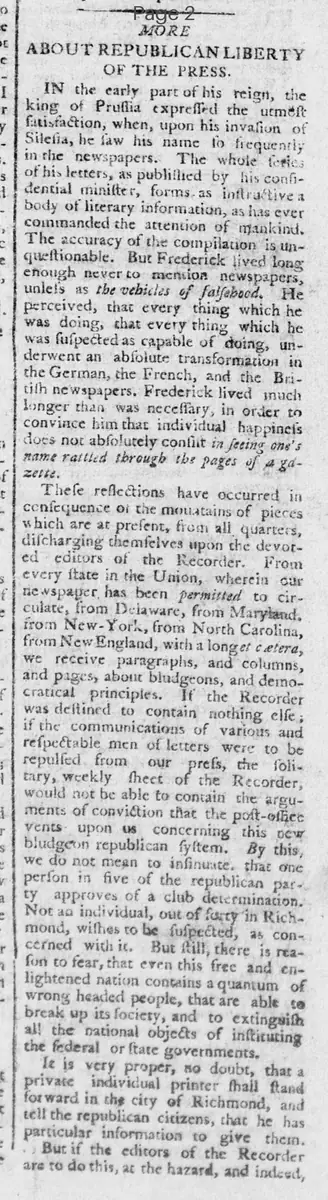
ABOUT REPUBLICAN LIBERTY
OF THE PRESS.
In the early part of his reign, the king of Prussia expressed the utmost satisfaction, when, upon his invasion of Silesia, he saw his name so frequently in the newspapers. The whole series of his letters, as published by his confidential minister, forms as instructive a body of literary information, as has ever commanded the attention of mankind. The accuracy of the compilation is unquestionable. But Frederick lived long enough never to mention newspapers, unless as the vehicles of falsehood. He perceived, that every thing which he was doing, that every thing which he was suspected as capable of doing, underwent an absolute transformation in the German, the French, and the British newspapers. Frederick lived much longer than was necessary, in order to convince him that individual happiness does not absolutely consist in seeing one's name rattled through the pages of a gazette.
These reflections have occurred in consequence of the mountains of pieces which are at present, from all quarters, discharging themselves upon the devoted editors of the Recorder. From every state in the Union, wherein our newspaper has been permitted to circulate, from Delaware, from Maryland, from New-York, from North Carolina, from New England, with a longer etcetera, we receive paragraphs, and columns, and pages, about bludgeons, and democratical principles. If the Recorder was destined to contain nothing else: if the communications of various and respectable men of letters were to be repulsed from our press, the solitary, weekly Sheet of the Recorder, would not be able to contain the arguments of conviction that the post-office vents upon us concerning this new bludgeon republican system. By this, we do not mean to insinuate, that one person in five of the republican party approves of a club determination. Not one individual, out of fifty in Richmond, wishes to be suspected, as concerned with it. But still, there is reason to fear, that even this free and enlightened nation contains a quantum of wrong headed people, that are able to break up its society, and to extinguish all the national objects of instituting the federal or state governments.
It is very proper, no doubt, that a private individual printer shall stand forward in the city of Richmond, and tell the republican citizens, that he has particular information to give them. But if the editors of the Recorder are to do this, at the hazard, and indeed,
At the utmost probability of getting their brains knocked out by walking fifty yards from their own door, do you think that men who have something to lose in the shape of property are to be surrounded by bank-rupts and ruffians, by place-hunters and gamblers! While we feel ourselves in such a state of superiority to the enmity and madness of some Richmond democrats, is it to be supposed that without a reasonable pause, we are to bend under an extinction of civilized society?
While editors are compelled to keep their houses supplied with fire-arms, there cannot be a man in the union sufficiently ignorant or stupid to enquire about the state of the freedom of the press in the ancient dominion.
ANSWER TO THAT PART OF THE SPEECH OF GEORGE HAY,
Which was inserted in last Wednesday's Recorder.
"Et fit, till thy proud heart burst."
SHAKESPEARE.
The readers of this paper have been informed that it was our design to re-publish, from the Virginia Gazette, an account of the proceedings in this trial. The speech of Mr. Marshall must be postponed till the paper after the present. Large additions and corrections have been promised to Mr. Wood's report. The spirited address of Mr. James Rind will come next in order. The hydrophobian savageness of Alexander M'Rae may shortly fill and deform two succeeding columns of "The Recorder." The total extinction of intellect, which marks every sentence, may perhaps induce us to cast aside his invective, and avoid so deplorable a prostitution of print and paper. If M'Rae had indeed been employed to expatiate upon the subject of intercepted letters to Oliver Wolcott, we should have republished with attention his remarks upon a subject so familiar to his sagacity and experience. A short peroration from George Hay, following Mr. Rind, like a cur snapping at the heels of a stallion, will close this procession of legal abilities. In the mean time, it is the purpose of the present article to give a Yorkshire hug to Hay's introductory harangue. In quotation, we shall be the less particular, because the piece itself, on which we are to animadvert, has appeared in last week's paper. He began by observing that the case was of the greatest importance to HIMSELF. This we firmly believe. If Hay had not been conscious of many cracks and leaks at the bottom of the vessel, he could not have been so feverishly afraid that she was on the point of foundering. When a man tells you that a column and a half of a newspaper can destroy his character, he tells you very plainly that it has long since been in the last agonies of expiration. Long before this bludgeon affair, it was known that three features predominated in the character of Hay. These were pride, malignity, and ingratitude. An accidental absence of talent in the courts of Dinwiddie, of Chesterfield, and of Petersburg, had made Hay suspect that he was a man of abilities. A professed gambler must of course feel hatred for every person who beats him at the game. Of unthankfulness to his benefactors, Hay has given specimens, which, for their sakes, and not for his, we do not choose to repeat.
This person proceeds to tell that if the licentiousness of the press could not be stopped, it would end in overwhelming all that was moral and virtuous. We suppose that this general destruction was to be accomplished by the fatal pages of The Recorder. For an hundred and fiftieth time, we ask, we demand, what virtuous character has been destroyed by this paper? If seduction and hypocrisy, if the great breach of personal friendship, and of domestic confidence, form a department in the new code of morality and virtue, it is indeed true that the Recorder has overwhelmed them. In the numerous and respectable list of the patrons of this paper, John Walker of Albemarle appears as one. A few weeks ago he came down to Richmond. He brought along with him a celebrated correspondence, which the Recorder has more than once hinted at, as being on the point of publication. He showed this to a number of gentlemen, several of whom we must, for the tenth time, affirm that we can produce in a court of justice. Mr. Walker was advised to postpone the publication. The reason we take to be this. It is still almost two years till the election of the next president. It was suspected that the horrible infamy of the contents of a part of this correspondence might have its edge blunted in eighteen months of newspaper repercussion. That the letters will be printed, first or last, there can be no question. The destruction of such characters is what Hay refers to when he speaks of the overwhelming all that was moral and virtuous. Did Juvenal overwhelm virtue by exposing the vices of Nero and Domitian? or Junius, by holding up to scorn Burgoyne, the gambler, and compelling him to sit down infamous and contented?
Hay has repeatedly acknowledged in court that he had been in the habit of calling Callender a scoundrel, and of saying that he should have been hanged before his seditious trial. He said that he would continue to use such expressions, and that Callender was welcome to speak in the same way of him; but not to print. This is the man who affects to complain of being calumniated! He did not even hint that Callender had given him the slightest provocation. And as for printing, is not the press as free as the tongue? If a man says in conversation that you are a rogue, are you not at liberty to print that he is a calumniator? To be sure the single tongue of George Hay is a very unequal match for the weekly circulation of fifteen hundred papers. But Hay should have considered this before he forced a quarrel; and when you attack an adversary, he must be permitted to wield his strongest weapon.
Hay said that he was actuated by motives the most natural and honorable to the human mind, the protection of his own feelings, and those of his family. As for his family, their character has never been attacked in the Recorder; and it certainly never will. He needs not to tremble upon that score. And was it a natural and honorable motive to pace about Richmond reviling Callender, while the latter was doing every thing possible to serve and to flatter him? If it is natural and honorable to knock a man down behind his back, it is not the constitution, but the cudgel, that a citizen ought to study. He said that he both felt and was wounded by the slanders of the Recorder. He might have foreseen that when he attacked both editors, he was to expect a retort. As for slanders, he has never denied a single specific assertion that the Recorder made. Has he denied that he suppressed Colls's testimony? And that he did this for the blackest of purposes? We do not recollect that he has made such a denial. And if he did, it is of no consequence. The matter is upon record; and we shall publish a faithful copy of it. He complains that he was represented in the Recorder as a murderer and an assassin. The united voice of America echoes to the charge. His name is too insignificant to detain public attention long. But at present he is held in more universal contempt and execration than any other man upon the continent. He stands, but not in the attitude of Shakespeare or Patrick Henry, unrivalled and alone. Setting aside the pacific and virtuous characters, which are equally numerous in all parties, even the most abandoned ruffians in Richmond, his probable prompters, his intimate companions, have found it advisable to desert him.
It is true, indeed, that Captain Quarrier waited upon Hay, "in the name of fifteen respectable members of the assembly, and thanked him for having given Callender so sound a beating." This only shows what sort of characters the good people of Virginia do, sometimes, send to the assembly. It is no wonder that we have so many curious laws to blot and disgrace the statute book, when a number of the members of assembly suppose that a bludgeon is better than a law. And was it for merits like those so much admired by Quarrier, that Jefferson's nephew, Peter Carr, and John Mercer of Fredericksburg, walked along with Hay to the court house, at a time when every decent man in Richmond shunned his company; when, provoked by the wanton insult of their laws, of their court, of their mayor, the whole body of our citizens had combined against him in one thunder clap of execration? Before our old friend John returns from France, we trust that his taste of society will undergo an improvement. At such a time, to walk with Hay to the court house was to proclaim approbation of his actions, and to sit down along with him in the embraces of dishonor! Is this the way that John supports the fame of his father? Or, if the departed spirit of the general could look back upon his son, with what sorrow would he behold that one the solitary companion of a gambler, a coward, and an assassin?
Hay said that he was solely restrained from punishing Callender as he deserved, with the apprehension that he should have given him a fatal blow. The first question is, who gave Hay any right of punishing at all? Is this the language of a republican, of a lawyer, of a member of the executive council? Or is it the language of a brute and a madman? What is the use of making laws, if every man is to make and execute laws for himself? When a robber or a horse-stealer comes to the bar, he endeavors to palliate or deny his crime? But here is a felon that comes forward to boast of his. He boasts of it in a court of justice. He boasts of it after an interval of almost three weeks, when his passions might have begun to cool. He boasts of it, while his throbbing heart was conscious that the thunder and lightning of universal abhorrence were rolling and flashing around him! Father of mercies! can such insolence and audacity exist in man? Can such a monster be a work of THINE?
Hay frankly informs the court that he had not punished Callender as he deserved. In other words, Callender deserved an additional drubbing. "I have committed one robbery," says the felon, "and I have a right to commit a second. Admire my probity and forbearance." This is a fair translation of Hay's idea; and it forms the quintessence of brutality and blackguardism. It is not easy to conceive upon what principle the court suffered Hay to proceed in such a style. The insult could hardly have been greater if he had cast a handful of stones in their faces. Hay well knows that for a tenth part of such stuff, Sam Chase would have sent him to jail.
As for the tenderness of Hay's attack, and his fear of giving Callender a fatal blow, it is an impudent falsehood. He struck as hard and as heavy as he possibly could. C. was standing within the door of Mr. Darmstadt's store, where there was not room to give the bludgeon a proper swing. Hay did however very well. He beat in a coarse hat for some inches. He beat a hole through it; and the surgeon says that if he had not providentially hit one of the thickest parts of the skull, that if the blow had varied two inches, he must have knocked out the writer's brains. This is that meanness of cowards, that blackest of villains, who glories in his crime, and who vaunts of his clemency. He says that he was not sent for from the other end of the bridge. He presses upon this point. He affirms that his meeting with C. was accidental. There was no meeting; for you do not meet a man when you only come behind his back. This assertion is not English. But whether the meeting was by chance or not, does not alter the case as to Hay. He had formed a deliberate design. He exults in the success of its execution. Hence it is of no consequence whether the meeting, as Hay calls it, was accidental or not. His denial, if true or otherwise, can neither make a better nor a worse of the story. Such is the logical acuteness of a lawyer to whose abilities the preservation of property, and in one instance of life, has been entrusted?
To be continued:-
Matters of much greater consequence have prevented us from paying attention as yet to Mrs. Knight and parson Courtney. We regret that our narrative is correct, notwithstanding the woman's story. More of this in due time.
The following conclusion of a well written essay, referring to the late attack on the Freedom of the Press in Virginia, is taken from the Norfolk Herald:
"Before the subject is dismissed, it may not be improper to bestow a few remarks on the proceedings of the court. The opening counsel for the prosecution seems well to have understood the temper of the court; he told the court that the defendants were infamous libellers, that they had libelled Mr. Giles, and many other virtuous characters which he forbore to mention, perhaps the learned counsel himself. A libel is a crime no doubt, but of which no man is guilty until he has been proven to be so. If a man (we will suppose of good character) is prosecuted for a felony, will the court allow (without proof) the prosecutor to say the prisoner is a notorious felon--that he committed a felony at this place and at that place--the court would confine him to the fact in issue. A man's general bad character may be urged against him in a criminal prosecution; but particular offences, which constitute crimes such as he may be tried charged with, shall not be imputed to him, unless proven to have been committed. Callender and Pace have not been by the sentence of a jury pronounced libellers. Callender individually has been, but perhaps Mr. M'Crea never heard of it; yet it is supposed Mr. Hay the prosecutor could have furnished some information on this subject---or perhaps Mr. M'Crea knew the court of Henrico would have considered the crime for which Mr. Callender was punished as no crime. To libel Gen. Washington, Mr. Adams, Mr. Jay, and Mr. Hamilton, with many others, was meritorious, and perhaps it could not be a pleasant duty to call that a libel, which the learned prosecutor had once advocated, and which Mr. Giles, and some other great and good men, it is said, have patronized and rewarded.
"Old men forget, yet all shall not forget,
But think of us and the deeds we have done."
It is to be lamented that in this business the spirit of party seems to have found its way. For the honor of free government, let us hope that an adherence to principles, and not to the passions of the moment will yet prevail-- and may the free bodings of the present king of England, when announcing our independence never be verified. He said he hoped that we might never experience what England had done; and that was "that monarchy was essential to liberty." Whether his wishes were sincere or not would not enquire, but we must clearly see that if the spirit of party can bend the law to suit its own purposes, the day is not far distant when the agitations of conflicting parties must end, not in monarchy, but in despotism, the last desperate retreat of oppressed humanity.--Let us turn our eyes to another country, and an awful illustration will be found.
VIRGINIUS
NOTE. Alexander M'Rae is an exception.
NOTES. + Peter Carr, the favorite nephew of Thomas Jefferson, was Hay's principal companion during the late business; and one of his securities. He has been appointed secretary to Mr. Monroe, in his present embassy to France.
What sub-type of article is it?
What keywords are associated?
What entities or persons were involved?
Editorial Details
Primary Topic
Defense Of Press Freedom Against Republican Threats And Legal Attacks In Virginia
Stance / Tone
Strongly Pro Press Freedom, Vehemently Critical Of George Hay And Democrats
Key Figures
Key Arguments