Thank you for visiting SNEWPapers!
Sign up free
Virginia Argus
Richmond, Virginia
What is this article about?
In the House of Commons on April 23, Mr. Fox moved to revise defence bills and consider further measures against potential invasion, criticizing ministers. Speeches from Pitt, Windham supporting; Chancellor, Yorke, Attorney General opposing. Motion defeated 204-256.
Clipping
OCR Quality
Full Text
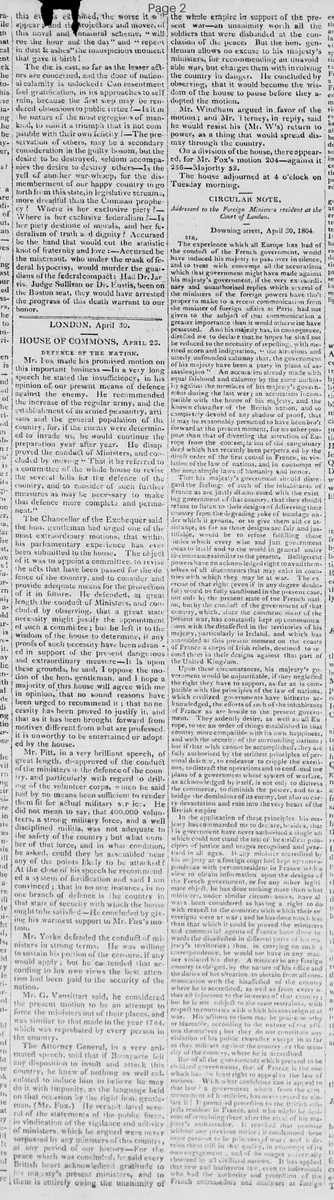
HOUSE OF COMMONS, APRIL 23.
DEFENCE OF THE NATION.
Mr. Fox made his promised motion on this important business - In a very long speech he stated the insufficiency, in his opinion of, our present means of defence against the enemy. He recommended the increase of the regular army, and the establishment of an armed peasantry, artisans and the general population of the country, for, if the enemy were determined to invade us, he would continue the preparation year after year. He disapproved the conduct of Ministers, and concluded by moving " That it be referred to a committee of the whole house to revise the several bills for the defence of the country, and to consider of such further measures as may be necessary to make that defence more complete and permanent."
The Chancellor of the Exchequer said the hon. gentleman had urged one of the most extraordinary motions, that within his parliamentary experience has ever been submitted to the house. The object of it was to appoint a committee, to revise the acts that have been passed for the defence of the country, and to consider and provide adequate means for the protection of it in future. He defended, at great length the conduct of Ministers, and concluded by observing, that a great state necessity might justify the appointment of such a committee; but he left it to the wisdom of the house to determine, if any proofs of such necessity have been advanced in support of the present dangerous and extraordinary measure--It is upon these grounds, he said, I oppose the motion of the hon. gentleman, and I hope a majority of this house will agree with me in opinion, that no sound reasons have been urged to recommend it ; that no necessity has been proved to justify it, and that as it has been brought forward from motives different from what are professed. it is unworthy to be entertained or adopted by the house.
Mr. Pitt, in a very brilliant speech, of great length, disapproved of the conduct of the ministers in the defence of the country, and particularly with regard to drilling of the volunteer corps, which he said had by no means been sufficient to render them fit for actual military service. He did not mean to say, that 400,000 volunteers, a strong military force, and a well disciplined militia, was not adequate to the safety of the country ; but what number of that force, and in what condition, he asked, could they be assembled near any of the points likely to be attacked?
At the close of his speech he recommended a system of fortification and said I am convinced; that in no one instance, in no one branch of defence is the country in that state of security with which the house ought to be satisfied--He concluded by giving his warmest support to Mr. Fox's motion.
Mr. Yorke defended the conduct of ministers in strong terms. He was willing to sustain his portion of the censure, if any would apply ; but he contended that according to his own views the best attention had been paid to the security of the nation.
Mr. G. Vansittart said, he considered the present motion to be an attempt to force the ministers out of their places, and was similar to that made in the year 1784, which was reprobated by every person in the country.
The Attorney General, in a very animated speech, said that if Bonaparte felt any disposition to insult and attack this country, he knew of nothing as well calculated to induce him to believe he may do it with impunity, as the language held on that occasion by the right hon. gentleman, (Mr. Fox.) He recapitulated several of the statements of the public force, in vindication of the vigilance and activity of ministers, which he argued were never surpassed by any ministers of this country, at any period of our history--For the peace which was concluded, he said every British heart acknowledged gratitude to his majesty's present ministers, and to them is entirely owing the unanimity of the whole empire in support of the present war an unanimity worth all the soldiers that were disbanded at the conclusion of the peace. But the hon. gentleman allows no excuse to his majesty's ministers, for recommending an unavoidable war, but charges them with involving the country in danger. He concluded by observing, that it would become the wisdom of the house to pause before they adopted the motion.
Mr. Windham argued in favor of the motion; and Mr. Tierney, in reply, said he would resist his (Mr. W's) return to power, as a thing that would spread dismay through the country.
On a division of the house, there appeared, for Mr. Fox's motion 204--against it 256--Majority 52.
The house adjourned at 4 o'clock on Tuesday morning.
What sub-type of article is it?
What keywords are associated?
What entities or persons were involved?
Where did it happen?
Foreign News Details
Primary Location
London
Event Date
April 23
Key Persons
Outcome
motion defeated: 204 for, 256 against, majority 52.
Event Details
Mr. Fox moved to refer defence bills to a committee for revision and further measures, criticizing ministers' conduct and recommending army increase and armed population. Chancellor opposed as extraordinary and unproven. Mr. Pitt supported, criticizing volunteer drilling and recommending fortifications. Mr. Yorke, Mr. G. Vansittart, and Attorney General defended ministers. Mr. Windham supported; Mr. Tierney opposed Windham's return.