Thank you for visiting SNEWPapers!
Sign up free
Story
May 28, 1946
Atlanta Daily World
Atlanta, Fulton County, Georgia
What is this article about?
Column reflecting on the 1946 Memphis Cotton-Makers Jubilee's impacts: favorable white press coverage, children's participation, recognition of Negro womanhood, and organizers' non-profit civic contributions, promoting interracial harmony and self-respect.
Clipping
OCR Quality
95%
Excellent
Full Text
ATLANTA DAILY WORLD, ATLANTA, GEORGIA
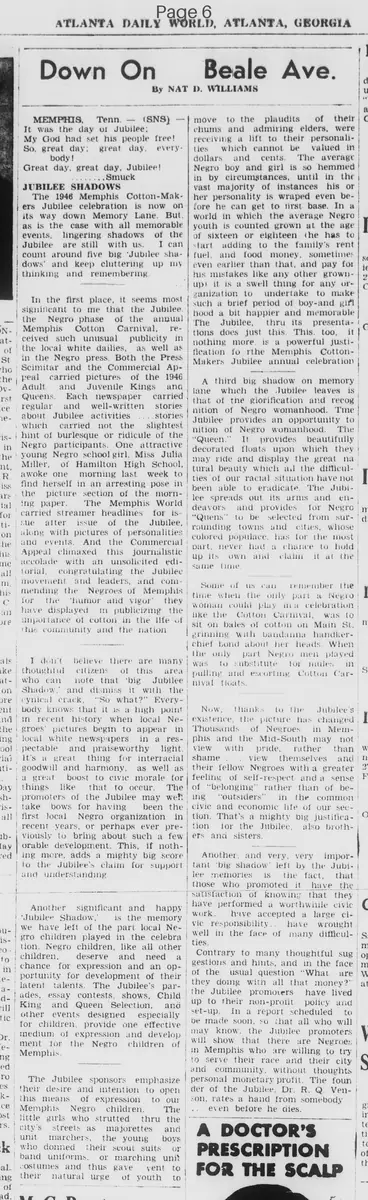
Down On Beale Ave.
MEMPHIS, Tenn. — (SNS)
It was the day of Jubilee:
My God had set his people free!
So, great day: great day. everybody!
Great day, great day, Jubilee!
..Smuck
JUBILEE SHADOWS
The 1946 Memphis Cotton-Makers Jubilee celebration is now on its way down Memory Lane. But, as is the case with all memorable events, lingering shadows of the Jubilee are still with us. I can count around five big 'Jubilee shadows' and keep cluttering up my thinking and remembering.
In the first place, it seems most significant to me that the Jubilee the Negro phase of the annual Memphis Cotton Carnival, received such unusual publicity in the local white dailies, as well as in the Negro press. Both the Press Scimitar and the Commercial Appeal carried pictures of the 1946 Adult and Juvenile Kings and Queens. Each newspaper carried regular and well-written stories about Jubilee activities .. stories which carried not the slightest hint of burlesque or ridicule of the Negro participants. One attractive young Negro school girl, Miss Julia Miller, of Hamilton High School awoke one morning last week to find herself in an arresting pose in the picture section of the morning paper.
The Memphis World carried streamer headlines for issue after issue of the Jubilee, along with pictures of personalities and events. And the Commercial Appeal climaxed this journalistic accolade with an unsolicited editorial, congratulating the Jubilee movement and leaders, and commending the Negroes of Memphis for the 'humor and vigor' they have displayed in publicizing the importance of cotton in the life of the community and the nation.
I don't believe there are many thoughtful citizens of this area who can note that big Jubilee Shadow, and dismiss it with the cynical crack, "So what?" Everybody knows that it is a high point in recent history when local Negroes' pictures begin to appear in local white newspapers in a respectable and praiseworthy light. It's a great thing for interracial goodwill and harmony, as well as a great boost to civic morale for things like that to occur. The promoters of the Jubilee may well take bows for having been the first local Negro organization in recent years, or perhaps ever previously to bring about such a favorable development. This, if nothing more, adds a mighty big score to the Jubilee's claim for support and understanding.
Another significant and happy Jubilee Shadow,' is the memory we have left of the part local Negro children played in the celebration. Negro children, like all other children, deserve and need a chance for expression and an opportunity for development of their latent talents. The Jubilee's parades, essay contests, shows, Child King and Queen Selection, and other events designed especially for children, provide one effective medium of expression and development for the Negro children of Memphis.
The Jubilee sponsors emphasize their desire and intention to open this means of expression to our Memphis Negro children.
The little girls who strutted thru the city's streets as majorettes and unit marchers, the young boys who donned their scout suits or band uniforms, or marching unit costumes and thus gave vent to their natural urge of youth to move to the plaudits of their chums and admiring elders, were receiving a lift to their personalities which cannot be valued in dollars and cents. The average Negro boy and girl is so hemmed in by circumstances, until in the vast majority of instances his or her personality is warped even before he can get to first base. In a world in which the average Negro youth is counted grown at the age of sixteen or eighteen (he has to start adding to the family's rent fuel, and food money, sometimes even earlier than that, and pay for his mistakes like any other grown-up) it is a swell thing for any organization to undertake to make such a brief period of boy-and girl hood a bit happier and memorable.
The Jubilee, thru its presentations does just this. This, if nothing more is a powerful justification for the Memphis Cotton-Makers Jubilee annual celebration.
A third big shadow on memory lane which the Jubilee leaves is that of the glorification and recognition of Negro womanhood. The Jubilee provides an opportunity to nition of Negro womanhood. The "Queen." It provides beautifully decorated floats upon which they may ride and display the great natural beauty which all the difficulties of our racial situation have not been able to eradicate. The Jubilee spreads out its arms and endeavors and provides for Negro "Queens" to be selected from surrounding towns and cities, whose colored populace, has for the most part, never had a chance to hold up its own and claim it at the same time.
Some of us can remember the time when the only part a Negro woman could play in a celebration like the Cotton Carnival, was to sit on bales of cotton on Main St. grinning with bandanna handkerchief around her head. When the only part Negro men played was to substitute for mules in pulling and escorting cotton Carnival floats.
Now, thanks to the Jubilee's existence, the picture has changed. Thousands of Negroes in Memphis and the Mid-South may now view with pride, rather than shame . view themselves and their fellow Negroes with a greater feeling of self-respect and a sense of "belonging" rather than of being "outsiders" in the common civic and economic life of our section. That's a mighty big justification for the Jubilee, also brothers and sisters.
Another, and very, very important big shadow' left by the Jubilee memories is the fact, that those who promoted it have the satisfaction of knowing that they have performed a worthwhile civic work, have accepted a large civic responsibility, have wrought well in the face of many difficulties.
Contrary to many thoughtful suggestions and hints, and in the face of the usual question "What are they doing with all that money?" the Jubilee promoters have lived up to their non-profit policy and set-up. In a report scheduled to be made soon, so that all who will may know, the Jubilee promoters will show that there are Negroes in Memphis who are willing to try to serve their race and their city and community, without thoughts personal monetary profit. The founder of the Jubilee, Dr. R. Q. Venson, rates a hand from somebody even before he dies.
Down On Beale Ave.
MEMPHIS, Tenn. — (SNS)
It was the day of Jubilee:
My God had set his people free!
So, great day: great day. everybody!
Great day, great day, Jubilee!
..Smuck
JUBILEE SHADOWS
The 1946 Memphis Cotton-Makers Jubilee celebration is now on its way down Memory Lane. But, as is the case with all memorable events, lingering shadows of the Jubilee are still with us. I can count around five big 'Jubilee shadows' and keep cluttering up my thinking and remembering.
In the first place, it seems most significant to me that the Jubilee the Negro phase of the annual Memphis Cotton Carnival, received such unusual publicity in the local white dailies, as well as in the Negro press. Both the Press Scimitar and the Commercial Appeal carried pictures of the 1946 Adult and Juvenile Kings and Queens. Each newspaper carried regular and well-written stories about Jubilee activities .. stories which carried not the slightest hint of burlesque or ridicule of the Negro participants. One attractive young Negro school girl, Miss Julia Miller, of Hamilton High School awoke one morning last week to find herself in an arresting pose in the picture section of the morning paper.
The Memphis World carried streamer headlines for issue after issue of the Jubilee, along with pictures of personalities and events. And the Commercial Appeal climaxed this journalistic accolade with an unsolicited editorial, congratulating the Jubilee movement and leaders, and commending the Negroes of Memphis for the 'humor and vigor' they have displayed in publicizing the importance of cotton in the life of the community and the nation.
I don't believe there are many thoughtful citizens of this area who can note that big Jubilee Shadow, and dismiss it with the cynical crack, "So what?" Everybody knows that it is a high point in recent history when local Negroes' pictures begin to appear in local white newspapers in a respectable and praiseworthy light. It's a great thing for interracial goodwill and harmony, as well as a great boost to civic morale for things like that to occur. The promoters of the Jubilee may well take bows for having been the first local Negro organization in recent years, or perhaps ever previously to bring about such a favorable development. This, if nothing more, adds a mighty big score to the Jubilee's claim for support and understanding.
Another significant and happy Jubilee Shadow,' is the memory we have left of the part local Negro children played in the celebration. Negro children, like all other children, deserve and need a chance for expression and an opportunity for development of their latent talents. The Jubilee's parades, essay contests, shows, Child King and Queen Selection, and other events designed especially for children, provide one effective medium of expression and development for the Negro children of Memphis.
The Jubilee sponsors emphasize their desire and intention to open this means of expression to our Memphis Negro children.
The little girls who strutted thru the city's streets as majorettes and unit marchers, the young boys who donned their scout suits or band uniforms, or marching unit costumes and thus gave vent to their natural urge of youth to move to the plaudits of their chums and admiring elders, were receiving a lift to their personalities which cannot be valued in dollars and cents. The average Negro boy and girl is so hemmed in by circumstances, until in the vast majority of instances his or her personality is warped even before he can get to first base. In a world in which the average Negro youth is counted grown at the age of sixteen or eighteen (he has to start adding to the family's rent fuel, and food money, sometimes even earlier than that, and pay for his mistakes like any other grown-up) it is a swell thing for any organization to undertake to make such a brief period of boy-and girl hood a bit happier and memorable.
The Jubilee, thru its presentations does just this. This, if nothing more is a powerful justification for the Memphis Cotton-Makers Jubilee annual celebration.
A third big shadow on memory lane which the Jubilee leaves is that of the glorification and recognition of Negro womanhood. The Jubilee provides an opportunity to nition of Negro womanhood. The "Queen." It provides beautifully decorated floats upon which they may ride and display the great natural beauty which all the difficulties of our racial situation have not been able to eradicate. The Jubilee spreads out its arms and endeavors and provides for Negro "Queens" to be selected from surrounding towns and cities, whose colored populace, has for the most part, never had a chance to hold up its own and claim it at the same time.
Some of us can remember the time when the only part a Negro woman could play in a celebration like the Cotton Carnival, was to sit on bales of cotton on Main St. grinning with bandanna handkerchief around her head. When the only part Negro men played was to substitute for mules in pulling and escorting cotton Carnival floats.
Now, thanks to the Jubilee's existence, the picture has changed. Thousands of Negroes in Memphis and the Mid-South may now view with pride, rather than shame . view themselves and their fellow Negroes with a greater feeling of self-respect and a sense of "belonging" rather than of being "outsiders" in the common civic and economic life of our section. That's a mighty big justification for the Jubilee, also brothers and sisters.
Another, and very, very important big shadow' left by the Jubilee memories is the fact, that those who promoted it have the satisfaction of knowing that they have performed a worthwhile civic work, have accepted a large civic responsibility, have wrought well in the face of many difficulties.
Contrary to many thoughtful suggestions and hints, and in the face of the usual question "What are they doing with all that money?" the Jubilee promoters have lived up to their non-profit policy and set-up. In a report scheduled to be made soon, so that all who will may know, the Jubilee promoters will show that there are Negroes in Memphis who are willing to try to serve their race and their city and community, without thoughts personal monetary profit. The founder of the Jubilee, Dr. R. Q. Venson, rates a hand from somebody even before he dies.
What sub-type of article is it?
Historical Event
Personal Triumph
What themes does it cover?
Social Manners
Triumph
Moral Virtue
What keywords are associated?
Memphis Jubilee
Cotton Carnival
Interracial Goodwill
Negro Children
Negro Womanhood
Civic Celebration
What entities or persons were involved?
Julia Miller
R. Q. Venson
Where did it happen?
Memphis, Tenn.
Story Details
Key Persons
Julia Miller
R. Q. Venson
Location
Memphis, Tenn.
Event Date
1946
Story Details
Reflections on the 1946 Memphis Cotton-Makers Jubilee, noting its positive coverage in white newspapers, opportunities for Negro children's expression, glorification of Negro womanhood, and the non-profit civic service by organizers led by Dr. R. Q. Venson.