Thank you for visiting SNEWPapers!
Sign up free
The Massachusetts Spy
Worcester, Worcester County, Massachusetts
What is this article about?
Historical account of witchcraft accusations in Massachusetts Bay from 1645, focusing on 1692 Salem hysteria: children accuse locals, leading to trials, executions of 19, imprisonment of 150+, and eventual cessation as frenzy is recognized as unjust.
Clipping
OCR Quality
Full Text
[From the New-York Daily Advertiser.]
WITCHCRAFT.
The following concise history of Witchcraft, as it occurred in the province of Massachusetts Bay, from the middle to near the close of the seventeenth century, is copied from President Dwight's Travels, the first volume of which has just been published. As it is the only connected account of this extraordinary infatuation that we have ever met with, we think it will prove amusing to our readers:—
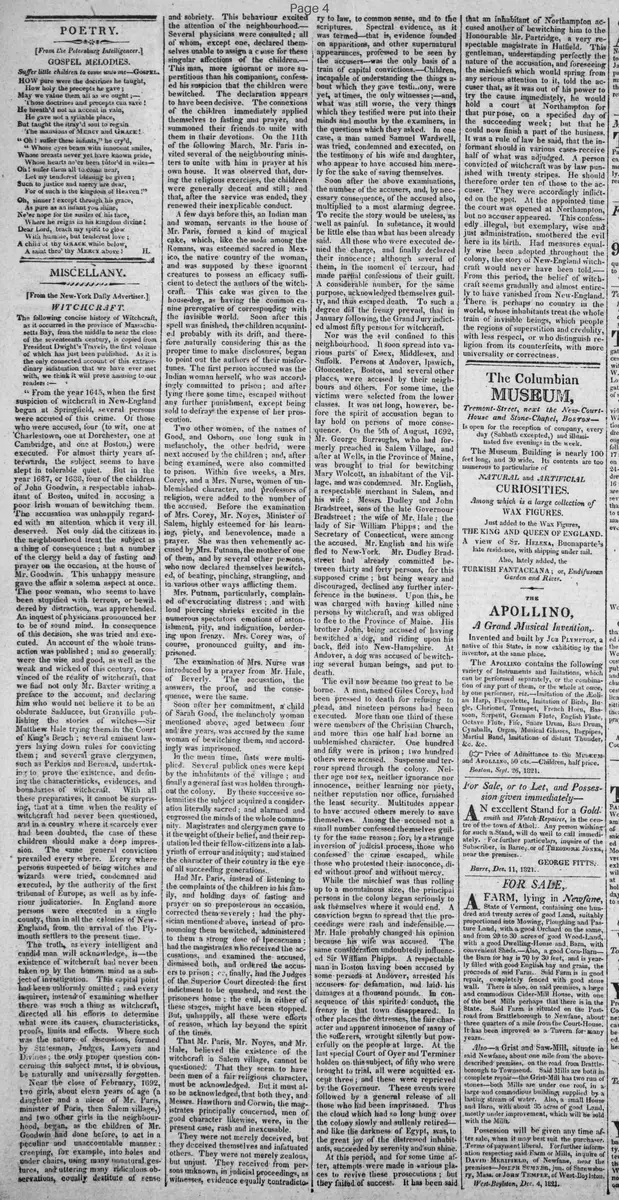
"From the year 1645, when the first suspicion of witchcraft in New-England began at Springfield, several persons were accused of this crime. Of those who were accused, four (to wit, one at Charlestown, one at Dorchester, one at Cambridge, and one at Boston,) were executed. For almost thirty years afterwards, the subject seems to have slept in tolerable quiet. But in the year 1687, or 1688, four of the children of John Goodwin, a respectable inhabitant of Boston, united in accusing a poor Irish woman of bewitching them. The accusation was unhappily regarded with an attention which it very ill deserved. Not only did the citizens in the neighbourhood treat the subject as a thing of consequence; but a number of the clergy held a day of fasting and prayer on the occasion, at the house of Mr. Goodwin. This unhappy measure gave the affair a solemn aspect at once. The poor woman, who seems to have been stupified with terrour, or bewildered by distraction, was apprehended. An inquest of physicians pronounced her to be of sound mind. In consequence of this decision, she was tried and executed. An account of the whole transaction was published; and so generally were the wise and good, as well as the weak and wicked of this century, convinced of the reality of witchcraft, that we find not only Mr. Baxter writing a preface to the account, and declaring him who would not believe it to be an obdurate Sadducee, but Granville publishing the stories of witches—Sir Matthew Hale trying them in the Court of King's Bench; several eminent lawyers laying down rules for convicting them; and several grave clergymen, such as Perkins and Bernard, undertaking to prove the existence, and defining the characteristics, evidences, and boundaries of witchcraft. With all these preparatives, it cannot be surprising, that at a time when the reality of witchcraft had never been questioned, and in a country where it scarcely ever had been doubted, the case of these children should make a deep impression. The same general conviction prevailed every where. Every where persons suspected of being witches and wizards were tried, condemned and executed, by the authority of the first tribunal of Europe, as well as by inferior judicatories. In England more persons were executed in a single county, than in all the colonies of New-England, from the arrival of the Plymouth settlers to the present time. The truth, as every intelligent and candid man will acknowledge, is—the existence of witchcraft had never been taken up by the human mind as a subject of investigation. This capital point had been uniformly omitted; and every inquirer, instead of examining whether there was such a thing as witchcraft, directed all his efforts to determine what were its causes, characteristics, proofs, limits and effects. Where such was the nature of discussions, formed by Statesmen, Judges, Lawyers and Divines; the only proper question concerning this subject must, it is obvious, be naturally and universally forgotten.
Near the close of February, 1692, two girls, about eleven years of age (a daughter and a niece of Mr. Paris, minister of Paris, then Salem village,) and two other girls in the neighbourhood, began, as the children of Mr. Goodwin had done before, to act in a peculiar and unaccountable manner: creeping, for example, into holes and under chairs, using many unnatural gestures, and uttering many ridiculous observations, equally destitute of sense and sobriety. This behaviour excited the attention of the neighbourhood. Several physicians were consulted; all of whom, except one, declared themselves unable to assign a cause for these singular affections of the children. This man, more ignorant or more superstitious than his companions, confessed his suspicion that the children were bewitched. The declaration appears to have been decisive. The connexions of the children immediately applied themselves to fasting and prayer, and summoned their friends to unite with them in their devotions. On the 11th of the following March, Mr. Paris invited several of the neighbouring ministers to unite with him in prayer at his own house. It was observed that, during the religious exercises, the children were generally decent and still; and that, after the service was ended, they renewed their inexplicable conduct. A few days before this, an Indian man and woman, servants in the house of Mr. Paris, formed a kind of magical cake, which, like the mola among the Romans, was esteemed sacred in Mexico, the native country of the woman, and was supposed by these ignorant creatures to possess an efficacy sufficient to detect the authors of the witchcraft. This cake was given to the house-dog, as having the common canine prerogative of corresponding with the invisible world. Soon after this spell was finished, the children acquainted, probably with its drift, and therefore naturally considering this as the proper time to make disclosures, began to point out the authors of their misfortunes. The first person accused was the Indian woman herself, who was accordingly committed to prison; and after lying there some time, escaped without any further punishment, except being sold to defray the expense of her prosecution. Two other women, of the names of Good, and Osborn, one long sunk in melancholy, the other bedrid, were next accused by the children; and, after being examined, were also committed to prison. Within five weeks, a Mrs. Corey, and a Mrs. Nurse, women of unblemished character, and professors of religion, were added to the number of the accused. Before the examination of Mrs. Corey, Mr. Noyes, Minister of Salem, highly esteemed for his learning, piety, and benevolence, made a prayer. She was then vehemently accused by Mrs. Putnam, the mother of one of them, and by several other persons, who now declared themselves bewitched, of beating, pinching, strangling, and in various other ways afflicting them. Mrs. Putnam, particularly, complained of excruciating distress; and with loud piercing shrieks excited in the numerous spectators emotions of astonishment, pity, and indignation, bordering upon frenzy. Mrs. Corey was, of course, pronounced guilty, and imprisoned. The examination of Mrs. Nurse was introduced by a prayer from Mr. Hale, of Beverly. The accusation, the answers, the proof, and the consequence, were the same. Soon after her commitment, a child of Sarah Good, the melancholy woman mentioned above, aged between four and five years, was accused by the same woman of bewitching them, and accordingly was imprisoned. In the mean time, fasts were multiplied. Several publick ones were kept by the inhabitants of the village; and finally a general fast was holden throughout the colony. By these successive solemnities the subject acquired a consideration literally sacred; and alarmed and engrossed the minds of the whole community. Magistrates and clergymen gave to it the weight of their belief, and their reputation led their fellow-citizens into a labyrinth of errour and iniquity; and stained the character of their country in the eye of all succeeding generations. Had Mr. Paris, instead of listening to the complaints of the children in his family, and holding days of fasting and prayer on so preposterous an occasion, corrected them severely; had the physician mentioned above, instead of pronouncing them bewitched, administered to them a strong dose of Ipecacuanha; had the magistrates who received the accusations, and examined the accused, dismissed both, and ordered the accusers to prison; or, finally, had the Judges of the Superior Court directed the first indictment to be quashed, and sent the prisoners home; the evil, in either of these stages, might have been stopped. But, unhappily, all these were efforts of reason, which lay beyond the spirit of the times. That Mr. Paris, Mr. Noyes, and Mr. Hale, believed the existence of the witchcraft in Salem village, cannot be questioned: That they seem to have been men of a fair religious character, must be acknowledged. But it must also be acknowledged, that both they, and Messrs. Hawthorn and Corwin, the magistrates principally concerned, men of good character likewise, were, in the present case, rash and inexcusable. They were not merely deceived, but they deceived themselves and infatuated others. They were not merely zealous, but unjust. They received from persons unknown, in judicial proceedings, as witnesses, evidence equally contradictory to law, to common sense, and to the scriptures. Spectral evidence, as it was termed—that is, evidence founded on apparitions, and other supernatural appearances, professed to be seen by the accusers—was the only basis of a train of capital convictions. Children, incapable of understanding the things about which they gave testimony, were yet, at times, the only witnesses;—and, what was still worse, the very things which they testified were put into their minds and mouths by the examiners, in the questions which they asked. In one case, a man named Samuel Wardwell, was tried, condemned and executed, on the testimony of his wife and daughter, who appear to have accused him merely for the sake of saving themselves. Soon after the above examinations, the number of the accusers, and, by necessary consequence, of the accused also, multiplied to a most alarming degree. To recite the story would be useless, as well as painful. In substance, it would be little else than what has been already said. All those who were executed denied the charge, and finally declared their innocence; although several of them, in the moment of terrour, had made partial confessions of their guilt. A considerable number, for the same purpose, acknowledged themselves guilty, and thus escaped death. To such a degree did the frenzy prevail, that in January following, the Grand Jury indicted almost fifty persons for witchcraft. Nor was the evil confined to this neighbourhood. It soon spread into various parts of Essex, Middlesex, and Suffolk. Persons at Andover, Ipswich, Gloucester, Boston, and several other places, were accused by their neighbours and others. For some time, the victims were selected from the lower classes. It was not long, however, before the spirit of accusation began to lay hold on persons of more consequence. On the 5th of August, 1692, Mr. George Burroughs, who had formerly preached in Salem Village, and after at Wells, in the Province of Maine, was brought to trial for bewitching Mary Wolcott, an inhabitant of the Village, and was condemned. Mr. English, a respectable merchant in Salem, and his wife; Messrs. Dudley and John Bradstreet, sons of the late Governour Bradstreet: the wife of Mr. Hale; the lady of Sir William Phipps; and the Secretary of Connecticut, were among the accused. Mr. English and his wife fled to New-York. Mr. Dudley Bradstreet had already committed between thirty and forty persons, for this supposed crime; but being weary and discouraged, declined any further interference in the business. Upon this, he was charged with having killed nine persons by witchcraft, and was obliged to flee to the Province of Maine. His brother John, being accused of having bewitched a dog, and riding upon his back, fled into New-Hampshire. At Andover, a dog was accused of bewitching several human beings, and put to death. The evil now became too great to be borne. A man, named Giles Corey, had been pressed to death for refusing to plead, and nineteen persons had been executed. More than one third of these were members of the Christian Church, and more than one half had borne an unblemished character. One hundred and fifty were in prison; two hundred others were accused. Suspense and terrour spread through the colony. Neither age nor sex, neither ignorance nor innocence, neither learning nor piety, neither reputation nor office, furnished the least security. Multitudes appear to have accused others merely to save themselves. Among the accused not a small number confessed themselves guilty for the same reason; for, by a strange inversion of judicial process, those who confessed the crime escaped, while those who protested their innocence, died without proof and without mercy. While the mischief was thus rolling up to a mountainous size, the principal persons in the colony began seriously to ask themselves where it would end. A conviction began to spread that the proceedings were rash and indefensible.— Mr. Hale probably changed his opinion because his wife was accused. The same consideration undoubtedly influenced Sir William Phipps. A respectable man in Boston having been accused by some persons at Andover, arrested his accusers for defamation, and laid his damages at a thousand pounds. In consequence of this spirited conduct, the frenzy in that town disappeared: In other places the distresses, the fair character and apparent innocence of many of the sufferers, wrought silently but powerfully on the people at large. At the last special Court of Oyer and Terminer holden on this subject, of fifty who were brought to trial, all were acquitted except three; and these were reprieved by the Governour. These events were followed by a general release of all those who had been imprisoned. Thus the cloud which had so long hung over the colony slowly and sullenly retired and like the darkness of Egypt, was, to the great joy of the distressed inhabitants, succeeded by serenity and sunshine. At this period, and for some time after, attempts were made in various places to revive these prosecutions; but they failed of success. It has been said that an inhabitant of Northampton accused another of bewitching him to the Honourable Mr. Partridge, a very respectable magistrate in Hatfield. This gentleman, understanding perfectly the nature of the accusation, and foreseeing the mischiefs which would spring from any serious attention to it, told the accuser that, as it was out of his power to try the cause immediately, he would hold a court at Northampton for that purpose, on a specified day of the succeeding week; but that he could now finish a part of the business. It was a rule of law he said, that the informant should in various cases receive half of what was adjudged. A person convicted of witchcraft was by law punished with twenty stripes. He should therefore order ten of those to the accuser. They were accordingly inflicted on the spot. At the appointed time the court was opened at Northampton, but no accuser appeared. This confessedly illegal, but exemplary, wise and just administration, smothered the evil here in its birth. Had measures equally wise been adopted throughout the colony, the story of New-England witchcraft would never have been told.— From this period, the belief of witchcraft seems gradually and almost entirely to have vanished from New-England. There is perhaps no country in the world, whose inhabitants treat the whole train of invisible beings, which people the regions of superstition and credulity, with less respect, or who distinguish religion from its counterfeits, with more universality or correctness."
What sub-type of article is it?
What themes does it cover?
What keywords are associated?
What entities or persons were involved?
Where did it happen?
Story Details
Key Persons
Location
Province Of Massachusetts Bay, Salem Village
Event Date
From 1645 To Near The Close Of The Seventeenth Century, Main Events In 1692
Story Details
From 1645, sporadic witchcraft accusations and executions in New England escalated in 1692 when Salem children exhibited strange behaviors, accusing locals like Tituba, Good, and Osborn. Hysteria spread, leading to trials using spectral evidence, 19 executions including Giles Corey pressed to death, over 150 imprisoned. Ministers and magistrates fueled the frenzy; eventual doubts and releases ended it by late 1692.