Thank you for visiting SNEWPapers!
Sign up free
Editorial
May 30, 1877
The Indiana State Sentinel
Indianapolis, Marion County, Indiana
What is this article about?
Editorial criticizes President Hayes and Treasury Secretary John Sherman's plan to contract the currency for specie resumption on January 1, 1879, claiming it violates the 1875 Resumption Act and will cause national bankruptcy and economic prostration. Quotes Senator Jones of Nevada opposing additional legislation and predicting failure of resumption.
Clipping
OCR Quality
98%
Excellent
Full Text
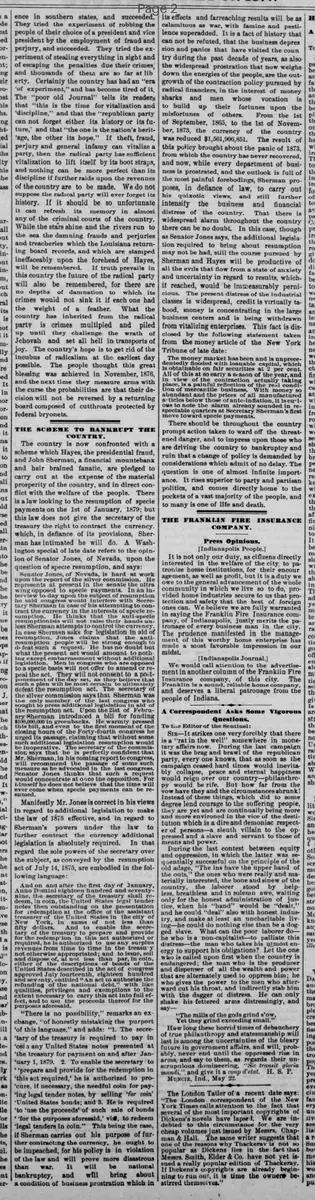
THE SCHEME TO BANKRUPT THE COUNTRY.
The country is now confronted with a scheme which Hayes, the presidential fraud, and John Sherman, a financial mountebank and hair-brained fanatic, are pledged to carry out at the expense of the material prosperity of the country, and in direct conflict with the welfare of the people. There is a law looking to the resumption of specie payments on the 1st of January, 1879; but this law does not give the secretary of the treasury the right to contract the currency, which, in defiance of its provisions, Sherman has intimated he will do. A Washington special of late date refers to the opinion of Senator Jones, of Nevada, upon the question of specie resumption, and says:
Senator Jones, of Nevada, is hard at work upon the report of the silver commission. He represents at present in the senate the ultra wing opposed to specie payments. In an interview to-day upon the subject of resumption he said congress would interfere with Secretary Sherman in case of his attempting to contract the currency in the interests of specie resumption. He thinks that the anti-specie resumptionists will not raise their hands unless Sherman attempts to control the currency. In case Sherman asks for legislation in aid of resumption, Jones claims that the anti-resumption people will be strong enough to defeat such a request. He has no doubt but what the present act would amount to nothing except embarrassment without additional legislation. Men in congress who are opposed to a specie basis will not offer to amend or repeal the act. They will not consent to a postponement of the day set, as they believe that such a plan will be most certain to ultimately defeat the resumption act. The secretary of the silver commission says that Sherman was the only member of the last congress who sought to press additional legislation in aid of the resumption act. Upon the 21st of February Sherman introduced a bill for funding $100,000,000 in greenbacks. He warmly pressed this bill, and even to the first moment of the closing hours of the Forty-fourth congress he urged its passage, claiming that without some such additional legislation resumption would be inoperative. The secretary of the commission says that he is perfectly confident that Mr. Sherman, in his coming report to congress, will recommend the passage of some such measure as he advocated in the last congress. Senator Jones thinks that such a request would concentrate at once the opposition. For himself he does not believe that the time will ever come when specie payments can be resumed.
Manifestly Mr. Jones is correct in his views in regard to additional legislation to make the law of 1875 effective, and in regard to Sherman's powers under the law to further contract the currency additional legislation is absolutely required. In that regard the sole powers of the secretary over the subject, as conveyed by the resumption act of July 14, 1875, are embodied in the following language:
And on and after the first day of January, Anno Domini eighteen hundred and seventy-nine, the secretary of the treasury shall redeem, in coin, the United States legal tender notes then outstanding on the presentation for redemption at the office of the assistant treasurer of the United States in the city of New York, in sums of not less than fifty dollars. And to enable the secretary of the treasury to prepare and provide for the redemption in this act authorized or required, he is authorized to use any surplus revenues from time to time in the treasury not otherwise appropriated; and to issue, sell and dispose of, at not less than par, in coin, either of the descriptions of bonds of the United States described in the act of congress approved July fourteenth, eighteen hundred and seventy, entitled "An act to authorize the refunding of the national debt," with like qualities, privileges and exemptions to the extent necessary to carry this act into full effect, and to use the proceeds thereof for the purposes aforesaid.
"There is no possibility," remarks an exchange, "of honestly mistaking the purport of this language," and adds: "1. The secretary of the treasury is required to pay in coin any United States notes presented at the treasury for payment on and after January 1, 1879. 2. To enable the secretary to 'prepare and provide for the redemption in this act required,' he is authorized to procure, if necessary, the needful coin for paying legal tender notes, by selling 'for coin' United States bonds; and 3. He is required to 'use the proceeds' of such sale of bonds 'for the purposes aforesaid,' viz, to redeem legal tenders in coin." This being the case, if Sherman carries out his purpose of further contracting the currency, he ought to be impeached, for his policy is in violation of the law and will prove more disastrous than war.
It will be national bankruptcy, and will bring about a condition of business prostration which in its effects and far-reaching results will be as calamitous as war, with famine and pestilence superadded. It is a fact of history that can not be refuted, that the business depression and panics that have visited the country during the past decade of years, as also the widespread prostration that now weighs down the energies of the people, are the outgrowth of the contraction policy pursued by radical financiers, in the interest of money sharks and men whose vocation is to build up their fortunes upon the misfortunes of others. From the 1st of September, 1865, to the 1st of November, 1873, the currency of the country was reduced $1,561,906,851. The result of this policy brought about the panic of 1873, from which the country has never recovered, and now, while every department of business is prostrated, and the outlook is full of the most painful forebodings, Sherman proposes, in defiance of law, to carry out his quixotic views, and still further intensify the business and financial distress of the country. That there is widespread alarm throughout the country there can be no doubt. In this case, though as Senator Jones says, the additional legislation required to bring about resumption may not be had, still the course pursued by Sherman and Hayes will be productive of all the evils that flow from a state of anxiety and uncertainty in regard to results, which, if reached, would be immeasurably pernicious. The present distress of the industrial classes is widespread, credit is virtually tabooed, money is concentrating in the large business centers and is being withdrawn from vitalizing enterprises. This fact is disclosed by the following statement taken from the money article of the New York Tribune of late date:
The money market has been and is unprecedentedly flooded with loanable capital, which is obtainable on fair securities at 2 per cent. All of this at so early a season of the year, and in view of the contraction actually taking place, is a painful reflection of the real condition of mercantile business. With money so abundant and the prices of all manufactured articles below those of ante-inflation, it is curious to note the alarm already sounded in respectable quarters at Secretary Sherman's first move toward specie payments.
There should be throughout the country prompt action taken to ward off the threatened danger, and to impress upon those who are driving the country to bankruptcy and ruin that a change of policy is demanded by considerations which admit of no delay. The question is one of almost infinite importance. It rises superior to party and partisan politics, and comes directly home to the pockets of a vast majority of the people, and to many is one of life and death.
The country is now confronted with a scheme which Hayes, the presidential fraud, and John Sherman, a financial mountebank and hair-brained fanatic, are pledged to carry out at the expense of the material prosperity of the country, and in direct conflict with the welfare of the people. There is a law looking to the resumption of specie payments on the 1st of January, 1879; but this law does not give the secretary of the treasury the right to contract the currency, which, in defiance of its provisions, Sherman has intimated he will do. A Washington special of late date refers to the opinion of Senator Jones, of Nevada, upon the question of specie resumption, and says:
Senator Jones, of Nevada, is hard at work upon the report of the silver commission. He represents at present in the senate the ultra wing opposed to specie payments. In an interview to-day upon the subject of resumption he said congress would interfere with Secretary Sherman in case of his attempting to contract the currency in the interests of specie resumption. He thinks that the anti-specie resumptionists will not raise their hands unless Sherman attempts to control the currency. In case Sherman asks for legislation in aid of resumption, Jones claims that the anti-resumption people will be strong enough to defeat such a request. He has no doubt but what the present act would amount to nothing except embarrassment without additional legislation. Men in congress who are opposed to a specie basis will not offer to amend or repeal the act. They will not consent to a postponement of the day set, as they believe that such a plan will be most certain to ultimately defeat the resumption act. The secretary of the silver commission says that Sherman was the only member of the last congress who sought to press additional legislation in aid of the resumption act. Upon the 21st of February Sherman introduced a bill for funding $100,000,000 in greenbacks. He warmly pressed this bill, and even to the first moment of the closing hours of the Forty-fourth congress he urged its passage, claiming that without some such additional legislation resumption would be inoperative. The secretary of the commission says that he is perfectly confident that Mr. Sherman, in his coming report to congress, will recommend the passage of some such measure as he advocated in the last congress. Senator Jones thinks that such a request would concentrate at once the opposition. For himself he does not believe that the time will ever come when specie payments can be resumed.
Manifestly Mr. Jones is correct in his views in regard to additional legislation to make the law of 1875 effective, and in regard to Sherman's powers under the law to further contract the currency additional legislation is absolutely required. In that regard the sole powers of the secretary over the subject, as conveyed by the resumption act of July 14, 1875, are embodied in the following language:
And on and after the first day of January, Anno Domini eighteen hundred and seventy-nine, the secretary of the treasury shall redeem, in coin, the United States legal tender notes then outstanding on the presentation for redemption at the office of the assistant treasurer of the United States in the city of New York, in sums of not less than fifty dollars. And to enable the secretary of the treasury to prepare and provide for the redemption in this act authorized or required, he is authorized to use any surplus revenues from time to time in the treasury not otherwise appropriated; and to issue, sell and dispose of, at not less than par, in coin, either of the descriptions of bonds of the United States described in the act of congress approved July fourteenth, eighteen hundred and seventy, entitled "An act to authorize the refunding of the national debt," with like qualities, privileges and exemptions to the extent necessary to carry this act into full effect, and to use the proceeds thereof for the purposes aforesaid.
"There is no possibility," remarks an exchange, "of honestly mistaking the purport of this language," and adds: "1. The secretary of the treasury is required to pay in coin any United States notes presented at the treasury for payment on and after January 1, 1879. 2. To enable the secretary to 'prepare and provide for the redemption in this act required,' he is authorized to procure, if necessary, the needful coin for paying legal tender notes, by selling 'for coin' United States bonds; and 3. He is required to 'use the proceeds' of such sale of bonds 'for the purposes aforesaid,' viz, to redeem legal tenders in coin." This being the case, if Sherman carries out his purpose of further contracting the currency, he ought to be impeached, for his policy is in violation of the law and will prove more disastrous than war.
It will be national bankruptcy, and will bring about a condition of business prostration which in its effects and far-reaching results will be as calamitous as war, with famine and pestilence superadded. It is a fact of history that can not be refuted, that the business depression and panics that have visited the country during the past decade of years, as also the widespread prostration that now weighs down the energies of the people, are the outgrowth of the contraction policy pursued by radical financiers, in the interest of money sharks and men whose vocation is to build up their fortunes upon the misfortunes of others. From the 1st of September, 1865, to the 1st of November, 1873, the currency of the country was reduced $1,561,906,851. The result of this policy brought about the panic of 1873, from which the country has never recovered, and now, while every department of business is prostrated, and the outlook is full of the most painful forebodings, Sherman proposes, in defiance of law, to carry out his quixotic views, and still further intensify the business and financial distress of the country. That there is widespread alarm throughout the country there can be no doubt. In this case, though as Senator Jones says, the additional legislation required to bring about resumption may not be had, still the course pursued by Sherman and Hayes will be productive of all the evils that flow from a state of anxiety and uncertainty in regard to results, which, if reached, would be immeasurably pernicious. The present distress of the industrial classes is widespread, credit is virtually tabooed, money is concentrating in the large business centers and is being withdrawn from vitalizing enterprises. This fact is disclosed by the following statement taken from the money article of the New York Tribune of late date:
The money market has been and is unprecedentedly flooded with loanable capital, which is obtainable on fair securities at 2 per cent. All of this at so early a season of the year, and in view of the contraction actually taking place, is a painful reflection of the real condition of mercantile business. With money so abundant and the prices of all manufactured articles below those of ante-inflation, it is curious to note the alarm already sounded in respectable quarters at Secretary Sherman's first move toward specie payments.
There should be throughout the country prompt action taken to ward off the threatened danger, and to impress upon those who are driving the country to bankruptcy and ruin that a change of policy is demanded by considerations which admit of no delay. The question is one of almost infinite importance. It rises superior to party and partisan politics, and comes directly home to the pockets of a vast majority of the people, and to many is one of life and death.
What sub-type of article is it?
Economic Policy
Partisan Politics
What keywords are associated?
Specie Resumption
Currency Contraction
John Sherman
Rutherford Hayes
National Bankruptcy
Economic Depression
Resumption Act
Silver Commission
What entities or persons were involved?
Hayes
John Sherman
Senator Jones Of Nevada
Secretary Of The Treasury
Congress
Silver Commission
Editorial Details
Primary Topic
Opposition To Currency Contraction For Specie Resumption
Stance / Tone
Strongly Critical Of Resumption Policy As Illegal And Disastrous
Key Figures
Hayes
John Sherman
Senator Jones Of Nevada
Secretary Of The Treasury
Congress
Silver Commission
Key Arguments
The 1875 Resumption Act Does Not Authorize Currency Contraction
Sherman Plans To Contract Currency In Defiance Of The Law
Additional Legislation Is Needed For Effective Resumption But Will Be Defeated
Past Currency Contractions Caused The 1873 Panic And Ongoing Depression
Further Contraction Will Lead To National Bankruptcy And Business Prostration Worse Than War
Sherman's Policy Should Result In Impeachment
Anxiety From The Policy Harms The Economy Even Without Full Implementation
Prompt Action Is Needed To Change The Policy