Thank you for visiting SNEWPapers!
Sign up free
Literary
December 4, 1829
Rhode Island American, Statesman And Providence Gazette
Providence, Providence County, Rhode Island
What is this article about?
A physician's letter from St. Augustine, Florida, in November 1829, praises the local climate's benefits for consumptive patients, detailing temperatures, soil, food, and low disease prevalence compared to other regions.
Clipping
OCR Quality
95%
Excellent
Full Text
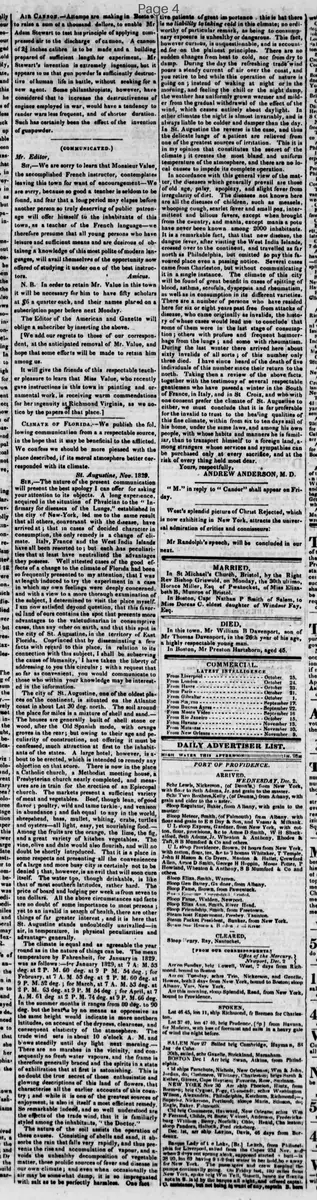
CLIMATE OF FLORIDA.—We publish the following communication from a respectable source, in the hope that it may be beneficial to the afflicted. We confess we should be more pleased with the place described, if its moral atmosphere better corresponded with its climate.
St. Augustine, Nov. 1829.
SIR,—The nature of the present communication will present the best apology I can offer for asking your attention to its objects. A long experience, acquired in the situation of Physician to the "Infirmary for diseases of the Lung," established in the city of New-York, led me to the same result that all others, conversant with the disease, have arrived at; that in cases of decided character in consumption, the only remedy is a change of climate. Italy, France and the West India Islands have all been resorted to; but each has peculiarities that at least have neutralized the advantages they possess. Well attested cases of the good effects of a change to the climate of Florida had been so frequently presented to my attention, that I was at length induced to try the experiment in a case in which my own feelings were deeply concerned, and with a view to a more thorough examination of the subject, I determined to visit the place myself. I am now satisfied beyond question, that this favored land of ours contains the spot that presents more advantages to the valetudinarian in consumptive cases, than any other on earth, and that this spot is the city of St. Augustine, in the territory of East Florida. Convinced that by disseminating a few facts with regard to this place, in relation to its connection with this subject, I shall be subserving the cause of humanity, I have taken the liberty of addressing to you this circular; with a request that so far as convenient, you would communicate to those who within your knowledge may be interested in the information.
The city of St. Augustine, one of the oldest places on the continent, is situated on the Atlantic coast in about Lat 30 deg. north. The soil around the place for miles is a mixture of shell and sand.— The houses are generally built of shell stone or wood, after the Old Spanish mode, with orange groves in the rear; but owing to their age and peculiarity of construction, not offering it must be confessed, much attraction at first to the inhabitants of the states. A large hotel, however, is about to be erected, which is intended to remedy any objection on that score. There is now in the place a Catholic church, a Methodist meeting house, a Presbyterian church nearly completed, and measures are in train for the erection of an Episcopal church. The markets present a sufficient variety of meat and vegetables. Beef, though lean, of good flavor ; poultry, wild and tame turkeys, and venison in abundance ; and fish equal to any in the world, sheepshead, bass, mullet, whiting, crabs, turtles and oysters—all light, easy, yet nourishing food.— Among the fruits are the orange, the lime, the fig, and a great variety of kitchen vegetables. The vine, olive and date would also flourish, and will no doubt be shortly introduced. That it is a place in some respects not presenting all the conveniences of a large and more busy city is certainly not to be denied ; that, however, is an evil that will soon cure itself. The water too, though drinkable, is like that of most southern latitudes, rather hard. The price of board and lodging per week is from seven to ten dollars. All the above circumstances and facts are no doubt of some importance to most persons ; yet to an invalid in search of health, there are other things of far greater interest , and it is here that St. Augustine stands undoubtedly unrivalled—in air, in temperature, in physical peculiarities and advantage—generally.
The climate is equal and as agreeable the year round as in the nature of things can be. The mean temperature by Fahrenheit, for January in 1829. was as follows: for January 1829, at 7 A. M. 53 deg. at 2 P. M. 60 deg. at 9 P. M. 54 deg.; for February, at 7 A. M. 53 deg. at 2 P. M. 60 deg. at 9 P. M. 52 deg. ; for March, at 7 A. M. 53 deg. at 2 P. M. 63 deg. at 9 P. M 54 deg ; for April, at 7 A. M. 61 deg at 2 P. M. 74 deg. at 9 P. M. 66 deg. In the summer months it ranges from 80 deg. to 90 deg. but the heat is by no means as oppressive as the same height would indicate in more northern latitudes, on account of the dryness, clearness, and consequent elasticity of the atmosphere. The trade wind sets in about 10 o'clock A. M. and blows steadily until day light next morning.— There are no marshes in the vicinity, and consequently no fresh water vapours, and the frame is therefore generally braced and the spirits in a state of exhilaration that at first is astonishing. This is no doubt the true secret of those enthusiastic and glowing descriptions of this land of flowers, that characterize all the earlier accounts of this country ; and while it is one of the greatest sources of enjoyment, is also in itself a most efficient remedy. So remarkable indeed, and so well understood are the effects of the trade wind, that it is familiarly styled among the inhabitants, " the Doctor."
The nature of the soil assists the operation of these causes. Consisting of shells and sand, it absorbs the rain that falls very rapidly, and thus prevents the rise and accumulation of vapour, and avoids the unhealthy decomposition of vegetable matter, those prolific sources of fever and disease in our own climate; and even when occasionally the air may be somewhat damp, it is so impregnated with salt as to be perfectly harmless. One fact of great importance to consumptive patients . this is that there in no liability to taking cold in this climate; no ordinary exposure is unhealthy or dangerous. This fact, however curious, is unquestionable, and is accounted for on the plainest principles. There are no sudden changes from heat to cold, nor from dry to damp. During the day the refreshing trade wind pours a steady current of air over the coast, and you retire to bed while this operation of nature is going on ; instead of waking at night or in the morning, and feeling the chill or the night damp, the weather has uniformly grown warmer and milder from the gradual withdrawal of the effect of the wind, which ceases entirely about daylight. In other climates the night is almost invariably, and is always liable to be colder and damper than the day. In St. Augustine the reverse is the case, and thus the delicate lungs of a patient are relieved from one of the greatest sources of irritation. 'This it is in my opinion that constitutes the secret of the climate; it creates the most bland and uniform temperature of the atmosphere, and there are no local causes to impede its complete operation.
In accordance with this general view of the matter, the diseases which generally prevail are those of old age, palsy. apoplexy, and slight fever from irregularity of diet. The diseases not known here are all the diseases of children, such as measles, whooping cough, scarlet fever and small pox, intermittent and bilious fevers, except when brought from the country, and mania, except mania a potu have never been known among 2000 inhabitants. It is a remarkable fact, that that new disease, the dengue fever, after visiting the West India Islands, crossed over to the continent, and travelled as far north as Philadelphia, but omitted to pay this favored place even a passing notice. Several cases came from Charleston, but without communicating it in a single instance. The climate of this city will be found of great benefit in cases of spitting of blood, asthma, scrofula, dyspepsia and rheumatism, as well as in consumption in its different varieties. There are a number of persons who have resided here for six or eight years past free from attacks of disease, who came originally as invalids, the history of whose cases would lead me to conclude' that some of them were in the last stage of consumption; others with profuse and frequent haemorrhage from the lungs; and some with rheumatism. During the last winter there arrived here about sixty invalids of all sorts; of this number only three died. I have since heard of the death of five individuals of this number since their return to the north. Taking then a review of the above facts. together with the testimony of several respectable gentlemen who have passed a winter in the South of France, in Italy, and in St Croix, and who with one consent prefer the climate of St. Augustine to either, we must conclude that it is far preferable for the invalid to trust to the healing qualities of this fine climate, within from six to ten days sail of his home, under the same laws, and among his own people, with whose habits and manners he is familiar, than to transport himself to a foreign land, among strangers whose services and sympathies can be purchased only at every sacrifice, and at the risk of every thing held most dear.
Yours, respectfully,
ANDREW ANDERSON, M. D.
St. Augustine, Nov. 1829.
SIR,—The nature of the present communication will present the best apology I can offer for asking your attention to its objects. A long experience, acquired in the situation of Physician to the "Infirmary for diseases of the Lung," established in the city of New-York, led me to the same result that all others, conversant with the disease, have arrived at; that in cases of decided character in consumption, the only remedy is a change of climate. Italy, France and the West India Islands have all been resorted to; but each has peculiarities that at least have neutralized the advantages they possess. Well attested cases of the good effects of a change to the climate of Florida had been so frequently presented to my attention, that I was at length induced to try the experiment in a case in which my own feelings were deeply concerned, and with a view to a more thorough examination of the subject, I determined to visit the place myself. I am now satisfied beyond question, that this favored land of ours contains the spot that presents more advantages to the valetudinarian in consumptive cases, than any other on earth, and that this spot is the city of St. Augustine, in the territory of East Florida. Convinced that by disseminating a few facts with regard to this place, in relation to its connection with this subject, I shall be subserving the cause of humanity, I have taken the liberty of addressing to you this circular; with a request that so far as convenient, you would communicate to those who within your knowledge may be interested in the information.
The city of St. Augustine, one of the oldest places on the continent, is situated on the Atlantic coast in about Lat 30 deg. north. The soil around the place for miles is a mixture of shell and sand.— The houses are generally built of shell stone or wood, after the Old Spanish mode, with orange groves in the rear; but owing to their age and peculiarity of construction, not offering it must be confessed, much attraction at first to the inhabitants of the states. A large hotel, however, is about to be erected, which is intended to remedy any objection on that score. There is now in the place a Catholic church, a Methodist meeting house, a Presbyterian church nearly completed, and measures are in train for the erection of an Episcopal church. The markets present a sufficient variety of meat and vegetables. Beef, though lean, of good flavor ; poultry, wild and tame turkeys, and venison in abundance ; and fish equal to any in the world, sheepshead, bass, mullet, whiting, crabs, turtles and oysters—all light, easy, yet nourishing food.— Among the fruits are the orange, the lime, the fig, and a great variety of kitchen vegetables. The vine, olive and date would also flourish, and will no doubt be shortly introduced. That it is a place in some respects not presenting all the conveniences of a large and more busy city is certainly not to be denied ; that, however, is an evil that will soon cure itself. The water too, though drinkable, is like that of most southern latitudes, rather hard. The price of board and lodging per week is from seven to ten dollars. All the above circumstances and facts are no doubt of some importance to most persons ; yet to an invalid in search of health, there are other things of far greater interest , and it is here that St. Augustine stands undoubtedly unrivalled—in air, in temperature, in physical peculiarities and advantage—generally.
The climate is equal and as agreeable the year round as in the nature of things can be. The mean temperature by Fahrenheit, for January in 1829. was as follows: for January 1829, at 7 A. M. 53 deg. at 2 P. M. 60 deg. at 9 P. M. 54 deg.; for February, at 7 A. M. 53 deg. at 2 P. M. 60 deg. at 9 P. M. 52 deg. ; for March, at 7 A. M. 53 deg. at 2 P. M. 63 deg. at 9 P. M 54 deg ; for April, at 7 A. M. 61 deg at 2 P. M. 74 deg. at 9 P. M. 66 deg. In the summer months it ranges from 80 deg. to 90 deg. but the heat is by no means as oppressive as the same height would indicate in more northern latitudes, on account of the dryness, clearness, and consequent elasticity of the atmosphere. The trade wind sets in about 10 o'clock A. M. and blows steadily until day light next morning.— There are no marshes in the vicinity, and consequently no fresh water vapours, and the frame is therefore generally braced and the spirits in a state of exhilaration that at first is astonishing. This is no doubt the true secret of those enthusiastic and glowing descriptions of this land of flowers, that characterize all the earlier accounts of this country ; and while it is one of the greatest sources of enjoyment, is also in itself a most efficient remedy. So remarkable indeed, and so well understood are the effects of the trade wind, that it is familiarly styled among the inhabitants, " the Doctor."
The nature of the soil assists the operation of these causes. Consisting of shells and sand, it absorbs the rain that falls very rapidly, and thus prevents the rise and accumulation of vapour, and avoids the unhealthy decomposition of vegetable matter, those prolific sources of fever and disease in our own climate; and even when occasionally the air may be somewhat damp, it is so impregnated with salt as to be perfectly harmless. One fact of great importance to consumptive patients . this is that there in no liability to taking cold in this climate; no ordinary exposure is unhealthy or dangerous. This fact, however curious, is unquestionable, and is accounted for on the plainest principles. There are no sudden changes from heat to cold, nor from dry to damp. During the day the refreshing trade wind pours a steady current of air over the coast, and you retire to bed while this operation of nature is going on ; instead of waking at night or in the morning, and feeling the chill or the night damp, the weather has uniformly grown warmer and milder from the gradual withdrawal of the effect of the wind, which ceases entirely about daylight. In other climates the night is almost invariably, and is always liable to be colder and damper than the day. In St. Augustine the reverse is the case, and thus the delicate lungs of a patient are relieved from one of the greatest sources of irritation. 'This it is in my opinion that constitutes the secret of the climate; it creates the most bland and uniform temperature of the atmosphere, and there are no local causes to impede its complete operation.
In accordance with this general view of the matter, the diseases which generally prevail are those of old age, palsy. apoplexy, and slight fever from irregularity of diet. The diseases not known here are all the diseases of children, such as measles, whooping cough, scarlet fever and small pox, intermittent and bilious fevers, except when brought from the country, and mania, except mania a potu have never been known among 2000 inhabitants. It is a remarkable fact, that that new disease, the dengue fever, after visiting the West India Islands, crossed over to the continent, and travelled as far north as Philadelphia, but omitted to pay this favored place even a passing notice. Several cases came from Charleston, but without communicating it in a single instance. The climate of this city will be found of great benefit in cases of spitting of blood, asthma, scrofula, dyspepsia and rheumatism, as well as in consumption in its different varieties. There are a number of persons who have resided here for six or eight years past free from attacks of disease, who came originally as invalids, the history of whose cases would lead me to conclude' that some of them were in the last stage of consumption; others with profuse and frequent haemorrhage from the lungs; and some with rheumatism. During the last winter there arrived here about sixty invalids of all sorts; of this number only three died. I have since heard of the death of five individuals of this number since their return to the north. Taking then a review of the above facts. together with the testimony of several respectable gentlemen who have passed a winter in the South of France, in Italy, and in St Croix, and who with one consent prefer the climate of St. Augustine to either, we must conclude that it is far preferable for the invalid to trust to the healing qualities of this fine climate, within from six to ten days sail of his home, under the same laws, and among his own people, with whose habits and manners he is familiar, than to transport himself to a foreign land, among strangers whose services and sympathies can be purchased only at every sacrifice, and at the risk of every thing held most dear.
Yours, respectfully,
ANDREW ANDERSON, M. D.
What sub-type of article is it?
Essay
What themes does it cover?
Nature
Seasonal Cycle
What keywords are associated?
Florida Climate
St Augustine
Consumption Remedy
Trade Winds
Health Benefits
What entities or persons were involved?
Andrew Anderson, M. D.
Literary Details
Title
Climate Of Florida
Author
Andrew Anderson, M. D.
Subject
Benefits Of St. Augustine Climate For Consumptive Patients
Form / Style
Prose Letter On Climate And Health
Key Lines
I Am Now Satisfied Beyond Question, That This Favored Land Of Ours Contains The Spot That Presents More Advantages To The Valetudinarian In Consumptive Cases, Than Any Other On Earth, And That This Spot Is The City Of St. Augustine, In The Territory Of East Florida.
The Trade Wind Sets In About 10 O'clock A. M. And Blows Steadily Until Day Light Next Morning.— There Are No Marshes In The Vicinity, And Consequently No Fresh Water Vapours, And The Frame Is Therefore Generally Braced And The Spirits In A State Of Exhilaration That At First Is Astonishing.
So Remarkable Indeed, And So Well Understood Are The Effects Of The Trade Wind, That It Is Familiarly Styled Among The Inhabitants, " The Doctor."
There In No Liability To Taking Cold In This Climate; No Ordinary Exposure Is Unhealthy Or Dangerous.