Thank you for visiting SNEWPapers!
Sign up free
Editorial
September 7, 1843
The Hillsborough Recorder
Hillsboro, Orange County, North Carolina
What is this article about?
Editorial criticizes the Democratic Standard newspaper for misrepresenting George Washington's views on paper money to attack banks, defends Whig positions on banking and decency, and refutes charges of Whig profanity and ignorance.
Clipping
OCR Quality
95%
Excellent
Full Text
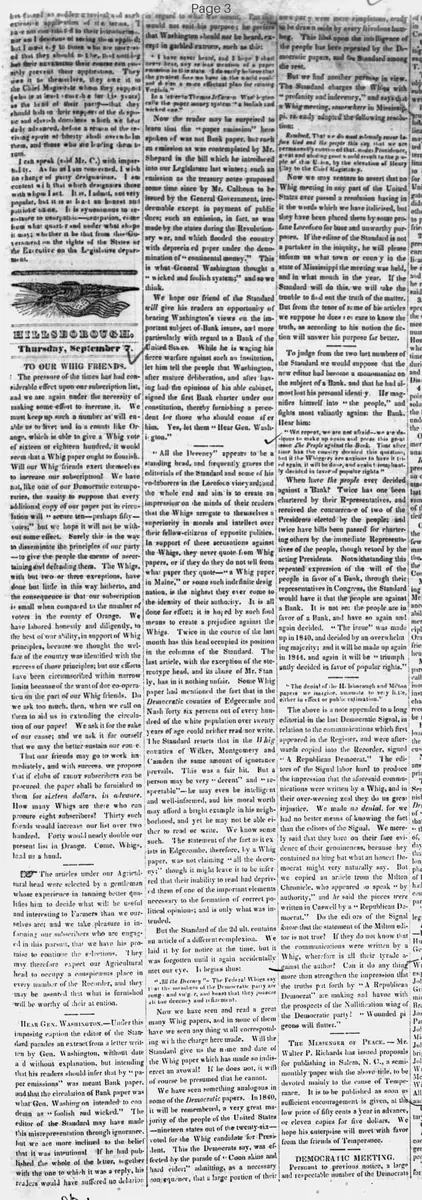
Hear Gen. Washington.—Under this imposing caption the editor of the Standard parades an extract from a letter written by Gen. Washington, without date and without explanation, but intending that his readers should infer that by "paper emissions" was meant Bank paper and that the circulation of Bank paper was what "Gen. Washington intended to condemn as "foolish and wicked." The editor of the Standard may have made this misrepresentation through ignorance, but we are more inclined to the belief that it was intentional. If he had published the whole of the letter, together with the one to which it was a reply, his readers would have suffered no delusion regarding it. It would not suit his purpose; he prefers that Washington should not be heard, except in garbled extracts, such as this:
I have never heard, and I hope I never shall hear, any such incantation of a paper remaining in this state. I do verily believe that the greatest evil we have in the world would not devise a more effectual plan for ruining Virginia.
In a letter from James Madison, Washington calls the paper money system "a foolish and wicked one."
Now the reader may be surprised to learn that the "paper emission" here spoken of was not Bank paper, but such an emission as was contemplated by Mr. Shepard in the bill which he introduced into our Legislature last winter; such an emission as the treasury notes proposed some time since by Mr. Calhoun to be issued by the General Government, irredeemable except in payment of public dues; such an emission, in fact, as was made by the states during the Revolutionary war, and which flooded the country with depreciated paper under the denomination of "continental money." This is what General Washington thought a "wicked and foolish system;" and so we think.
We hope our friend of the Standard will give his readers an opportunity of hearing Washington's views on the important subject of Bank issues, and more particularly with regard to a Bank of the United States. While he is waging his fierce warfare against such an institution, let him tell the people that Washington, after mature deliberation, and after having had the opinions of his able cabinet, signed the first Bank charter under our constitution, thereby furnishing a precedent for those who should come after him. Yes, let them "hear Gen. Washington."
"All the Decency" appears to be a standing head, and frequently graces the editorials of the Standard and some of his co-laborers in the Locofoco vineyard; and the whole end and aim is to create an impression on the minds of their readers that the Whigs arrogate to themselves a superiority in morals and intellect over their fellow-citizens of opposite politics. In support of these accusations against the Whigs, they never quote from Whig papers, or if they do they do not tell from what paper they quote—"a Whig paper in Maine," or some such indefinite designation, is the nearest they ever come to the identity of their authority. It is all done for effect; it is hoped by such foul means to create a prejudice against the Whigs. Twice in the course of the last month has this head occupied its position in the columns of the Standard. The last article, with the exception of the stereotype head, and its abuse of Mr. Stanly, has in it nothing unfair. Some Whig paper had mentioned the fact that in the Democratic counties of Edgecombe and Nash forty six persons out of every hundred of the white population over twenty years of age could neither read nor write. The Standard retorts that in the Whig counties of Wilkes, Montgomery and Camden the same amount of ignorance prevails. This was a fair hit. But a person may be very "decent" and "respectable"—he may even be intelligent and well-informed, and his moral worth may afford a bright example in his neighborhood, and yet he may not be able either to read or write. We know some such. The statement of the fact as it exists in Edgecombe, therefore, by a Whig paper, was not claiming "all the decency;" though it might leave it to be inferred that their inability to read had deprived them of one of the important elements necessary to the formation of correct political opinions; and is only what was intended.
But the Standard of the 2d ult. contains an article of a different complexion. We laid it by for notice at the time, but it was forgotten until it again accidentally met our eye. It begins thus:
"All the Decency"—The Federal Whigs say that the members of the Democratic party are rough and vulgar, and boast that they possess all the decency and respectability.
Now we have seen and read a great many Whig papers, and in none of them have we seen anything at all corresponding with the charge here made. Will the Standard give us the name and date of the Whig paper which has made so indiscreet an avowal? If he does not, it will of course be presumed that he cannot.
We have seen something analogous in some of the Democratic papers. In 1840, it will be remembered, a very great majority of the people of the United States—nineteen states out of the twenty-six—voted for the Whig candidate for President. This the Democrats say, was effected by the parade of "Coon skins and hard cider;" admitting, as a necessary consequence, that a large portion of their own supporters must have been drawn wide by every frivolous humbug. This libel upon the intelligence of the people has been repeated by the Democratic papers, and the Standard among the rest.
But we had another purpose in view. The Standard charges the Whigs with "profanity and indecency," and says that a Whig meeting, somewhere in Mississippi, recently adopted the following resolution:
Resolved, That we do most assuredly swear before God and the people this day that we are permanently convinced that, under Providence, great and abiding good will result to the people of this Union, by the elevation of Henry Clay to the Chief Magistracy.
Now we may venture to assert that no Whig meeting in any part of the United States ever passed a resolution having in it the words which we have italicised, but they have been placed there by some profligate Locofoco for base and unworthy purposes. If the editor of the Standard is not a partaker in the iniquity, he will please inform us what town or county in the state of Mississippi the meeting was held, and in what month in the year. If the Standard will do this, we will take the trouble to find out the truth of the matter. But from the tenor of some of his articles we suppose he does not care to know the truth, as according to his notion the fiction will answer his purpose far better.
To judge from the two last numbers of the Standard we would suppose that the new editor had become a monomaniac on the subject of a Bank, and that he had almost lost his personal identity. He magnifies himself into "the people," and fights most valiantly against the Bank. Hear him:
"We repeat, we are not afraid—we are desirous to make up again and press this great question The People against the Bank. Time after time has the country decided this question; but if the Whiggery are anxious to have it tried again, it will be done, and again triumphantly decided in favor of popular rights."
When have the people ever decided against a Bank? Twice has one been chartered by their Representatives, and received the concurrence of two of the Presidents elected by the people; and twice have bills been passed for chartering others by the immediate Representatives of the people, though vetoed by the acting Presidents. Notwithstanding this repeated expression of the will of the people in favor of a Bank, through their representatives in Congress, the Standard would have it that the people are against a Bank. It is not so: the people are in favor of a Bank, and have so again and again decided. "The issue" was made up in 1840, and decided by an overwhelming majority; and it will be made up again in 1844, and again it will be "triumphantly decided in favor of popular rights."
"The denial of the Hillsborough and Milton papers we imagine, amounts to very little, either in effect or public estimation."
The above is a note appended to a long editorial in the last Democratic Signal, in relation to the communications which first appeared in the Register, and were afterwards copied into the Recorder, signed "A Republican Democrat." The editors of the Signal labor hard to produce the impression that the aforesaid communications were written by a Whig, and in their over-weening zeal they do us great injustice. We make no denial, for we had no better means of knowing the fact than the editors of the Signal. We merely said that they bore on their face evidence of their genuineness, because they contained nothing but what an honest Democrat might very naturally say. But we copied an article from the Milton Chronicle, who appeared to speak "by authority," and he said the pieces were written in Caswell by a "Republican Democrat." Do the editors of the Signal know that the statement of the Milton editor is not true? If they do not know that the communications were written by a Whig, wherefore is all their tirade against the author? Can it do anything more than strengthen the impression that the truths put forth by "A Republican Democrat" are making sad havoc with the prospects of the Nullification wing of the Democratic party? "Wounded pigeons will flutter."
I have never heard, and I hope I never shall hear, any such incantation of a paper remaining in this state. I do verily believe that the greatest evil we have in the world would not devise a more effectual plan for ruining Virginia.
In a letter from James Madison, Washington calls the paper money system "a foolish and wicked one."
Now the reader may be surprised to learn that the "paper emission" here spoken of was not Bank paper, but such an emission as was contemplated by Mr. Shepard in the bill which he introduced into our Legislature last winter; such an emission as the treasury notes proposed some time since by Mr. Calhoun to be issued by the General Government, irredeemable except in payment of public dues; such an emission, in fact, as was made by the states during the Revolutionary war, and which flooded the country with depreciated paper under the denomination of "continental money." This is what General Washington thought a "wicked and foolish system;" and so we think.
We hope our friend of the Standard will give his readers an opportunity of hearing Washington's views on the important subject of Bank issues, and more particularly with regard to a Bank of the United States. While he is waging his fierce warfare against such an institution, let him tell the people that Washington, after mature deliberation, and after having had the opinions of his able cabinet, signed the first Bank charter under our constitution, thereby furnishing a precedent for those who should come after him. Yes, let them "hear Gen. Washington."
"All the Decency" appears to be a standing head, and frequently graces the editorials of the Standard and some of his co-laborers in the Locofoco vineyard; and the whole end and aim is to create an impression on the minds of their readers that the Whigs arrogate to themselves a superiority in morals and intellect over their fellow-citizens of opposite politics. In support of these accusations against the Whigs, they never quote from Whig papers, or if they do they do not tell from what paper they quote—"a Whig paper in Maine," or some such indefinite designation, is the nearest they ever come to the identity of their authority. It is all done for effect; it is hoped by such foul means to create a prejudice against the Whigs. Twice in the course of the last month has this head occupied its position in the columns of the Standard. The last article, with the exception of the stereotype head, and its abuse of Mr. Stanly, has in it nothing unfair. Some Whig paper had mentioned the fact that in the Democratic counties of Edgecombe and Nash forty six persons out of every hundred of the white population over twenty years of age could neither read nor write. The Standard retorts that in the Whig counties of Wilkes, Montgomery and Camden the same amount of ignorance prevails. This was a fair hit. But a person may be very "decent" and "respectable"—he may even be intelligent and well-informed, and his moral worth may afford a bright example in his neighborhood, and yet he may not be able either to read or write. We know some such. The statement of the fact as it exists in Edgecombe, therefore, by a Whig paper, was not claiming "all the decency;" though it might leave it to be inferred that their inability to read had deprived them of one of the important elements necessary to the formation of correct political opinions; and is only what was intended.
But the Standard of the 2d ult. contains an article of a different complexion. We laid it by for notice at the time, but it was forgotten until it again accidentally met our eye. It begins thus:
"All the Decency"—The Federal Whigs say that the members of the Democratic party are rough and vulgar, and boast that they possess all the decency and respectability.
Now we have seen and read a great many Whig papers, and in none of them have we seen anything at all corresponding with the charge here made. Will the Standard give us the name and date of the Whig paper which has made so indiscreet an avowal? If he does not, it will of course be presumed that he cannot.
We have seen something analogous in some of the Democratic papers. In 1840, it will be remembered, a very great majority of the people of the United States—nineteen states out of the twenty-six—voted for the Whig candidate for President. This the Democrats say, was effected by the parade of "Coon skins and hard cider;" admitting, as a necessary consequence, that a large portion of their own supporters must have been drawn wide by every frivolous humbug. This libel upon the intelligence of the people has been repeated by the Democratic papers, and the Standard among the rest.
But we had another purpose in view. The Standard charges the Whigs with "profanity and indecency," and says that a Whig meeting, somewhere in Mississippi, recently adopted the following resolution:
Resolved, That we do most assuredly swear before God and the people this day that we are permanently convinced that, under Providence, great and abiding good will result to the people of this Union, by the elevation of Henry Clay to the Chief Magistracy.
Now we may venture to assert that no Whig meeting in any part of the United States ever passed a resolution having in it the words which we have italicised, but they have been placed there by some profligate Locofoco for base and unworthy purposes. If the editor of the Standard is not a partaker in the iniquity, he will please inform us what town or county in the state of Mississippi the meeting was held, and in what month in the year. If the Standard will do this, we will take the trouble to find out the truth of the matter. But from the tenor of some of his articles we suppose he does not care to know the truth, as according to his notion the fiction will answer his purpose far better.
To judge from the two last numbers of the Standard we would suppose that the new editor had become a monomaniac on the subject of a Bank, and that he had almost lost his personal identity. He magnifies himself into "the people," and fights most valiantly against the Bank. Hear him:
"We repeat, we are not afraid—we are desirous to make up again and press this great question The People against the Bank. Time after time has the country decided this question; but if the Whiggery are anxious to have it tried again, it will be done, and again triumphantly decided in favor of popular rights."
When have the people ever decided against a Bank? Twice has one been chartered by their Representatives, and received the concurrence of two of the Presidents elected by the people; and twice have bills been passed for chartering others by the immediate Representatives of the people, though vetoed by the acting Presidents. Notwithstanding this repeated expression of the will of the people in favor of a Bank, through their representatives in Congress, the Standard would have it that the people are against a Bank. It is not so: the people are in favor of a Bank, and have so again and again decided. "The issue" was made up in 1840, and decided by an overwhelming majority; and it will be made up again in 1844, and again it will be "triumphantly decided in favor of popular rights."
"The denial of the Hillsborough and Milton papers we imagine, amounts to very little, either in effect or public estimation."
The above is a note appended to a long editorial in the last Democratic Signal, in relation to the communications which first appeared in the Register, and were afterwards copied into the Recorder, signed "A Republican Democrat." The editors of the Signal labor hard to produce the impression that the aforesaid communications were written by a Whig, and in their over-weening zeal they do us great injustice. We make no denial, for we had no better means of knowing the fact than the editors of the Signal. We merely said that they bore on their face evidence of their genuineness, because they contained nothing but what an honest Democrat might very naturally say. But we copied an article from the Milton Chronicle, who appeared to speak "by authority," and he said the pieces were written in Caswell by a "Republican Democrat." Do the editors of the Signal know that the statement of the Milton editor is not true? If they do not know that the communications were written by a Whig, wherefore is all their tirade against the author? Can it do anything more than strengthen the impression that the truths put forth by "A Republican Democrat" are making sad havoc with the prospects of the Nullification wing of the Democratic party? "Wounded pigeons will flutter."
What sub-type of article is it?
Partisan Politics
Economic Policy
What keywords are associated?
Washington Letter
Paper Money
Bank Of The United States
Whig Defense
Democratic Standard
Partisan Misrepresentation
Locofoco Attacks
Henry Clay
What entities or persons were involved?
Gen. Washington
James Madison
Mr. Shepard
Mr. Calhoun
Henry Clay
Mr. Stanly
Standard Editor
Whigs
Democrats
Locofocos
Editorial Details
Primary Topic
Criticism Of Standard Newspaper's Misrepresentations On Washington, Banking, And Whig Decency
Stance / Tone
Pro Whig Defense Against Democratic Attacks
Key Figures
Gen. Washington
James Madison
Mr. Shepard
Mr. Calhoun
Henry Clay
Mr. Stanly
Standard Editor
Whigs
Democrats
Locofocos
Key Arguments
Washington's Condemnation Of Paper Emissions Referred To Irredeemable State Issued Currency, Not Bank Paper
Washington Signed The First Bank Of The United States Charter
Standard Misquotes Whig Papers To Claim Whigs Arrogate All Decency
No Whig Paper Boasts Of Possessing All Decency And Respectability
Whig Meetings Did Not Pass Resolutions With Profane Language
People Have Repeatedly Supported Banks Through Congress And Elections
Communications By 'A Republican Democrat' Are Genuine And Damaging To Nullification Democrats