Thank you for visiting SNEWPapers!
Sign up free
Story
March 25, 1797
The New Hampshire Gazette
Portsmouth, Rockingham County, New Hampshire
What is this article about?
A newcomer to London is baffled by men wearing short-tailed coats called Spencers. A friend explains it originated from a bet by Lord C. Spencer to popularize the most ridiculous fashion imaginable, which succeeded due to societal obsequiousness to trends.
Clipping
OCR Quality
95%
Excellent
Full Text
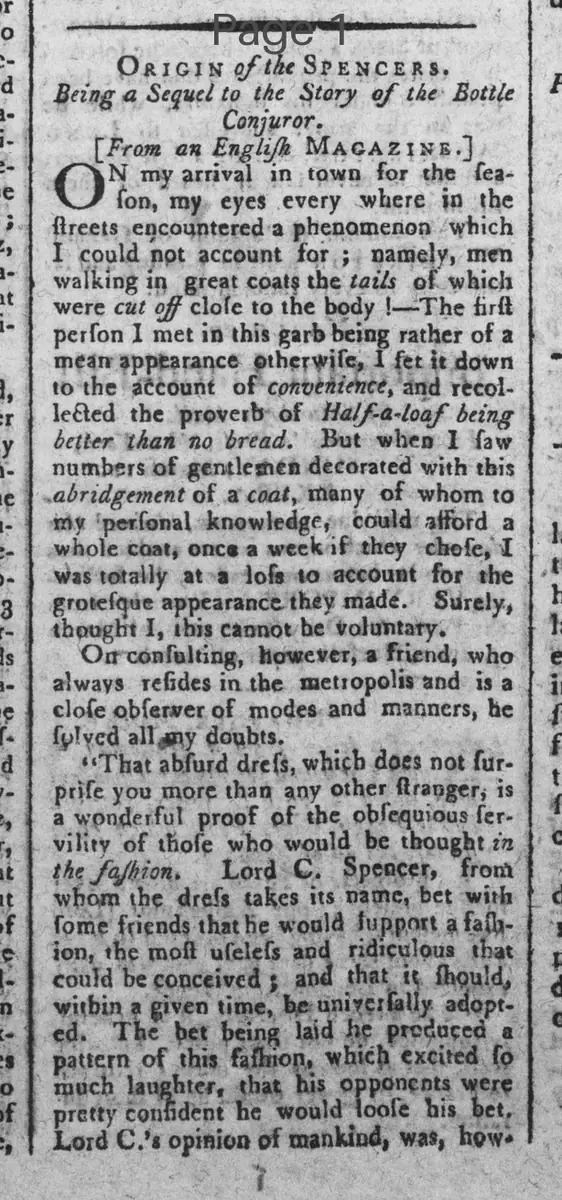
Origin of the Spencers.
Being a Sequel to the Story of the Bottle Conjuror.
[From an English Magazine.]
On my arrival in town for the season, my eyes every where in the streets encountered a phenomenon which I could not account for; namely, men walking in great coats the tails of which were cut off close to the body! The first person I met in this garb being rather of a mean appearance otherwise, I set it down to the account of convenience, and recollected the proverb of Half-a-loaf being better than no bread. But when I saw numbers of gentlemen decorated with this abridgement of a coat, many of whom to my personal knowledge, could afford a whole coat, once a week if they chose, I was totally at a loss to account for the grotesque appearance they made. Surely, thought I, this cannot be voluntary.
On consulting, however, a friend, who always resides in the metropolis and is a close observer of modes and manners, he solved all my doubts.
"That absurd dress, which does not surprise you more than any other stranger, is a wonderful proof of the obsequious servility of those who would be thought in the fashion. Lord C. Spencer, from whom the dress takes its name, bet with some friends that he would support a fashion, the most useless and ridiculous that could be conceived; and that it should, within a given time, be universally adopted. The bet being laid he produced a pattern of this fashion, which excited so much laughter, that his opponents were pretty confident he would lose his bet. Lord C.'s opinion of mankind, was, however, better founded.
Being a Sequel to the Story of the Bottle Conjuror.
[From an English Magazine.]
On my arrival in town for the season, my eyes every where in the streets encountered a phenomenon which I could not account for; namely, men walking in great coats the tails of which were cut off close to the body! The first person I met in this garb being rather of a mean appearance otherwise, I set it down to the account of convenience, and recollected the proverb of Half-a-loaf being better than no bread. But when I saw numbers of gentlemen decorated with this abridgement of a coat, many of whom to my personal knowledge, could afford a whole coat, once a week if they chose, I was totally at a loss to account for the grotesque appearance they made. Surely, thought I, this cannot be voluntary.
On consulting, however, a friend, who always resides in the metropolis and is a close observer of modes and manners, he solved all my doubts.
"That absurd dress, which does not surprise you more than any other stranger, is a wonderful proof of the obsequious servility of those who would be thought in the fashion. Lord C. Spencer, from whom the dress takes its name, bet with some friends that he would support a fashion, the most useless and ridiculous that could be conceived; and that it should, within a given time, be universally adopted. The bet being laid he produced a pattern of this fashion, which excited so much laughter, that his opponents were pretty confident he would lose his bet. Lord C.'s opinion of mankind, was, however, better founded.
What sub-type of article is it?
Curiosity
Historical Event
What themes does it cover?
Social Manners
Deception
What keywords are associated?
Spencer Coat
Fashion Bet
Lord Spencer
Ridiculous Fashion
Social Servility
What entities or persons were involved?
Lord C. Spencer
Where did it happen?
Town (Metropolis)
Story Details
Key Persons
Lord C. Spencer
Location
Town (Metropolis)
Story Details
Lord C. Spencer bet friends he could make a ridiculous short-tailed coat fashion universally adopted within a given time; it succeeded, proving societal servility to fashion.