Thank you for visiting SNEWPapers!
Sign up free
The Fitzgerald Leader Enterprise And Press
Fitzgerald, Ben Hill County, Georgia
What is this article about?
At the Tifton Experimental Station in Georgia, various methods to control boll weevils in cotton are being tested, including poisons and the Florida method. As of July 10, 1923, poisoned areas show fewer weevils and more bolls than unpoisoned ones, with homemade syrup poison proving effective and cheap.
Clipping
OCR Quality
Full Text
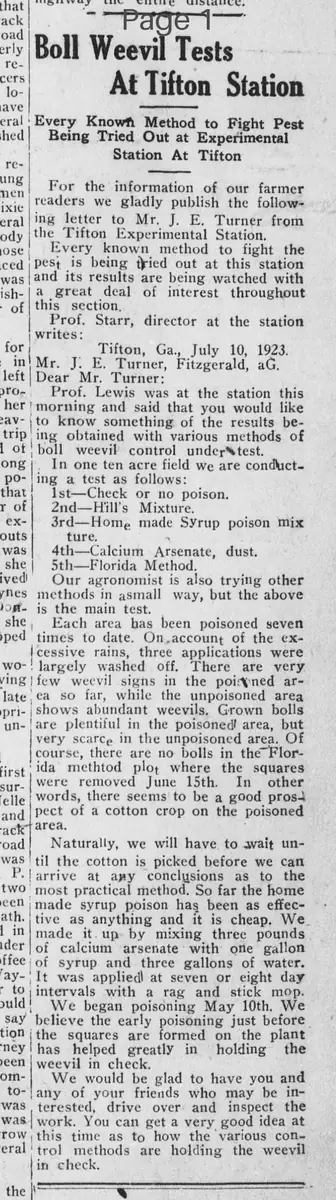
At Tifton Station
Every Known Method to Fight Pest Being Tried Out at Experimental Station At Tifton
For the information of our farmer readers we gladly publish the following letter to Mr. J. E. Turner from the Tifton Experimental Station.
Every known method to fight the pest is being tried out at this station and its results are being watched with a great deal of interest throughout this section
Prof. Starr, director at the station writes:
Tifton, Ga., July 10, 1923.
Mr. J. E. Turner, Fitzgerald, Ga.
Dear Mr. Turner:
Prof. Lewis was at the station this morning and said that you would like to know something of the results being obtained with various methods of boll weevil control under test.
In one ten acre field we are conducting a test as follows:
1st—Check or no poison
2nd—Hill’s Mixture.
3rd—Home made Syrup poison mixture,
4th—Calcium Arsenate, dust.
5th—Florida Method
Our agronomist is also trying other methods in a small way, but the above is the main test.
Each area has been poisoned seven times to date. On account of the excessive rains, three applications were largely washed off. There are very few weevil signs in the poisoned area so far, while the unpoisoned area shows abundant weevils. Grown bolls are plentiful in the poisoned area, but very scarce in the unpoisoned area. Of course, there are no bolls in the Florida method plot where the squares were removed June 15th. In other words, there seems to be a good prospect of a cotton crop on the poisoned area.
Naturally, we will have to wait until the cotton is picked before we can arrive at any conclusions as to the most practical method. So far the home made syrup poison has been as effective as anything and it is cheap. We made it up by mixing three pounds of calcium arsenate with one gallon of syrup and three gallons of water.
It was applied at seven or eight day intervals with a rag and stick mop.
We began poisoning May 10th. We believe the early poisoning just before the squares are formed on the plant has helped greatly in holding the weevil in check.
We would be glad to have you and any of your friends who may be interested, drive over and inspect the work. You can get a very good idea at this time as to how the various control methods are holding the weevil in check.
What sub-type of article is it?
What keywords are associated?
What entities or persons were involved?
Where did it happen?
Domestic News Details
Primary Location
Tifton, Ga.
Event Date
July 10, 1923
Key Persons
Outcome
poisoned areas show very few weevil signs and plentiful grown bolls, indicating good prospect of cotton crop; unpoisoned area has abundant weevils and scarce bolls; no bolls in florida method plot; home made syrup poison effective and cheap; final conclusions pending cotton picking.
Event Details
Tests of boll weevil control methods in a ten-acre cotton field at Tifton Experimental Station, including check (no poison), Hill’s Mixture, home made syrup poison, calcium arsenate dust, and Florida Method (squares removed June 15th). Poisoning began May 10th, applied seven times at seven or eight day intervals; three applications washed off by rains. Other methods tried on smaller scale.