Thank you for visiting SNEWPapers!
Sign up free
Virginia Free Press & Farmers' Repository
Charles Town, Jefferson County, West Virginia
What is this article about?
Historical anecdotes from Napoleon's recollections praising the bravery and honor of Polish soldiers, including incidents involving Solkowski's sacrifice in Egypt and Miaczencki's suicide, as recorded in O'Meara and Bourrienne's works.
Clipping
OCR Quality
Full Text
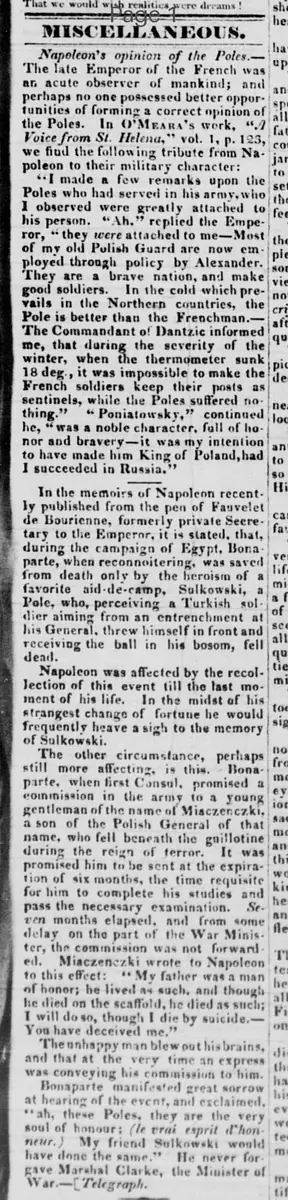
Napoleon's opinion of the Poles.—
The late Emperor of the French was
an acute observer of mankind; and
perhaps no one possessed better oppor-
tunities of forming a correct opinion of
the Poles. In O'Meara's work, "A
Voice from St. Helena," vol. 1, p. 123,
we find the following tribute from Na-
poleon to their military character:
"I made a few remarks upon the
Poles who had served in his army, who
I observed were greatly attached to
his person. "Ah," replied the Empe-
ror, "they were attached to me—Most
of my old Polish Guard are now em-
ployed through policy by Alexander.
They are a brave nation, and make
good soldiers. In the cold which pre-
vails in the Northern countries, the
Pole is better than the Frenchman.—
The Commandant of Dantzic informed
me, that during the severity of the
winter, when the thermometer sunk
18 deg., it was impossible to make the
French soldiers keep their posts as
sentinels, while the Poles suffered no-
thing."
"Poniatowsky," continued
he, "was a noble character, full of ho-
nor and bravery—it was my intention
to have made him King of Poland, had
I succeeded in Russia."
In the memoirs of Napoleon recent-
ly published from the pen of Fayvel de
Bourienne, formerly private Secre-
tary to the Emperor, it is stated, that,
during the campaign of Egypt, Bona-
parte, when reconnoitering, was saved
from death only by the heroism of a
favorite aid-de-camp, Solkowski, a
Pole, who, perceiving a Turkish sol-
dier aiming from an entrenchment at
his General, threw himself in front and
receiving the ball in his bosom, fell
dead.
Napoleon was affected by the recol-
lection of this event till the last mo-
ment of his life. In the midst of his
strangest change of fortune he would
frequently heave a sigh to the memory
of Sulkowski.
The other circumstance, perhaps
still more affecting, is this. Bona-
parte, when First Consul, promised a
commission in the army to a young
gentleman of the name of Miaczenczki,
a son of the Polish General of that
name, who fell beneath the guillotine
during the reign of terror. It was
promised him to be sent at the expira-
tion of six months, the time requisite
for him to complete his studies and
pass the necessary examination. Se-
ven months elapsed, and from some
delay on the part of the War Minis-
ter, the commission was not forward-
ed. Miaczenczki wrote to Napoleon
to this effect: "My father was a man
of honor; he lived as such, and though
he died on the scaffold, he died as such;
I will do so, though I die by suicide.—
You have deceived me."
The unhappy man blew out his brains,
and that at the very time an express
was conveying his commission to him.
Bonaparte manifested great sorrow
at hearing of the event, and exclaimed,
"Ah, these Poles, they are the very
soul of honour: (le vrai esprit d'hon-
neur.) My friend Solkowski would
have done the same." He never for-
gave Marshal Clarke, the Minister of
War.
What sub-type of article is it?
What keywords are associated?
What entities or persons were involved?
Where did it happen?
Foreign News Details
Primary Location
Poland
Key Persons
Outcome
solkowski killed by turkish soldier; miaczenczki suicide by gunshot; napoleon's intended appointment of poniatowsky as king of poland unrealized.
Event Details
Napoleon praises Polish soldiers' bravery and attachment, especially in cold weather during campaigns; recounts Solkowski's heroic death saving him in Egypt; describes Miaczencki's suicide due to delayed commission, highlighting Polish honor; expresses intention to make Poniatowsky King of Poland if successful in Russia.