Thank you for visiting SNEWPapers!
Sign up free
The Republic
Washington, District Of Columbia
What is this article about?
The St. Louis Daily Democrat criticizes Judge Douglas's tonnage duties plan as unconstitutional and of nullification origin, predicting it would lead to internal taxation, forts, and commercial oppression among states. It warns of its role in segregating states, with Douglas as champion post-Calhoun and Rhett, backed by Atchison. The paper, aligned with Colonel Benton, opposes it on principles.
Clipping
OCR Quality
Full Text
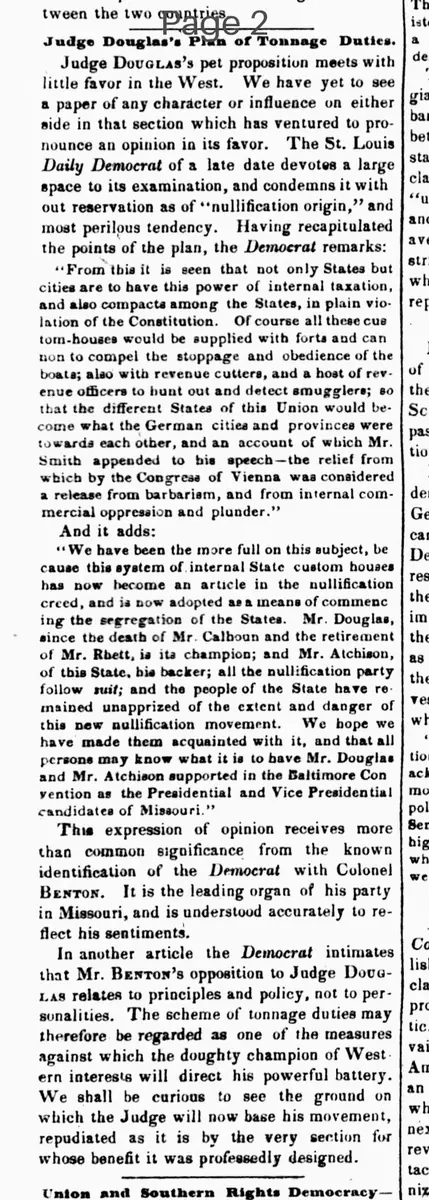
Judge Douglas's pet proposition meets with little favor in the West. We have yet to see a paper of any character or influence on either side in that section which has ventured to pronounce an opinion in its favor. The St. Louis Daily Democrat of a late date devotes a large space to its examination, and condemns it without reservation as of "nullification origin." and most perilous tendency. Having recapitulated the points of the plan, the Democrat remarks:
"From this it is seen that not only States but cities are to have this power of internal taxation, and also compacts among the States, in plain violation of the Constitution. Of course all these custom-houses would be supplied with forts and cannon to compel the stoppage and obedience of the boats: also with revenue cutters, and a host of revenue officers to hunt out and detect smugglers; so that the different States of this Union would become what the German cities and provinces were towards each other, and an account of which Mr. Smith appended to his speech-the relief from which by the Congress of Vienna was considered a release from barbarism, and from internal commercial oppression and plunder."
And it adds:
"We have been the more full on this subject, because this system of internal State custom houses has now become an article in the nullification creed, and is now adopted as a means of commencing the segregation of the States. Mr. Douglas, since the death of Mr. Calhoun and the retirement of Mr. Rhett, is its champion; and Mr. Atchison, of this State, his backer; all the nullification party follow suit: and the people of the State have remained unapprized of the extent and danger of this new nullification movement. We hope we have made them acquainted with it, and that all persons may know what it is to have Mr. Douglas and Mr. Atchison supported in the Baltimore Convention as the Presidential and Vice Presidential candidates of Missouri."
The expression of opinion receives more than common significance from the known identification of the Democrat with Colonel Benton. It is the leading organ of his party in Missouri, and is understood accurately to reflect his sentiments.
In another article the Democrat intimates that Mr. Benton's opposition to Judge Douglas relates to principles and policy, not to personalities. The scheme of tonnage duties may therefore be regarded as one of the measures against which the doughty champion of Western interests will direct his powerful battery.
We shall be curious to see the ground on which the Judge will now base his movement, repudiated as it is by the very section for whose benefit it was professedly designed.
What sub-type of article is it?
What themes does it cover?
What keywords are associated?
What entities or persons were involved?
Where did it happen?
Story Details
Key Persons
Location
The West, St. Louis, Missouri
Story Details
Judge Douglas's tonnage duties plan faces strong opposition in the West, condemned by the St. Louis Daily Democrat as unconstitutional nullification scheme leading to internal taxation, forts, and state segregation; linked to Douglas as champion with Atchison's support, opposed by Benton on principles.