Thank you for visiting SNEWPapers!
Sign up free
Letter to Editor
September 3, 1828
Constitutional Whig
Richmond, Virginia
What is this article about?
A letter to the editors questions General Jackson's innocence in Aaron Burr's 1806 conspiracy, citing historical facts from General Adair's defense and Burr's visit to Nashville, urging the public to judge based on emerging evidence.
Clipping
OCR Quality
95%
Excellent
Full Text
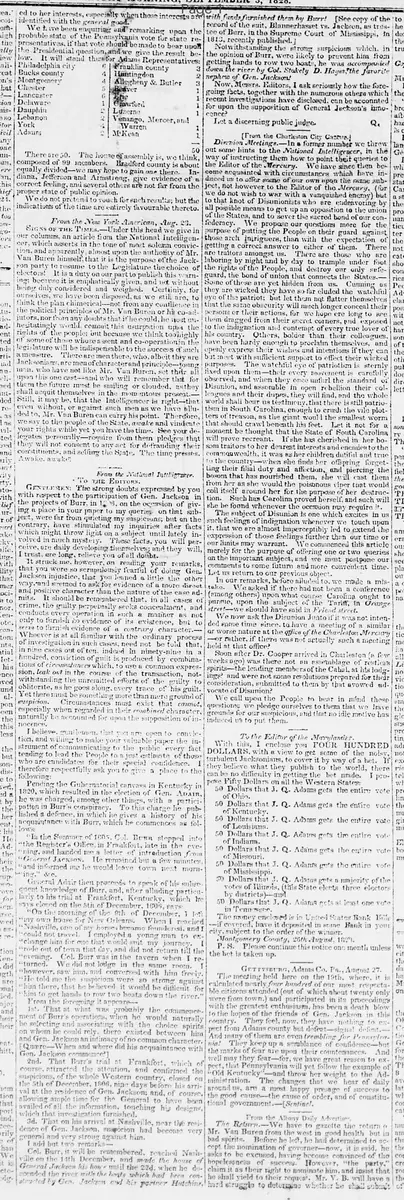
From the National Intelligencer.
TO THE EDITORS.
Gentlemen: The strong doubts expressed by you with respect to the participation of Gen. Jackson in the projects of Burr, in 1806, on the occasion of giving a place in your paper to my queries on that subject, were far from quieting my suspicions; but on the contrary, have stimulated my inquiries after facts which might throw light on a subject until lately involved in much mystery. These facts, you will perceive, are daily developing themselves; and they will, I trust, ere long, relieve you of all doubt.
It struck me, however, on reading your remarks, that you were so scrupulously fearful of doing Gen. Jackson injustice, that you leaned a little the other way, and seemed to ask for evidence of a more direct and positive character than the nature of the case admits. It should be remembered that, in all cases of crime, the guilty perpetually seeks concealment, and conducts every operation in such a manner as not only to furnish no evidence of its existence, but to seem to furnish evidence of a contrary character. Whoever is at all familiar with the ordinary process of investigation in such cases, need not be told that, in nine cases out of ten, indeed in ninety-nine in a hundred, conviction of guilt is produced by combinations of circumstances which, to use a common expression, leak out in the course of the transaction, notwithstanding the unremitted efforts of the guilty to obliterate, as he goes along, every trace of his guilt. Yet there must be something more than mere ground of suspicion. Circumstances must exist that cannot, especially when regarded in their combined character, naturally be accounted for upon the supposition of innocence.
I believe, gentlemen, that you are open to conviction, and willing to make your valuable paper the instrument of communicating to the public every fact tending to lead the People to a just estimate of those who are candidates for their special confidence. I therefore respectfully ask you to give a place to the following:
Pending the Gubernatorial canvass in Kentucky in 1820, which resulted in the election of Gen. Adair, he was charged, among other things, with a participation in Burr's conspiracy. To this charge he published a defence, in which he gives a history of his acquaintance with Burr, which he commences as follows:
"In the Summer of 1805, Col. Burr stopped into the Register's Office, in Frankfort, late in the evening, and handed me a letter of introduction from General Jackson. He remained but a few minutes, and informed me he would leave town next morning," &c.
General Adair then proceeds to speak of his subsequent knowledge of Burr, and, after alluding particularly to his trial at Frankfort, Kentucky, which he says closed on the 5th of December, 1806, says:
"On the morning of the 6th of December, I left my own house for New Orleans. When I reached Nashville, one of my horses became foundered, and I could not travel. I employed a young man to exchange him for one that would suit my journey. I rode out of town that day, and did not return till the evening. Col. Burr was in the tavern when I returned. We did not lodge in the same room. I however, saw him, and conversed with him freely. He told me the suspicions were so strong against him there, that he believed it would be difficult for him to get hands to row two boats down the river."
From the foregoing it appears--
1st. That at what was probably the commencement of Burr's operations, when he would naturally be selecting and associating with the choice spirits on whom he could rely, there existed between him and Gen. Jackson an intimacy of no common character. [Query--When and where did his acquaintance with Gen. Jackson commence?]
2nd. That Burr's trial at Frankfort, which of course, attracted the attention, and confirmed the suspicions, of the whole Western country, closed on the 5th of December, 1806, nine days before his arrival at the residence of Gen. Jackson; and, of course, allowing ample time for the General to have been availed of all the information, touching his designs, which that investigation furnished.
3d. That on his arrival at Nashville, near the residence of Gen. Jackson, suspicion had become very general and very strong against him.
I add but two remarks--
Col. Burr, it will be remembered, reached Nashville on the 10th December, and made the house of General Jackson his home until the 22d, when he descended the river with the boats which had been constructed by Gen. Jackson and his partner Hutchings, with funds furnished them by Burr! [See copy of the record of the suit, Blannerhassett vs. Jackson, as trustee of Burr, in the Supreme Court of Mississippi, in 1818, recently published.]
Notwithstanding the strong suspicions which, in the opinion of Burr, were likely to prevent him from getting hands to row two boats, he was accompanied down the river by Col. Stakely D. Hayes, the favorite nephew of Gen. Jackson!
Now, Messrs. Editors, I ask seriously how the foregoing facts, together with the numerous others which recent investigations have disclosed, can be accounted for upon the supposition of General Jackson's innocence?
Let a discerning public judge.
TO THE EDITORS.
Gentlemen: The strong doubts expressed by you with respect to the participation of Gen. Jackson in the projects of Burr, in 1806, on the occasion of giving a place in your paper to my queries on that subject, were far from quieting my suspicions; but on the contrary, have stimulated my inquiries after facts which might throw light on a subject until lately involved in much mystery. These facts, you will perceive, are daily developing themselves; and they will, I trust, ere long, relieve you of all doubt.
It struck me, however, on reading your remarks, that you were so scrupulously fearful of doing Gen. Jackson injustice, that you leaned a little the other way, and seemed to ask for evidence of a more direct and positive character than the nature of the case admits. It should be remembered that, in all cases of crime, the guilty perpetually seeks concealment, and conducts every operation in such a manner as not only to furnish no evidence of its existence, but to seem to furnish evidence of a contrary character. Whoever is at all familiar with the ordinary process of investigation in such cases, need not be told that, in nine cases out of ten, indeed in ninety-nine in a hundred, conviction of guilt is produced by combinations of circumstances which, to use a common expression, leak out in the course of the transaction, notwithstanding the unremitted efforts of the guilty to obliterate, as he goes along, every trace of his guilt. Yet there must be something more than mere ground of suspicion. Circumstances must exist that cannot, especially when regarded in their combined character, naturally be accounted for upon the supposition of innocence.
I believe, gentlemen, that you are open to conviction, and willing to make your valuable paper the instrument of communicating to the public every fact tending to lead the People to a just estimate of those who are candidates for their special confidence. I therefore respectfully ask you to give a place to the following:
Pending the Gubernatorial canvass in Kentucky in 1820, which resulted in the election of Gen. Adair, he was charged, among other things, with a participation in Burr's conspiracy. To this charge he published a defence, in which he gives a history of his acquaintance with Burr, which he commences as follows:
"In the Summer of 1805, Col. Burr stopped into the Register's Office, in Frankfort, late in the evening, and handed me a letter of introduction from General Jackson. He remained but a few minutes, and informed me he would leave town next morning," &c.
General Adair then proceeds to speak of his subsequent knowledge of Burr, and, after alluding particularly to his trial at Frankfort, Kentucky, which he says closed on the 5th of December, 1806, says:
"On the morning of the 6th of December, I left my own house for New Orleans. When I reached Nashville, one of my horses became foundered, and I could not travel. I employed a young man to exchange him for one that would suit my journey. I rode out of town that day, and did not return till the evening. Col. Burr was in the tavern when I returned. We did not lodge in the same room. I however, saw him, and conversed with him freely. He told me the suspicions were so strong against him there, that he believed it would be difficult for him to get hands to row two boats down the river."
From the foregoing it appears--
1st. That at what was probably the commencement of Burr's operations, when he would naturally be selecting and associating with the choice spirits on whom he could rely, there existed between him and Gen. Jackson an intimacy of no common character. [Query--When and where did his acquaintance with Gen. Jackson commence?]
2nd. That Burr's trial at Frankfort, which of course, attracted the attention, and confirmed the suspicions, of the whole Western country, closed on the 5th of December, 1806, nine days before his arrival at the residence of Gen. Jackson; and, of course, allowing ample time for the General to have been availed of all the information, touching his designs, which that investigation furnished.
3d. That on his arrival at Nashville, near the residence of Gen. Jackson, suspicion had become very general and very strong against him.
I add but two remarks--
Col. Burr, it will be remembered, reached Nashville on the 10th December, and made the house of General Jackson his home until the 22d, when he descended the river with the boats which had been constructed by Gen. Jackson and his partner Hutchings, with funds furnished them by Burr! [See copy of the record of the suit, Blannerhassett vs. Jackson, as trustee of Burr, in the Supreme Court of Mississippi, in 1818, recently published.]
Notwithstanding the strong suspicions which, in the opinion of Burr, were likely to prevent him from getting hands to row two boats, he was accompanied down the river by Col. Stakely D. Hayes, the favorite nephew of Gen. Jackson!
Now, Messrs. Editors, I ask seriously how the foregoing facts, together with the numerous others which recent investigations have disclosed, can be accounted for upon the supposition of General Jackson's innocence?
Let a discerning public judge.
What sub-type of article is it?
Investigative
Persuasive
Historical
What themes does it cover?
Politics
Crime Punishment
What keywords are associated?
Burr Conspiracy
Gen Jackson
1806 Nashville
Gen Adair Defense
Political Suspicions
What entities or persons were involved?
To The Editors.
Letter to Editor Details
Recipient
To The Editors.
Main Argument
the facts surrounding aaron burr's 1806 visit to nashville and interactions with general jackson indicate jackson's likely participation in burr's conspiracy, as they cannot be explained by innocence given the timing, intimacy, and circumstances.
Notable Details
Quotes General Adair's Defense From 1820
References Burr's Trial Closing December 5, 1806
Mentions Boats Constructed By Jackson With Burr's Funds
Cites Blannerhassett Vs. Jackson Lawsuit In 1818
Notes Accompaniment By Jackson's Nephew Col. Stakely D. Hayes