Thank you for visiting SNEWPapers!
Sign up free
The Virginia Gazette
Richmond, Williamsburg, Richmond County, Virginia
What is this article about?
Thomas Paine, signing as Common Sense, critiques the pamphlet 'Observations on the American Revolution' compiled by Gouverneur Morris and William Henry Drayton. He argues it unjustly omits key Revolutionary War events like the battles of Trenton and Princeton, skips historical connections, and buries other victories, while accusing the compilers of supporting Silas Deane's deceptions.
Clipping
OCR Quality
Full Text
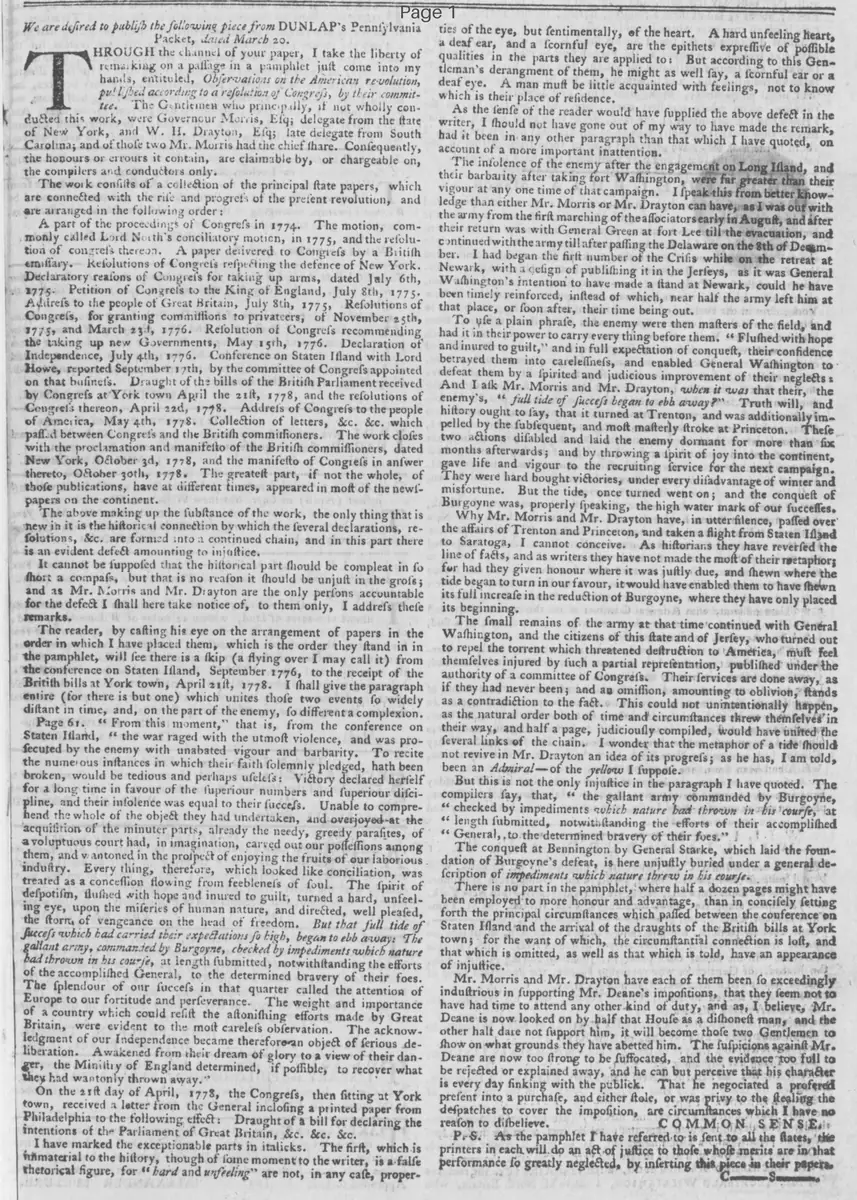
Through the channel of your paper, I take the liberty of remarking on a passage in a pamphlet just come into my hands, entitled, Observations on the American revolution, published according to a resolution of Congress, by their committee. The Gentlemen who principally, if not wholly conducted this work, were Governor Morris, Esq; delegate from the state of New York, and W. H. Drayton, Esq; late delegate from South Carolina; and of those two Mr. Morris had the chief share. Consequently, the honours or errors it contains, are claimable by, or chargeable on, the compilers and conductors only.
The work consists of a collection of the principal state papers, which are connected with the rise and progress of the present revolution, and are arranged in the following order:
A part of the proceedings of Congress in 1774. The motion, commonly called Lord North's conciliatory motion, in 1775, and the resolution of Congress thereon. A paper delivered to Congress by a British emissary. Resolutions of Congress respecting the defence of New York. Declaratory reasons of Congress for taking up arms, dated July 6th, 1775. Petition of Congress to the King of England, July 8th, 1775. Address to the people of Great Britain, July 8th, 1775. Resolutions of Congress, for granting commissions to privateers, of November 25th, 1775, and March 23d, 1776. Resolution of Congress recommending the taking up new Governments, May 15th, 1776. Declaration of Independence, July 4th, 1776. Conference on Staten Island with Lord Howe, reported September 17th, by the committee of Congress appointed on that business. Draught of the bills of the British Parliament received by Congress at York town April the 21st, 1778, and the resolutions of Congress thereon, April 22d, 1778. Address of Congress to the people of America, May 4th, 1778. Collection of letters, &c. &c. which passed between Congress and the British commissioners. The work closes with the proclamation and manifesto of the British commissioners, dated New York, October 3d, 1778, and the manifesto of Congress in answer thereto, October 30th, 1778. The greatest part, if not the whole, of those publications, have at different times, appeared in most of the newspapers on the continent.
The above making up the substance of the work, the only thing that is new in it is the historical connection by which the several declarations, resolutions, &c. are formed into a continued chain, and in this part there is an evident defect amounting to injustice.
It cannot be supposed that the historical part should be complete in so short a compass, but that is no reason it should be unjust in the gross; and as Mr. Morris and Mr. Drayton are the only persons accountable for the defect I shall here take notice of, to them only, I address these remarks.
The reader, by casting his eye on the arrangement of papers in the order in which I have placed them, which is the order they stand in in the pamphlet, will see there is a skip (a flying over I may call it) from the conference on Staten Island, September 1776, to the receipt of the British bills at York town, April 1st, 1778. I shall give the paragraph entire (for there is but one) which unites those two events so widely distant in time, and, on the part of the enemy, so different a complexion.
Page 61. "From this moment," that is, from the conference on Staten Island, "the war raged with the utmost violence, and was prosecuted by the enemy with unabated vigour and barbarity. To recite the numerous instances in which their faith solemnly pledged, hath been broken, would be tedious and perhaps useless: Victory declared herself for a long time in favour of the superior numbers and superior discipline, and their insolence was equal to their success. Unable to comprehend the whole of the object they had undertaken, and overjoyed at the acquisition of the minuter parts, already the needy, greedy parasites, of a voluptuous court had, in imagination, carved out our possessions among them, and wantoned in the prospect of enjoying the fruits of our laborious industry. Every thing, therefore, which looked like conciliation, was treated as a concession flowing from feebleness of soul. The spirit of despotism, flushed with hope and inured to guilt, turned a hard, unfeeling eye, upon the miseries of human nature, and directed, well pleased, the storm of vengeance on the head of freedom. But that full tide of success which had carried their expectations so high, began to ebb away: The gallant army, commanded by Burgoyne, checked by impediments which nature had thrown in his course, at length submitted, notwithstanding the efforts of the accomplished General, to the determined bravery of their foes. The splendour of our success in that quarter called the attention of Europe to our fortitude and perseverance. The weight and importance of a country which could resist the astonishing efforts made by Great Britain, were evident to the most careless observation. The acknowledgment of our Independence became therefore an object of serious deliberation. Awakened from their dream of glory to a view of their danger, the Ministry of England determined, if possible, to recover what they had wantonly thrown away."
On the 21st day of April, 1778, the Congress, then sitting at York town, received a letter from the General enclosing a printed paper from Philadelphia to the following effect: Draught of a bill for declaring the intentions of the Parliament of Great Britain, &c. &c. &c.
I have marked the exceptionable parts in italics. The first, which is immaterial to the history, though of some moment to the writer, is a false rhetorical figure, for "hard and unfeeling" are not, in any case, properly applicable to the qualities of the eye, but sentimentally, of the heart. A hard unfeeling heart, a deaf ear, and a scornful eye, are the epithets expressive of possible qualities in the parts they are applied to: But according to this Gentleman's derangement of them, he might as well say, a scornful ear or a deaf eye. A man must be little acquainted with feelings, not to know which is their place of residence.
As the sense of the reader would have supplied the above defect in the writer, I should not have gone out of my way to have made the remark, had it been in any other paragraph than that which I have quoted, on account of a more important inattention.
The insolence of the enemy after the engagement on Long Island, and their barbarity after taking Fort Washington, were far greater than their vigour at any one time of that campaign. I speak this from better knowledge than either Mr. Morris or Mr. Drayton can have, as I was out with the army from the first marching of the associators early in August, and after their return was with General Greene at Fort Lee till the evacuation, and continued with the army till after passing the Delaware on the 8th of December. I had begun the first number of the Crisis while on the retreat at Newark, with a design of publishing it in the Jerseys, as it was General Washington's intention to have made a stand at Newark, could he have been timely reinforced, instead of which, near half the army left him at that place, or soon after, their time being out.
To use a plain phrase, the enemy were then masters of the field, and had it in their power to carry every thing before them. "Flushed with hope and inured to guilt," and in full expectation of conquest, their confidence betrayed them into carelessness, and enabled General Washington to defeat them by a spirited and judicious improvement of their neglects. And I ask Mr. Morris and Mr. Drayton, when it was that their, the enemy's, "full tide of success began to ebb away?" Truth will, and history ought to say, that it turned at Trenton, and was additionally impelled by the subsequent, and most masterly stroke at Princeton. These two actions disabled and laid the enemy dormant for more than six months afterwards; and by throwing a spirit of joy into the continent, gave life and vigour to the recruiting service for the next campaign.
They were hard bought victories, under every disadvantage of winter and misfortune. But the tide, once turned went on; and the conquest of Burgoyne was, properly speaking, the high water mark of our success.
Why Mr. Morris and Mr. Drayton have, in utter silence, passed over the affairs of Trenton and Princeton, and taken a flight from Staten Island to Saratoga, I cannot conceive. As historians they have reversed the line of facts, and as writers they have not made the most of their metaphor; for had they given honour where it was justly due, and shewn where the tide began to turn in our favour, it would have enabled them to have shewn its full increase in the reduction of Burgoyne, where they have only placed its beginning.
The small remains of the army at that time continued with General Washington, and the citizens of this state and of Jersey, who turned out to repel the torrent which threatened destruction to America, must feel themselves injured by such a partial representation, published under the authority of a committee of Congress. Their services are done away, as if they had never been; and an omission, amounting to oblivion, stands as a contradiction to the fact. This could not unintentionally happen, as the natural order both of time and circumstances threw themselves in their way, and half a page, judiciously compiled, would have united the several links of the chain. I wonder that the metaphor of a tide should not revive in Mr. Drayton an idea of its progress; as he has, I am told, been an Admiral of the yellow I suppose.
But this is not the only injustice in the paragraph I have quoted. The compilers say, that, "the gallant army commanded by Burgoyne, checked by impediments which nature had thrown in his course, at length submitted, notwithstanding the efforts of their accomplished General, to the determined bravery of their foes."
The conquest at Bennington by General Starke, which laid the foundation of Burgoyne's defeat, is here unjustly buried under a general description of impediments which nature threw in his course.
There is no part in the pamphlet, where half a dozen pages might have been employed to more honour and advantage, than in concisely setting forth the principal circumstances which passed between the conference on Staten Island and the arrival of the draughts of the British bills at York town; for the want of which, the circumstantial connection is lost, and that which is omitted, as well as that which is told, have an appearance of injustice.
Mr. Morris and Mr. Drayton have each of them been so exceedingly industrious in supporting Mr. Deane's impositions, that they seem not to have had time to attend any other kind of duty, and as, I believe, Mr. Deane is now looked on by half that House as a dishonest man, and the other half dare not support him, it will become those two Gentlemen to show on what grounds they have abetted him. The suspicions against Mr. Deane are now too strong to be suffocated, and the evidence too full to be rejected or explained away, and he can but perceive that his character is every day sinking with the publick. That he negotiated a proffered present into a purchase, and either stole, or was privy to the stealing the dispatches to cover the imposition, are circumstances which I have no reason to disbelieve.
COMMON SENSE
P.S. As the pamphlet I have referred to is sent to all the states, the printers in each will do an act of justice to those whose merits are in that performance so greatly neglected, by inserting this piece in their papers.
What sub-type of article is it?
What themes does it cover?
What keywords are associated?
What entities or persons were involved?
Letter to Editor Details
Author
Common Sense
Recipient
Your Paper
Main Argument
the pamphlet 'observations on the american revolution' by morris and drayton unjustly omits key events like trenton and princeton, skips historical connections, and misrepresents the turning points of the war, while the compilers are accused of supporting silas deane's deceptions.
Notable Details