Thank you for visiting SNEWPapers!
Sign up free
Literary
January 8, 1800
The Providence Journal, And Town And Country Advertiser
Providence, Providence County, Rhode Island
What is this article about?
An essay reflecting on the biblical narrative of Jacob's trials and reunion with Joseph in Egypt, highlighting themes of parental grief, love, and the moral obligations of children to avoid bringing sorrow to their aging parents through vice.
Clipping
OCR Quality
92%
Excellent
Full Text
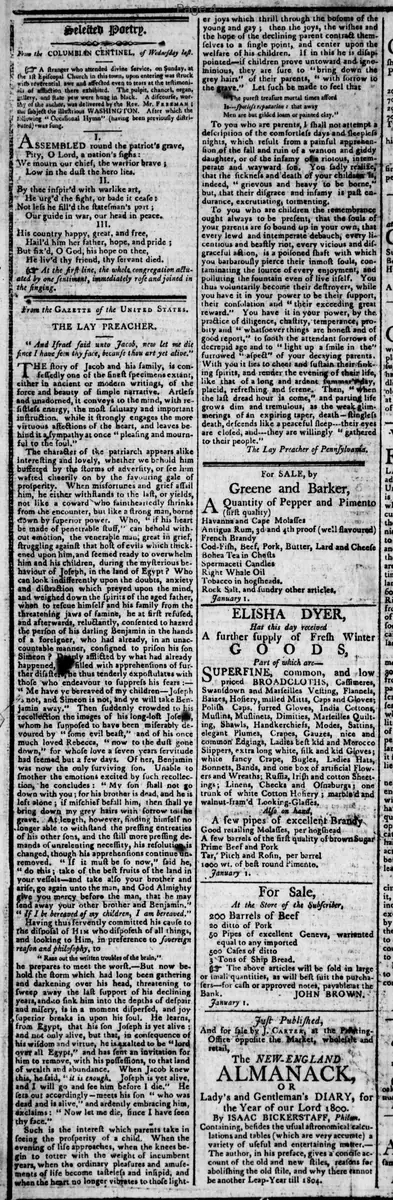
"And Israel said unto Jacob, now let me die since I have seen thy face, because thou art yet alive."
The story of Jacob and his family, is considered one of the finest specimens extant, either in ancient or modern writings, of the force and beauty of simple narrative. Artless and unadorned, it conveys to the mind, with resistless energy, the most salutary and important instruction, while it strongly engages the more virtuous affections of the heart, and leaves behind it a sympathy at once "pleasing and mournful to the soul."
The character of the patriarch appears alike interesting and lovely, whether we behold him buffeted by the storms of adversity, or see him wafted cheerily on by the favouring gale of prosperity. When misfortunes and grief assail him, he either withstands to the last, or yields not like a coward who faintheartedly shrinks from the encounter, but like a strong man, borne down by superior power. Who, "if his heart be made of penetrable stuff," can behold without emotion, the venerable man; great in grief struggling against that host of evils which thickened upon him, and seemed ready to overwhelm him and his children, during the mysterious behaviour of Joseph, in the land of Egypt? Who can look indifferently upon the doubts, anxiety and distraction which preyed upon the mind and weighed down the spirits of the aged father whom to rescue himself and his family from the threatening jaws of famine, he at first refused, and afterwards, reluctantly, consented to hazard the person of his darling Benjamin in the hands of a foreigner, who had already, in an unaccountable manner, consigned to prison his son Simeon? Deeply afflicted by what had already happened, filled with apprehensions of further disaster he thus tenderly expostulates with those who endeavour to suppress his fears :-- "Me have ye bereaved of my children-- Joseph is not, and Simeon is not, and ye will take Benjamin away." Then suddenly crowded to his recollection the images of his long-lost Joseph, whom he supposed to have been miserably devoured by "some evil beast," and of his once much loved Rebecca, "now to the dust gone down," for whose love a seven years servitude had seemed but a few days. Of her, Benjamin was now the only surviving son. Unable to master the emotions excited by such recollection. he concludes: "My son shall not go down with you ; for his brother is dead. and he is left alone ; if mischief befall him, then shall ye bring down my grey hairs with sorrow to the grave. At length, however, finding himself no longer able to withstand the pressing entreaties of his other sons, and the still more pressing demands of unrelenting necessity, his resolution is changed, though his apprehensions continue unremoved. "If it must be so now," said he. "do this ; --take of the best fruits of the land in your vessels and take also your brother and arise, go again unto the man, and God Almighty give you mercy before the man, that he may send away your other brother and Benjamin." "If I be bereaved of my children, I am bereaved."
Having thus fervently committed his cause to the disposal of Him who disposeth of all things, and looking to Him, in preference to sovereign reason and philosophy, to "Raze out the written troubles of the brain," he prepares to meet the worst.--But now behold the storm which had long been gathering and darkening over his head, threatening to sweep away the last support of his declining years,and.to sink him into the depths of despair and misery, is in a moment dispersed, and joy superior breaks in upon his soul. He learns, from Egypt, that his son Joseph is yet alive : and not only alive, but that, in consequence of his wisdom and virtue, he is exalted to be "lord over all Egypt," and has sent an invitation for him to remove, with his possessions, to that land of wealth and abundance. When Jacob knew this, he said, "it is enough. Joseph is yet alive, and I will go and see him before I die." He sets out accordingly -meets his son who was dead and is alive," and ardently embracing him, exclaims:"Now let me die, since I have seen thy face."
Such is the interest which parents take in seeing the prosperity of a child. When the evening of life approaches, when the knees begin to totter with the weight of incumbent years, when the ordinary pleasures and amusements of life become tasteless and insipid, and when the heart no longer vibrates to those lighter joys which thrill through the bosoms of the young and gay ; then the joys, the wishes and the hopes of the declining parent contract themselves to a single point,, and center upon the welfare of his children. If in this he is disappointed-if children prove untoward and ignominious, they are sure to "bring down the grey hairs" of their parents, "with sorrow to the grave."Let such be made to feel that
The purest treasure mortal times afford
Is--spotless reputation : that away
Men are but gilded loam or painted clay."
To you who are parents, I shall not attempt a description of the comfortless days and sleepless nights, which result from a painful apprehension,of the fall and ruin of a wanton and giddy daughter, or of the infamy of a riotous, intemperate and wayward son. You sadly realize. that the sickness and death of your children is. indeed, "grievous and heavy'to be borne,' but, that their disgrace and infamy is past endurance, excruciating, tormenting. To you who are children the remembrance ought always to be present, that the souls of your parents are so bound up in your own, that every lewd and intemperate debauch, every licentious and beastly riot, every vicious and disgraceful action, is a poisoned shaft with which you barbarously pierce their inmost souls, contaminating the source of every enjoyment, and polluting the fountain even of life itself. You thus voluntarily become their destroyers, while you have it in your power to be their support. their consolation and "their exceeding great reward." You have it in your power, by the practice of diligence, chastity, temperance, probity and" whatsoever things are honest and of good report."to sooth the attendant sorrows of decrepid age and to" light up a smile in the' furrowed"aspect" of your decaying parents. With you it lies to cheer and sustain their sinking spirits, and render the evening of their life. like that of along and ardent summer'l day, placid, refreshing. and serene. Then, " When the last dread hour is come,". and parting life grows dim and tremulous, as the weak glimmerings ofan expiring taper, death-stings death, descends like a peaceful sleep-.-their eyes are closed, and---they are willingly " gathered to their people."
The Lay Preacher of Pennsylvania.
The story of Jacob and his family, is considered one of the finest specimens extant, either in ancient or modern writings, of the force and beauty of simple narrative. Artless and unadorned, it conveys to the mind, with resistless energy, the most salutary and important instruction, while it strongly engages the more virtuous affections of the heart, and leaves behind it a sympathy at once "pleasing and mournful to the soul."
The character of the patriarch appears alike interesting and lovely, whether we behold him buffeted by the storms of adversity, or see him wafted cheerily on by the favouring gale of prosperity. When misfortunes and grief assail him, he either withstands to the last, or yields not like a coward who faintheartedly shrinks from the encounter, but like a strong man, borne down by superior power. Who, "if his heart be made of penetrable stuff," can behold without emotion, the venerable man; great in grief struggling against that host of evils which thickened upon him, and seemed ready to overwhelm him and his children, during the mysterious behaviour of Joseph, in the land of Egypt? Who can look indifferently upon the doubts, anxiety and distraction which preyed upon the mind and weighed down the spirits of the aged father whom to rescue himself and his family from the threatening jaws of famine, he at first refused, and afterwards, reluctantly, consented to hazard the person of his darling Benjamin in the hands of a foreigner, who had already, in an unaccountable manner, consigned to prison his son Simeon? Deeply afflicted by what had already happened, filled with apprehensions of further disaster he thus tenderly expostulates with those who endeavour to suppress his fears :-- "Me have ye bereaved of my children-- Joseph is not, and Simeon is not, and ye will take Benjamin away." Then suddenly crowded to his recollection the images of his long-lost Joseph, whom he supposed to have been miserably devoured by "some evil beast," and of his once much loved Rebecca, "now to the dust gone down," for whose love a seven years servitude had seemed but a few days. Of her, Benjamin was now the only surviving son. Unable to master the emotions excited by such recollection. he concludes: "My son shall not go down with you ; for his brother is dead. and he is left alone ; if mischief befall him, then shall ye bring down my grey hairs with sorrow to the grave. At length, however, finding himself no longer able to withstand the pressing entreaties of his other sons, and the still more pressing demands of unrelenting necessity, his resolution is changed, though his apprehensions continue unremoved. "If it must be so now," said he. "do this ; --take of the best fruits of the land in your vessels and take also your brother and arise, go again unto the man, and God Almighty give you mercy before the man, that he may send away your other brother and Benjamin." "If I be bereaved of my children, I am bereaved."
Having thus fervently committed his cause to the disposal of Him who disposeth of all things, and looking to Him, in preference to sovereign reason and philosophy, to "Raze out the written troubles of the brain," he prepares to meet the worst.--But now behold the storm which had long been gathering and darkening over his head, threatening to sweep away the last support of his declining years,and.to sink him into the depths of despair and misery, is in a moment dispersed, and joy superior breaks in upon his soul. He learns, from Egypt, that his son Joseph is yet alive : and not only alive, but that, in consequence of his wisdom and virtue, he is exalted to be "lord over all Egypt," and has sent an invitation for him to remove, with his possessions, to that land of wealth and abundance. When Jacob knew this, he said, "it is enough. Joseph is yet alive, and I will go and see him before I die." He sets out accordingly -meets his son who was dead and is alive," and ardently embracing him, exclaims:"Now let me die, since I have seen thy face."
Such is the interest which parents take in seeing the prosperity of a child. When the evening of life approaches, when the knees begin to totter with the weight of incumbent years, when the ordinary pleasures and amusements of life become tasteless and insipid, and when the heart no longer vibrates to those lighter joys which thrill through the bosoms of the young and gay ; then the joys, the wishes and the hopes of the declining parent contract themselves to a single point,, and center upon the welfare of his children. If in this he is disappointed-if children prove untoward and ignominious, they are sure to "bring down the grey hairs" of their parents, "with sorrow to the grave."Let such be made to feel that
The purest treasure mortal times afford
Is--spotless reputation : that away
Men are but gilded loam or painted clay."
To you who are parents, I shall not attempt a description of the comfortless days and sleepless nights, which result from a painful apprehension,of the fall and ruin of a wanton and giddy daughter, or of the infamy of a riotous, intemperate and wayward son. You sadly realize. that the sickness and death of your children is. indeed, "grievous and heavy'to be borne,' but, that their disgrace and infamy is past endurance, excruciating, tormenting. To you who are children the remembrance ought always to be present, that the souls of your parents are so bound up in your own, that every lewd and intemperate debauch, every licentious and beastly riot, every vicious and disgraceful action, is a poisoned shaft with which you barbarously pierce their inmost souls, contaminating the source of every enjoyment, and polluting the fountain even of life itself. You thus voluntarily become their destroyers, while you have it in your power to be their support. their consolation and "their exceeding great reward." You have it in your power, by the practice of diligence, chastity, temperance, probity and" whatsoever things are honest and of good report."to sooth the attendant sorrows of decrepid age and to" light up a smile in the' furrowed"aspect" of your decaying parents. With you it lies to cheer and sustain their sinking spirits, and render the evening of their life. like that of along and ardent summer'l day, placid, refreshing. and serene. Then, " When the last dread hour is come,". and parting life grows dim and tremulous, as the weak glimmerings ofan expiring taper, death-stings death, descends like a peaceful sleep-.-their eyes are closed, and---they are willingly " gathered to their people."
The Lay Preacher of Pennsylvania.
What sub-type of article is it?
Essay
What themes does it cover?
Religious
Moral Virtue
Death Mortality
What keywords are associated?
Jacob
Joseph
Parental Love
Biblical Narrative
Moral Instruction
Family Duty
Virtue
Sorrow
What entities or persons were involved?
The Lay Preacher Of Pennsylvania
Literary Details
Author
The Lay Preacher Of Pennsylvania
Subject
On The Biblical Story Of Jacob And Parental Affection
Form / Style
Prose Reflection On Scripture With Moral Exhortation
Key Lines
"And Israel Said Unto Jacob, Now Let Me Die Since I Have Seen Thy Face, Because Thou Art Yet Alive."
"Me Have Ye Bereaved Of My Children Joseph Is Not, And Simeon Is Not, And Ye Will Take Benjamin Away."
"If I Be Bereaved Of My Children, I Am Bereaved."
The Purest Treasure Mortal Times Afford
Is Spotless Reputation : That Away
Men Are But Gilded Loam Or Painted Clay.
"Their Exceeding Great Reward."