Thank you for visiting SNEWPapers!
Sign up free
Literary
March 2, 1818
Alexandria Gazette & Daily Advertiser
Alexandria, Virginia
What is this article about?
Philosophical essay on Divine Providence (No. II), arguing from natural religion against atheistic denial of God's creative power and governance. Refutes Epicurus's views, emphasizing God's omnipotence, omniscience, and omnipresence, and the absurdity of chance in creation.
Merged-components note: Merged the section title with the following two literary components as they form a single continuous essay on Divine Providence, introduced by the title.
Clipping
OCR Quality
98%
Excellent
Full Text
Original Miscellany.
PROVIDENCE....NO. II.
He summons into being, with like ease,
A whole creation, and a single grain.
"How doth God know?" cries the infidel admirer of Epicurus; "can he judge through the dark cloud? Thick clouds are a covering to him that he seeth not; and he walketh in the circuit of Heaven?"
As we may arrive at the conclusion of the being and attributes of God, in the temple of natural religion, so also the belief in Divine Providence is placed within reach of the light of nature; and to deny the Almighty fiat and agency in the creation of the world, and his providence in governing it, is the most dangerous kind of atheism; for, like the arch-apostate transformed into an angel of light, it aims deadly and concealed blows at the existence of the Deity—it strikes at that while it makes professions of fidelity, through this means to surprise, if possible, the more successfully, the relaxed vigilance of his friends. Epicurus, therefore, was consistent in his creed, in denying Jehovah both his creative power in the formation of the world and his providential care over his works.
But what an incongruous absurdity do they fall into who deny the government of a Divine Providence in the world?—At the creation of the world, when the morning stars sang together, and all the sons of God shouted for joy, they would have the Ancient of days slumbering on his throne, while chance was busily employed in building the mighty fabric of the universe, bringing light out of darkness and order out of chaos: and shall I say—but do not shudder—they would have chance peopling the world with intelligent beings, who have a providence to forecast and contrive how to preserve and govern that which they make or acquire?
From such horrid atheism as this even an enlightened heathen would turn away in abhorrence and disgust. And what the light of nature condemns must be too absurd indeed to deserve a serious answer from revealed religion.
What can an argument prove, but that he who urges it has lost his reason on the dark and stormy ocean of atheism, which supports the monstrous thesis, at which a heathen is offended, that he that made the eye cannot see—that he who put providence in the heart of man has none himself? We have shown from the light of nature, reasoning apart from revelation, that there must be a God, who created by his infinite wisdom and almighty power the world: that intelligence everywhere shines from the face of nature: and intelligence involves design, design a mind to forecast; and that this infinite mind must reside in God—a being far removed from the finite conceptions and comprehension of his creatures; and we now must be convinced of the remark, that—to deny him a providence who rules in the armies of Heaven and among the inhabitants of the earth," is the readiest way to impugn his very existence.
The existence of the Supreme Being is deeply involved in the conceptions which we form of his divine nature, being, character, and attributes, and will always be endangered in a just proportion to the erroneous opinions we may entertain of any of these. The remark is a just one, that a defective Deity is no Deity at all. Consequently, the Supreme Being, to be worthy of his creatures' adorations, their confidence and their trust, their gratitude and their obedience, must to their finite minds be
A God full orbed.
In his whole round of attributes complete.
And then, and not until then, will they repose in confidence in their trust in him, and dwell in delightful security under the shadow of his throne—ye who possesses Omnipotence to
Summon into being, with like ease,
A whole creation, and a single grain—
Omnipresence to attend them in their journey through this desert to the possession of unending felicities in Heaven,
and Omniscience to see every tear-drop before it falls from their eyes, and every groan that ascends from their hearts up into his compassionate ear. Our belief (Christians) is, that he sees our wants before they are known or felt by us; that he often sends temporal prosperity to the wicked in wrath, and withholds it from the righteous in love; and that the light of glory, when reflected in eternity upon his works, will clear up all these difficulties in his divine providence, in the kingdom of Grace, and among the productions of nature.
Z.
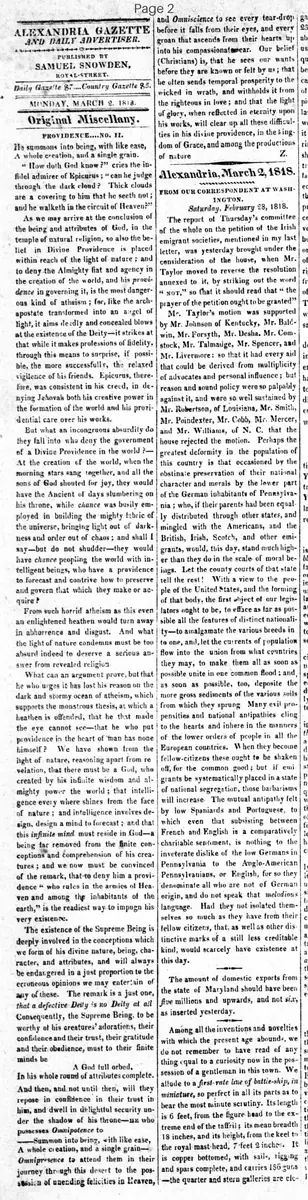
PROVIDENCE....NO. II.
He summons into being, with like ease,
A whole creation, and a single grain.
"How doth God know?" cries the infidel admirer of Epicurus; "can he judge through the dark cloud? Thick clouds are a covering to him that he seeth not; and he walketh in the circuit of Heaven?"
As we may arrive at the conclusion of the being and attributes of God, in the temple of natural religion, so also the belief in Divine Providence is placed within reach of the light of nature; and to deny the Almighty fiat and agency in the creation of the world, and his providence in governing it, is the most dangerous kind of atheism; for, like the arch-apostate transformed into an angel of light, it aims deadly and concealed blows at the existence of the Deity—it strikes at that while it makes professions of fidelity, through this means to surprise, if possible, the more successfully, the relaxed vigilance of his friends. Epicurus, therefore, was consistent in his creed, in denying Jehovah both his creative power in the formation of the world and his providential care over his works.
But what an incongruous absurdity do they fall into who deny the government of a Divine Providence in the world?—At the creation of the world, when the morning stars sang together, and all the sons of God shouted for joy, they would have the Ancient of days slumbering on his throne, while chance was busily employed in building the mighty fabric of the universe, bringing light out of darkness and order out of chaos: and shall I say—but do not shudder—they would have chance peopling the world with intelligent beings, who have a providence to forecast and contrive how to preserve and govern that which they make or acquire?
From such horrid atheism as this even an enlightened heathen would turn away in abhorrence and disgust. And what the light of nature condemns must be too absurd indeed to deserve a serious answer from revealed religion.
What can an argument prove, but that he who urges it has lost his reason on the dark and stormy ocean of atheism, which supports the monstrous thesis, at which a heathen is offended, that he that made the eye cannot see—that he who put providence in the heart of man has none himself? We have shown from the light of nature, reasoning apart from revelation, that there must be a God, who created by his infinite wisdom and almighty power the world: that intelligence everywhere shines from the face of nature: and intelligence involves design, design a mind to forecast; and that this infinite mind must reside in God—a being far removed from the finite conceptions and comprehension of his creatures; and we now must be convinced of the remark, that—to deny him a providence who rules in the armies of Heaven and among the inhabitants of the earth," is the readiest way to impugn his very existence.
The existence of the Supreme Being is deeply involved in the conceptions which we form of his divine nature, being, character, and attributes, and will always be endangered in a just proportion to the erroneous opinions we may entertain of any of these. The remark is a just one, that a defective Deity is no Deity at all. Consequently, the Supreme Being, to be worthy of his creatures' adorations, their confidence and their trust, their gratitude and their obedience, must to their finite minds be
A God full orbed.
In his whole round of attributes complete.
And then, and not until then, will they repose in confidence in their trust in him, and dwell in delightful security under the shadow of his throne—ye who possesses Omnipotence to
Summon into being, with like ease,
A whole creation, and a single grain—
Omnipresence to attend them in their journey through this desert to the possession of unending felicities in Heaven,
and Omniscience to see every tear-drop before it falls from their eyes, and every groan that ascends from their hearts up into his compassionate ear. Our belief (Christians) is, that he sees our wants before they are known or felt by us; that he often sends temporal prosperity to the wicked in wrath, and withholds it from the righteous in love; and that the light of glory, when reflected in eternity upon his works, will clear up all these difficulties in his divine providence, in the kingdom of Grace, and among the productions of nature.
Z.
What sub-type of article is it?
Essay
What themes does it cover?
Religious
Moral Virtue
What keywords are associated?
Divine Providence
Atheism
Epicurus
Natural Religion
Omnipotence
Omniscience
Creation
What entities or persons were involved?
Z.
Literary Details
Title
Providence....No. Ii.
Author
Z.
Subject
Belief In Divine Providence From Natural Religion
Form / Style
Argumentative Prose Essay
Key Lines
He Summons Into Being, With Like Ease,
A Whole Creation, And A Single Grain.
A God Full Orbed.
In His Whole Round Of Attributes Complete.
To Deny Him A Providence Who Rules In The Armies Of Heaven And Among The Inhabitants Of The Earth," Is The Readiest Way To Impugn His Very Existence.