Thank you for visiting SNEWPapers!
Sign up free
Editorial
December 30, 1809
The Enquirer
Richmond, Henrico County, Virginia
What is this article about?
An editorial critiquing US foreign policy options amid British and French aggressions on neutral rights, rejecting submission, embargo, and non-intercourse; proposes negotiations backed by potential letters of marque and reprisal, prioritizing Britain as adversary, and calls for defense preparations.
Clipping
OCR Quality
95%
Excellent
Full Text
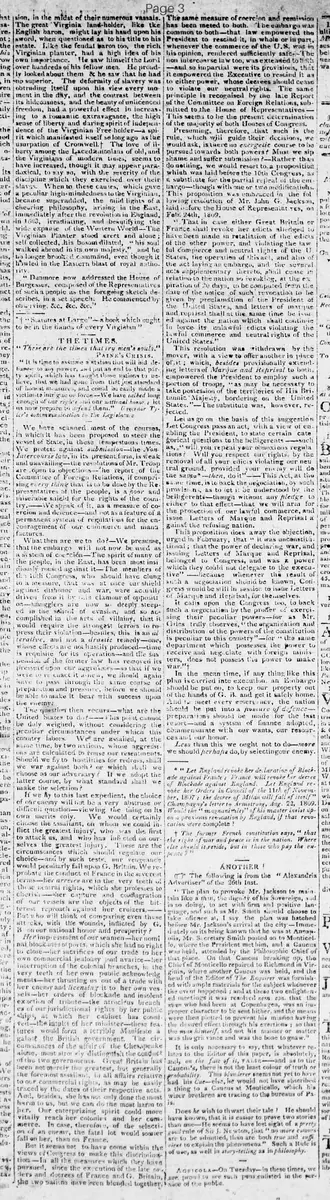
THE TIMES.
"These are the times that try men's souls."
PAINE'S CRISIS.
"It is time to assume a station that will bid defiance to any power, and put an end to that party spirit, which has taught those nations to believe, that we had gone from that just standard of honest measures, and could be easily made a victim to intrigue or force--We have talked long enough of our rights and our national honors; let us now prepare to defend them." Governor Tyler's communication to the Legislature.
We have scanned most of the courses, in which it has been proposed to steer the Vessel of State, in these tempestuous times. We protest against submission--the Non-Intercourse law, in its present form, is weak and unavailing--the resolutions of Mr. Randolph are open to objections--the report of the Committee of Foreign Relations, if comprising everything that is to be done by the Representatives of the people, is a poor and miserable shield for the rights of the country.---We speak of it, as a measure of coercion and defence--and not as a feature of a permanent system of regulations for the encouragement of our commerce and manufactures.
What then are we to do?--We presume, that the embargo will not now be used as a system of coercion--The spirit of many of the people, in the East, has been most insidiously roused against it--the members of the 10th Congress, who should have clung to a measure, that was at once our shield against dishonor and war, were actually driven from it by the clamour of opposition--smugglers are now so deeply steeped in the school of evasion, and so accomplished in the arts of villainy, that it would require the strongest terrors to repress their violation--besides, this is an alternative, and not a drastic remedy--one, whose effects are not hastily produced--time is requisite for its operation--and the suspension of the former law has removed its pressure upon our aggressors--so that if we were now to re-enact it, we should again have to pass through the same course of preparation and pressure, before we should be able to make it bear with success upon the enemy.
The question then recurs--what are the United States to do?---this point cannot be duly weighed, without considering the peculiar circumstances under which this country labors. We are assailed, at the same time, by two nations, whose aggressions are calculated to rouse our resentments. Should we fly to hostilities for redress, shall we war against both? or which shall we choose as our adversary? If we adopt the latter course, by what standard shall we make the selection?
If we fly to this last expedient, the choice of our enemy will not be a very abstruse or difficult question--viewing the thing on its own merits only. We would certainly choose the assailant, on whom we could inflict the greatest injury, who was the first to attack us, and who has inflicted on ourselves the greatest injury. These are the circumstances which should regulate our choice--and by such tests, our vengeance would peculiarly fall upon G. Britain. We reprobate the conduct of France in the severest terms--her armies are in the very teeth of the neutral rights, which she professes to cherish--her capture and conflagration of our vessels are the objects of the bitterest reproach against her cruizers.--But who will think of comparing even these attacks, with those wounds, inflicted by G. B. on our national honor and prosperity?
Her impressment of our seamen--her nominal blockades of ports, which she had no right to close--her sacrifices of our trade to her own commercial jealousy and avarice--her interruption of the colonial branches, in the very teeth of her own public acknowledgments--her thrusting us out of a trade with her enemy and licensing it to her own vessels--her orders of blockade and insolent exaction of tribute--the atrocious breaches of our jurisdictional rights by her public ships, at which her cabinet has connived--the insults of her minister--these features would form a terrible Manifesto against the British government. The circumstances of the affair of the Chesapeake alone, most strongly distinguish the conduct of the two governments. Great Britain has been not merely the greatest, but generally the foremost assailant, in all affairs relative to our commercial rights, as may be easily traced by the dates of their respective acts. And, besides, she has not only done the most harm to us, but we can do the most harm to her. Our enterprising spirit could more vitally reach her colonies and her commerce. In case, therefore, of the selection of an enemy, the fatal lot would sooner fall on her, than on France.
But it seems not to have come within the views of Congress to make this discrimination--In all the measures which they have pursued, since the execution of the late orders and decrees of France and G. Britain, the two nations have been blended together.
The same measure of coercion and remission has been meted to both. The embargo was common to both--that law empowered the President to rescind it, in whole or in part, whenever the commerce of the U.S. was in his opinion, rendered sufficiently safe--The non intercourse law too, was extended to both--and so impartial were its provisions, that it empowered the Executive to rescind it as to either power, whose decrees should cease to violate our neutral rights. The same principle is recognised by the late Report of the Committee on Foreign Relations, submitted to the House of Representatives--This seems to be the present determination of the majority of both Houses of Congress.
Presuming, therefore, that such is the rule, which will guide their decisions, we would ask, is there no energetic course to be pursued towards both powers? Must we sip shame and suffer submission?--Rather than do nothing, we would resort to a proposition which was laid before the 10th Congress, as a substitute for the partial repeal of the embargo--though with one or two modifications.
This proposition was embraced in the following resolution of Mr. John G. Jackson, laid before the House of Representatives, on Feb. 24th, 1809.
"That in case either Great Britain or France shall revoke her edicts alleged to have been made in retaliation of the edicts of the other power, and violating the lawful commerce and neutral rights of the United States, the operation of this act, and also of the act laying an embargo, and the several acts supplementary thereto, shall cease in relation to the nation so revoking, at the expiration of 90 days, to be computed from the date of the notice of such revocation to be given by proclamation of the President of the United States, and letters of marque and reprisal shall at the same time be issued against the nation which shall continue in force its unlawful edicts violating the lawful commerce and neutral rights of the United States."
This resolution was withdrawn by the mover, with a view to offer another in place of it: which, besides provisionally extending letters of Marque and Reprisal to both, empowered the President to employ such a portion of troops, "as may be necessary to take possession of the territories of His Britannic Majesty, bordering on the United States."--The substitute was, however, rejected.
Let us go on the basis of this suggestion. Let Congress pass an act, with a view of enabling the President, to state certain categorical questions to the belligerents--such as, "will you repeal your obnoxious regulations? Will you respect our rights, by the removal of all your edicts violating our neutral ground, provided your enemy will do the same?"--then, do it. This Act, at the same time, is to back the negociation, by such provision, as to let it be understood by the belligerents--though without any pledge to either to that effect--that we will arm for the protection of our lawful commerce, and issue Letters of Marque and Reprisal against the refusing nation.
This proposition does away the objection, urged in February, that "it was unconstitutional; that the power of declaring war, and issuing Letters of Marque and Reprisal, belonged to Congress, and was a power which they could not delegate to the executive"--because whenever the result of such a negociation should be known, Congress would be still in session to issue Letters of Marque and Reprisal, for themselves.
It calls upon the Congress too, to back such a negociation by the proper exercise of their peculiar powers--for as Mr. Giles truly observes, "the organization and distribution of the powers of the constitution is peculiar to this country"--for "the same department which possesses the power to receive and negotiate with foreign ministers, does not possess the power to make war."
In the mean time, if any thing like this plan is carried into execution, an Embargo should be put on, to keep our property out of the hands of G. B. and get it safely home. And to meet every emergency, the nation should be put into a posture of defence--preparatory should be made for the last resort--and a system of finance adopted, commensurate with our wants, our resources and our honor.
Less than this we ought not to do--more we should perhaps do, by selecting our enemy.
* "Let England revoke her declaration of Blockade against France: France will revoke her decree of Blockade against England. Let England revoke her Orders in Council of the 11th of November, 1807: the decree of Milan will fall of itself."
Champagny's letter to Armstrong, Aug. 22, 1809.
Would this "magnanimity" of his master insist upon a previous revocation by England, if that revocation were complete?
The former French constitution says, "that the right of war and peace is in the nation. Where else should it reside, but in those who pay the expense?"
"These are the times that try men's souls."
PAINE'S CRISIS.
"It is time to assume a station that will bid defiance to any power, and put an end to that party spirit, which has taught those nations to believe, that we had gone from that just standard of honest measures, and could be easily made a victim to intrigue or force--We have talked long enough of our rights and our national honors; let us now prepare to defend them." Governor Tyler's communication to the Legislature.
We have scanned most of the courses, in which it has been proposed to steer the Vessel of State, in these tempestuous times. We protest against submission--the Non-Intercourse law, in its present form, is weak and unavailing--the resolutions of Mr. Randolph are open to objections--the report of the Committee of Foreign Relations, if comprising everything that is to be done by the Representatives of the people, is a poor and miserable shield for the rights of the country.---We speak of it, as a measure of coercion and defence--and not as a feature of a permanent system of regulations for the encouragement of our commerce and manufactures.
What then are we to do?--We presume, that the embargo will not now be used as a system of coercion--The spirit of many of the people, in the East, has been most insidiously roused against it--the members of the 10th Congress, who should have clung to a measure, that was at once our shield against dishonor and war, were actually driven from it by the clamour of opposition--smugglers are now so deeply steeped in the school of evasion, and so accomplished in the arts of villainy, that it would require the strongest terrors to repress their violation--besides, this is an alternative, and not a drastic remedy--one, whose effects are not hastily produced--time is requisite for its operation--and the suspension of the former law has removed its pressure upon our aggressors--so that if we were now to re-enact it, we should again have to pass through the same course of preparation and pressure, before we should be able to make it bear with success upon the enemy.
The question then recurs--what are the United States to do?---this point cannot be duly weighed, without considering the peculiar circumstances under which this country labors. We are assailed, at the same time, by two nations, whose aggressions are calculated to rouse our resentments. Should we fly to hostilities for redress, shall we war against both? or which shall we choose as our adversary? If we adopt the latter course, by what standard shall we make the selection?
If we fly to this last expedient, the choice of our enemy will not be a very abstruse or difficult question--viewing the thing on its own merits only. We would certainly choose the assailant, on whom we could inflict the greatest injury, who was the first to attack us, and who has inflicted on ourselves the greatest injury. These are the circumstances which should regulate our choice--and by such tests, our vengeance would peculiarly fall upon G. Britain. We reprobate the conduct of France in the severest terms--her armies are in the very teeth of the neutral rights, which she professes to cherish--her capture and conflagration of our vessels are the objects of the bitterest reproach against her cruizers.--But who will think of comparing even these attacks, with those wounds, inflicted by G. B. on our national honor and prosperity?
Her impressment of our seamen--her nominal blockades of ports, which she had no right to close--her sacrifices of our trade to her own commercial jealousy and avarice--her interruption of the colonial branches, in the very teeth of her own public acknowledgments--her thrusting us out of a trade with her enemy and licensing it to her own vessels--her orders of blockade and insolent exaction of tribute--the atrocious breaches of our jurisdictional rights by her public ships, at which her cabinet has connived--the insults of her minister--these features would form a terrible Manifesto against the British government. The circumstances of the affair of the Chesapeake alone, most strongly distinguish the conduct of the two governments. Great Britain has been not merely the greatest, but generally the foremost assailant, in all affairs relative to our commercial rights, as may be easily traced by the dates of their respective acts. And, besides, she has not only done the most harm to us, but we can do the most harm to her. Our enterprising spirit could more vitally reach her colonies and her commerce. In case, therefore, of the selection of an enemy, the fatal lot would sooner fall on her, than on France.
But it seems not to have come within the views of Congress to make this discrimination--In all the measures which they have pursued, since the execution of the late orders and decrees of France and G. Britain, the two nations have been blended together.
The same measure of coercion and remission has been meted to both. The embargo was common to both--that law empowered the President to rescind it, in whole or in part, whenever the commerce of the U.S. was in his opinion, rendered sufficiently safe--The non intercourse law too, was extended to both--and so impartial were its provisions, that it empowered the Executive to rescind it as to either power, whose decrees should cease to violate our neutral rights. The same principle is recognised by the late Report of the Committee on Foreign Relations, submitted to the House of Representatives--This seems to be the present determination of the majority of both Houses of Congress.
Presuming, therefore, that such is the rule, which will guide their decisions, we would ask, is there no energetic course to be pursued towards both powers? Must we sip shame and suffer submission?--Rather than do nothing, we would resort to a proposition which was laid before the 10th Congress, as a substitute for the partial repeal of the embargo--though with one or two modifications.
This proposition was embraced in the following resolution of Mr. John G. Jackson, laid before the House of Representatives, on Feb. 24th, 1809.
"That in case either Great Britain or France shall revoke her edicts alleged to have been made in retaliation of the edicts of the other power, and violating the lawful commerce and neutral rights of the United States, the operation of this act, and also of the act laying an embargo, and the several acts supplementary thereto, shall cease in relation to the nation so revoking, at the expiration of 90 days, to be computed from the date of the notice of such revocation to be given by proclamation of the President of the United States, and letters of marque and reprisal shall at the same time be issued against the nation which shall continue in force its unlawful edicts violating the lawful commerce and neutral rights of the United States."
This resolution was withdrawn by the mover, with a view to offer another in place of it: which, besides provisionally extending letters of Marque and Reprisal to both, empowered the President to employ such a portion of troops, "as may be necessary to take possession of the territories of His Britannic Majesty, bordering on the United States."--The substitute was, however, rejected.
Let us go on the basis of this suggestion. Let Congress pass an act, with a view of enabling the President, to state certain categorical questions to the belligerents--such as, "will you repeal your obnoxious regulations? Will you respect our rights, by the removal of all your edicts violating our neutral ground, provided your enemy will do the same?"--then, do it. This Act, at the same time, is to back the negociation, by such provision, as to let it be understood by the belligerents--though without any pledge to either to that effect--that we will arm for the protection of our lawful commerce, and issue Letters of Marque and Reprisal against the refusing nation.
This proposition does away the objection, urged in February, that "it was unconstitutional; that the power of declaring war, and issuing Letters of Marque and Reprisal, belonged to Congress, and was a power which they could not delegate to the executive"--because whenever the result of such a negociation should be known, Congress would be still in session to issue Letters of Marque and Reprisal, for themselves.
It calls upon the Congress too, to back such a negociation by the proper exercise of their peculiar powers--for as Mr. Giles truly observes, "the organization and distribution of the powers of the constitution is peculiar to this country"--for "the same department which possesses the power to receive and negotiate with foreign ministers, does not possess the power to make war."
In the mean time, if any thing like this plan is carried into execution, an Embargo should be put on, to keep our property out of the hands of G. B. and get it safely home. And to meet every emergency, the nation should be put into a posture of defence--preparatory should be made for the last resort--and a system of finance adopted, commensurate with our wants, our resources and our honor.
Less than this we ought not to do--more we should perhaps do, by selecting our enemy.
* "Let England revoke her declaration of Blockade against France: France will revoke her decree of Blockade against England. Let England revoke her Orders in Council of the 11th of November, 1807: the decree of Milan will fall of itself."
Champagny's letter to Armstrong, Aug. 22, 1809.
Would this "magnanimity" of his master insist upon a previous revocation by England, if that revocation were complete?
The former French constitution says, "that the right of war and peace is in the nation. Where else should it reside, but in those who pay the expense?"
What sub-type of article is it?
Foreign Affairs
War Or Peace
Trade Or Commerce
What keywords are associated?
Neutral Rights
Embargo
Non Intercourse
Letters Of Marque
British Aggressions
French Decrees
War Preparations
Congressional Action
What entities or persons were involved?
Governor Tyler
Mr. Randolph
Committee Of Foreign Relations
G. Britain
France
Mr. John G. Jackson
Mr. Giles
Champagny
Armstrong
Editorial Details
Primary Topic
Us Policy Response To British And French Violations Of Neutral Rights
Stance / Tone
Assertive Advocacy For Coercive Measures And Potential Reprisals Against Aggressors
Key Figures
Governor Tyler
Mr. Randolph
Committee Of Foreign Relations
G. Britain
France
Mr. John G. Jackson
Mr. Giles
Champagny
Armstrong
Key Arguments
Protest Against Submission And Weak Non Intercourse Law
Embargo Ineffective Due To Public Opposition And Smuggling
Prioritize Britain As Adversary For Greater Injury Inflicted And Potential Harm To Her
Criticize French Aggressions But Emphasize British As Worse
Propose Negotiations With Categorical Questions To Belligerents Backed By Letters Of Marque
Congress Should Issue Reprisals If Demands Unmet
Implement Embargo And Defense Preparations Meanwhile
Avoid Impartial Treatment; Select Enemy If Necessary