Thank you for visiting SNEWPapers!
Sign up free
The New Hampshire Gazette
Portsmouth, Rockingham County, New Hampshire
What is this article about?
The General Assembly of Upper Peru decrees renaming the republic 'Bolivar' and its capital 'Sucre' in honor of Liberator Simon Bolivar and hero Antonio Jose de Sucre. It grants Bolivar supreme executive power, establishes national festivals, statues, medals, and awards $1 million to the liberating army.
Clipping
OCR Quality
Full Text
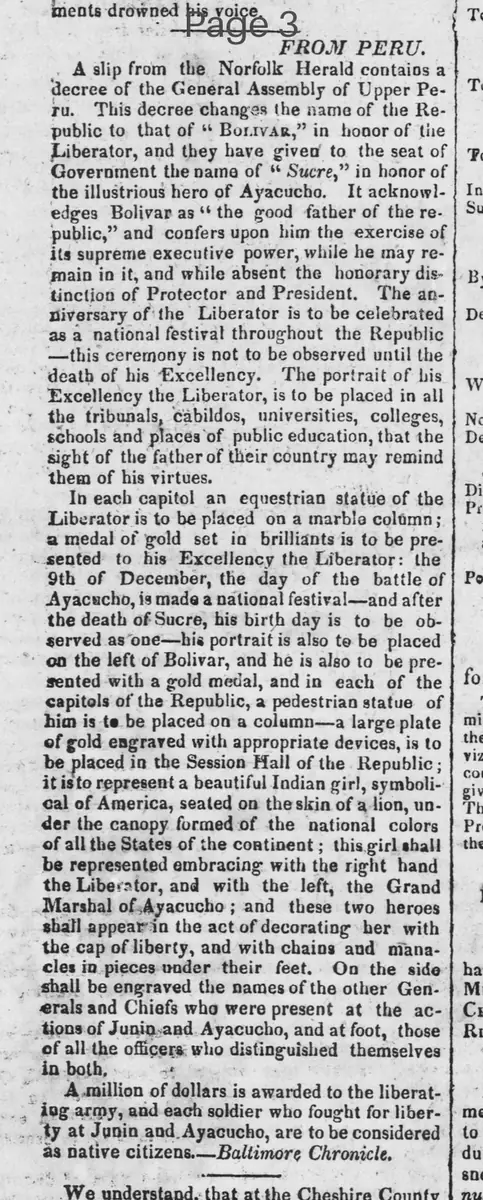
A slip from the Norfolk Herald contains a decree of the General Assembly of Upper Peru. This decree changes the name of the Republic to that of "Bolivar," in honor of the Liberator, and they have given to the seat of Government the name of "Sucre," in honor of the illustrious hero of Ayacucho. It acknowledges Bolivar as "the good father of the republic," and confers upon him the exercise of its supreme executive power, while he may remain in it, and while absent the honorary distinction of Protector and President. The anniversary of the Liberator is to be celebrated as a national festival throughout the Republic—this ceremony is not to be observed until the death of his Excellency. The portrait of his Excellency the Liberator, is to be placed in all the tribunals, cabildos, universities, colleges, schools and places of public education, that the sight of the father of their country may remind them of his virtues.
In each capitol an equestrian statue of the Liberator is to be placed on a marble column; a medal of gold set in brilliants is to be presented to his Excellency the Liberator: the 9th of December, the day of the battle of Ayacucho, is made a national festival—and after the death of Sucre, his birth day is to be observed as one—his portrait is also to be placed on the left of Bolivar, and he is also to be presented with a gold medal, and in each of the capitols of the Republic, a pedestrian statue of him is to be placed on a column—a large plate of gold engraved with appropriate devices, is to be placed in the Session Hall of the Republic; it is to represent a beautiful Indian girl, symbolical of America, seated on the skin of a lion, under the canopy formed of the national colors of all the States of the continent: this girl shall be represented embracing with the right hand the Liberator, and with the left, the Grand Marshal of Ayacucho; and these two heroes shall appear in the act of decorating her with the cap of liberty, and with chains and manacles in pieces under their feet. On the side shall be engraved the names of the other Generals and Chiefs who were present at the actions of Junin and Ayacucho, and at foot, those of all the officers who distinguished themselves in both.
A million of dollars is awarded to the liberating army, and each soldier who fought for liberty at Junin and Ayacucho, are to be considered as native citizens. —Baltimore Chronicle.
What sub-type of article is it?
What keywords are associated?
What entities or persons were involved?
Where did it happen?
Foreign News Details
Primary Location
Upper Peru
Key Persons
Outcome
republic renamed to bolivar; capital to sucre; bolivar granted supreme executive power; national festivals, portraits, statues, medals established; $1 million awarded to liberating army; soldiers granted citizenship.
Event Details
Decree of the General Assembly of Upper Peru honors Liberator Bolivar by renaming republic after him, acknowledging him as father of the republic and granting supreme executive power. Capital renamed Sucre after Ayacucho hero. Establishes festivals for Bolivar's anniversary (posthumously) and Ayacucho battle; Sucre's birthday festival posthumously. Requires portraits in public institutions, equestrian statues of Bolivar, pedestrian statues of Sucre in capitals, gold medals, and engraved gold plate symbolizing liberation. Awards million dollars to army; citizenship to Junin and Ayacucho soldiers.