Thank you for visiting SNEWPapers!
Sign up free
Daily National Intelligencer
Washington, District Of Columbia
What is this article about?
Agents Mills and Burgess of the American Colonization Society detail their stormy Atlantic voyage to England in 1817, narrowly escaping shipwreck off France's coast through divine providence. They receive warm welcomes, meet dignitaries like the Duke of Gloucester and William Wilberforce, secure support for African explorations, and report on Sierra Leone's flourishing colony before departing in February 1818.
Clipping
OCR Quality
Full Text
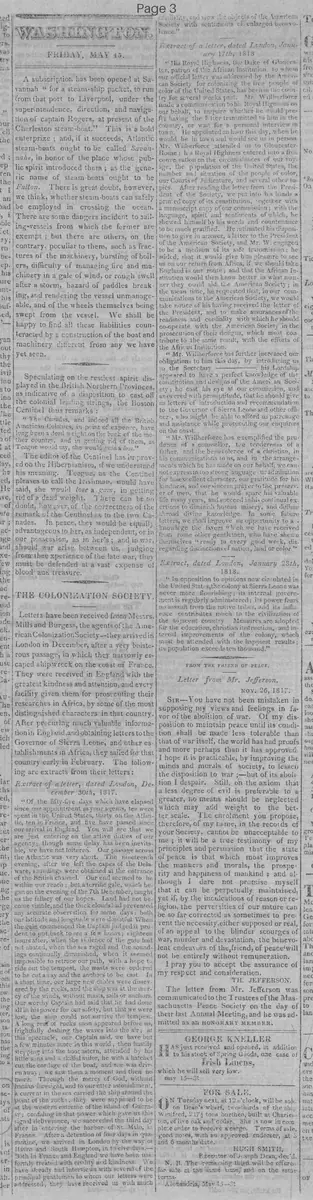
Letters have been received from Messrs. Mills and Burgess, the agents of the American Colonization Society--they arrived in London in December, after a very boisterous passage, in which they narrowly escaped shipwreck on the coast of France. They were received in England with the greatest kindness and attention, and every facility given them for prosecuting their researches in Africa, by some of the most distinguished characters in that country. After procuring much valuable information in England, and obtaining letters to the Governor of Sierra Leone, and other establishments in Africa, they sailed for that country early in February. The following are extracts from their letters:
Extract of a letter, dated London, December 30th, 1817.
"Of the fifty-five days which have elapsed since our appointment as your agents, ten were spent in the United States, thirty on the Atlantic, ten in France, and five have passed since our arrival in England. You will see that we are just entering on the active duties of our agency; though some delay has been inevitable, we have not loitered. Our passage across the Atlantic was very short. The nineteenth evening, after we left the capes of the Delaware, soundings were obtained at the entrance of the British channel. Our end seemed to be within our reach; but a terrific gale, which began on the evening of the 7th December, taught us the fallacy of our hopes. Land had not become visible, and the thick clouds had prevented any accurate observation for some days; both our latitude and longitude were doubtful. When the gale commenced the Captain judged it prudent to put back to sea a few hours; eighteen hours after, when the violence of the gale had not abated, when the sea raged and the soundings continually diminished, when it seemed impossible to retrace our path, with a hope to ride out the tempest, the masts were ordered to be cut away and the anchors to be cast. In a short time, our large new cables were dissevered by the rocks, and the ship was at the mercy of the winds, without masts, sails or anchors. Our worthy Captain had said that he had done all in his power for our safety, but that we were lost, the ship could not survive the tempest. A long reef of rocks soon appeared before us, frightfully dashing the waves into the air; at this spectacle, our Captain said, we have but a few minutes more in this world; then hastily stepping into the boat astern, attended by his little sons and a skilful sailor, he with a hatchet cut the cordage of the boat, and she was driven away; we saw them a moment and then no more. Through the mercy of God, without human foresight, and to our utter astonishment, a current in the sea carried the ship around the point of the rocks; they were supposed to be at the western extreme of the island of Guernsey; confiding in that power which gave us this signal deliverance, we succeeded the third day after in entering the harbor of St. Malo, in France. After a detention of four days in quarantine, we arrived in London by the way of Havre and South Hampton, in twelve days.-- Both in France and England we have been uniformly treated with civility and kindness. We have already had interviews with several of the principal gentlemen to whom our letters were addressed, they have received us with much cordiality, and view the objects of the American Society with sentiments of enlarged benevolence."
Extract of a Letter, dated London, January 17th, 1818
"His Royal Highness, the Duke of Gloucester, patron of the African Institution to whom our official letter was addressed by the American Society for colonizing the free people of color of the United States, has been in the country for several weeks past. Mr. Wilberforce made a communication to his Royal Highness on our behalf, to enquire whether he would prefer having the letter transmitted to him in the country, or wait for a personal interview in town. He appointed an hour this day, when he would be in town and would see us in person. Mr. Wilberforce attended us to Gloucester-House; his Royal Highness entered into a free conversation on the circumstances of our voyage, the population of the United States, the number and situation of the people of color, our Courts of Judicature, and several other topics. After reading the letter from the President of the Society, we put into his hands a printed copy of its constitution, together with a manuscript copy of our commission; with the language, spirit and sentiments of which, he shewed himself by his words and countenance to be much gratified. He intimated his disposition to give in answer, a letter to the President of the American Society, and Mr. W. engaged to be a medium of its safe transmission; he added, that it would give him pleasure to see us on our return from Africa, if we should take England in our route; and that the African Institution would then know better in what manner they could aid the American Society; in the mean time, he requested that, in our communications to the American Society, we would take notice of his having received the letter of the President, and to make assurances of the readiness and cordiality with which he should co-operate with the American Society in the prosecution of their designs, which must contribute to the same result, with the efforts of the African Institution.
"Mr. Wilberforce has further increased our obligations to him this day, by introducing us to the Secretary: his Lordship appeared to have a perfect knowledge of the constitution and designs of the American Society; he cast his eye at our commission, and answered with promptitude, that he should give us letters of introduction and recommendation to the Governor of Sierra Leone and other officers, who might be able to afford us patronage and assistance while prosecuting our enquiries on the coast.
"Mr. Wilberforce has exemplified the prudence of a counsellor, the tenderness of a father, and the benevolence of a christian, in his communications to us, and in the arrangements which he has made on our behalf; we cannot express in too strong language our admiration for his excellent character, our gratitude for his kindness, and our sincere prayer to the preserver of men, that he would spare his valuable life many years, and succeed in his continual exertions to diminish human misery, and diffuse abroad divine knowledge. In some future letters, we shall improve an opportunity to acknowledge the favors which we have received from some other gentlemen, who have shewn themselves "ready to every good work, disregarding distinctions of nation, land or color"
Extract, dated London, January 28th, 1818.
"In opposition to opinions now circulated in the United States, the colony at Sierra Leone was never more flourishing; its internal government is regularly administered; its power fears no assault from the native tribes, and its influence contributes much to the civilization of the adjacent country. Measures are adopted for the education, christian instruction, and internal improvements of the colony, which must be attended with the happiest results; its population exceeds ten thousand."
What sub-type of article is it?
What themes does it cover?
What keywords are associated?
What entities or persons were involved?
Where did it happen?
Story Details
Key Persons
Location
Atlantic Ocean, Coast Of France, London, St. Malo, Sierra Leone
Event Date
December 1817 February 1818
Story Details
Agents Mills and Burgess endure a violent storm on their Atlantic voyage, losing masts and anchors near Guernsey rocks; miraculously saved by a current, they reach St. Malo, then London. There, they meet the Duke of Gloucester and Wilberforce, gaining support and letters for Sierra Leone investigations. The colony is reported as thriving with over 10,000 population.