Thank you for visiting SNEWPapers!
Sign up free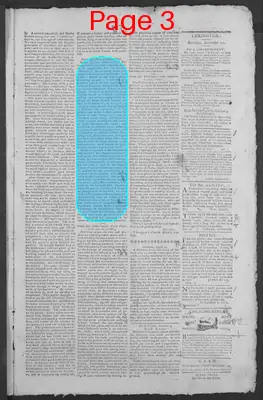
Editorial
November 11, 1797
The Kentucky Gazette
Lexington, Fayette County, Kentucky
What is this article about?
This editorial from the New-London Bee uses the Roman consul Spurius Postumius's rejection of the dishonorable Claudian treaty with the Samnites as an analogy to criticize modern negotiators who bind nations to disadvantageous treaties without public consent, arguing that the people should not bear the loss and disgrace.
Clipping
OCR Quality
98%
Excellent
Full Text
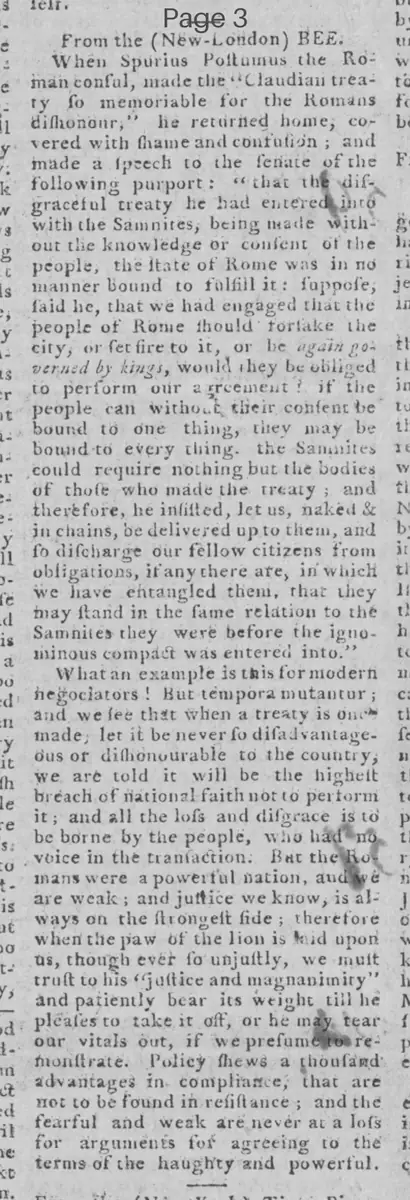
From the (New-London) BEE.
When Spurius Postumius the Roman consul, made the "Claudian treaty so memorable for the Romans dishonour," he returned home, covered with shame and confusion; and made a speech to the senate of the following purport: "that the disgraceful treaty he had entered into with the Samnites, being made without the knowledge or consent of the people, the state of Rome was in no manner bound to fulfill it: suppose, said he, that we had engaged that the people of Rome should forsake the city, or set fire to it, or be again governed by kings, would they be obliged to perform our agreement? if the people can without their consent be bound to one thing, they may be bound to every thing. the Samnites could require nothing but the bodies of those who made the treaty; and therefore, he insisted, let us, naked & in chains, be delivered up to them, and so discharge our fellow citizens from obligations, if any there are, in which we have entangled them, that they may stand in the same relation to the Samnites they were before the ignominious compact was entered into."
What an example is this for modern negotiators! But tempora mutantur; and we see that when a treaty is once made, let it be never so disadvantageous or dishonourable to the country; we are told it will be the highest breach of national faith not to perform it; and all the loss and disgrace is to be borne by the people, who had no voice in the transaction. But the Romans were a powerful nation, and we are weak; and justice we know, is always on the strongest side; therefore when the paw of the lion is laid upon us, though ever so unjustly, we must trust to his "justice and magnanimity" and patiently bear its weight till he pleases to take it off, or he may tear our vitals out, if we presume to remonstrate. Policy shows a thousand advantages in compliance; that are not to be found in resistance; and the fearful and weak are never at a loss for arguments for agreeing to the terms of the haughty and powerful.
When Spurius Postumius the Roman consul, made the "Claudian treaty so memorable for the Romans dishonour," he returned home, covered with shame and confusion; and made a speech to the senate of the following purport: "that the disgraceful treaty he had entered into with the Samnites, being made without the knowledge or consent of the people, the state of Rome was in no manner bound to fulfill it: suppose, said he, that we had engaged that the people of Rome should forsake the city, or set fire to it, or be again governed by kings, would they be obliged to perform our agreement? if the people can without their consent be bound to one thing, they may be bound to every thing. the Samnites could require nothing but the bodies of those who made the treaty; and therefore, he insisted, let us, naked & in chains, be delivered up to them, and so discharge our fellow citizens from obligations, if any there are, in which we have entangled them, that they may stand in the same relation to the Samnites they were before the ignominious compact was entered into."
What an example is this for modern negotiators! But tempora mutantur; and we see that when a treaty is once made, let it be never so disadvantageous or dishonourable to the country; we are told it will be the highest breach of national faith not to perform it; and all the loss and disgrace is to be borne by the people, who had no voice in the transaction. But the Romans were a powerful nation, and we are weak; and justice we know, is always on the strongest side; therefore when the paw of the lion is laid upon us, though ever so unjustly, we must trust to his "justice and magnanimity" and patiently bear its weight till he pleases to take it off, or he may tear our vitals out, if we presume to remonstrate. Policy shows a thousand advantages in compliance; that are not to be found in resistance; and the fearful and weak are never at a loss for arguments for agreeing to the terms of the haughty and powerful.
What sub-type of article is it?
Foreign Affairs
Constitutional
What keywords are associated?
Treaties
National Faith
Roman Analogy
Public Consent
Dishonorable Compacts
Diplomacy Critique
What entities or persons were involved?
Spurius Postumius
Samnites
Roman Senate
Modern Negotiators
Editorial Details
Primary Topic
Critique Of Treaties Made Without Public Consent Using Roman Analogy
Stance / Tone
Critical Of Modern Compliance With Dishonorable Treaties
Key Figures
Spurius Postumius
Samnites
Roman Senate
Modern Negotiators
Key Arguments
Treaties Made Without People's Consent Do Not Bind The State
People Should Not Bear Loss From Negotiators' Agreements
Historical Roman Example Of Rejecting Dishonorable Treaty
Modern Weakness Leads To Unjust Compliance With Powerful Nations
Justice Favors The Strong, Policy Favors Submission