Thank you for visiting SNEWPapers!
Sign up free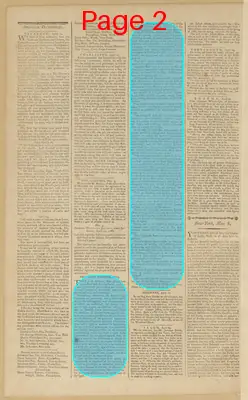
The New York Journal, And Daily Patriotic Register
New York, New York County, New York
What is this article about?
Maryland state convention on April 26, 1788, proposes amendments to the U.S. Constitution limiting federal powers, protecting individual rights like fair trials, free speech, and religion, and restricting Congress on taxes, army, and courts.
Clipping
OCR Quality
Full Text
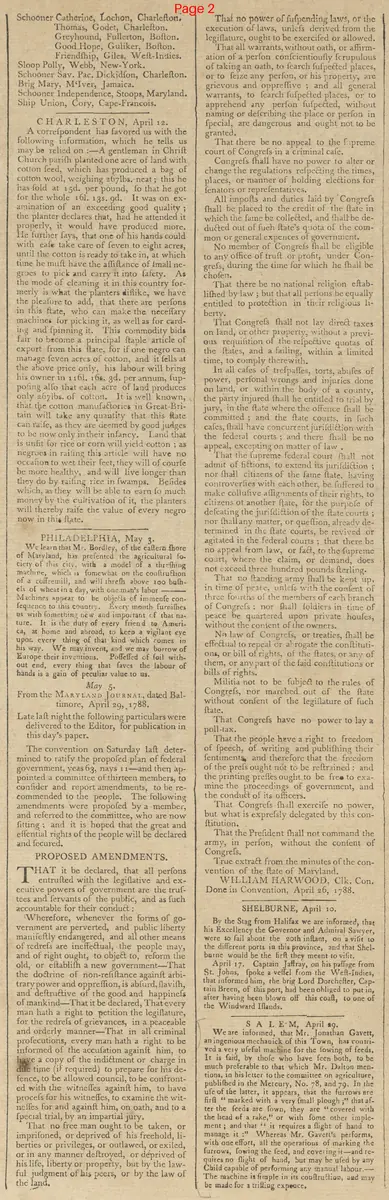
That the citizens entrusted with the legislative and executive powers of government are the trustees and servants of the public, and as such accountable for their conduct:
Wherefore, whenever the forms of government are perverted, and public liberty manifestly endangered, and all other means of redress are ineffectual, the people may, and of right ought, to object to, reform the old, or establish a new government—That the doctrine of non-resistance against arbitrary power and oppression, is absurd, slavish, and destructive of the good and happiness of mankind— That it be declared, That every man hath a right to petition the legislature, for the redress of grievances, in a peaceable and orderly manner—That in all criminal prosecutions, every man hath a right to be informed of the accusation against him, to have a copy of the indictment or charge in due time (if required) to prepare for his defence, to be allowed counsel, to be confronted with the witnesses against him, to have process for his witnesses, to examine the witnesses for and against him, on oath, and to a speedy trial, by an impartial jury.
That no free man ought to be taken, or imprisoned, or deprived of his freehold, liberties or privileges, or outlawed, or exiled, or in any manner destroyed, or deprived of his life, liberty or property, but by the lawful judgment of his peers, or by the law of the land.
That no power of suspending laws, or the execution of laws, unless derived from the legislature, ought to be exercised or allowed.
That all warrants, without oath, or affirmation of a person conscientiously scrupulous of taking an oath, to search suspected places, or to seize any person, or his property, are grievous and oppressive; and all general warrants, to search suspected places, or to apprehend any person suspected, without naming or describing the place or person in special, are dangerous and ought not to be granted.
That there be no appeal to the supreme court of Congress in a criminal case.
Congress shall have no power to alter or change the regulations respecting the times, places, or manner of holding elections for senators or representatives.
All imposts and duties laid by Congress shall be placed to the credit of the state in which the same be collected, and shall be deducted out of such state's quota of the common or general expenses of government.
No member of Congress shall be eligible to any office of trust or profit, under Congress, during the time for which he shall be chosen.
That there be no national religion established by law; but that all persons be equally entitled to protection in their religious liberty.
That Congress shall not lay direct taxes on land, or other property, without a previous requisition of the respective quotas of the states, and a failing, within a limited time, to comply therewith.
In all cases of trespass, torts, abuses of power, personal wrongs and injuries done on land, or within the body of a county, the party injured shall be entitled to trial by jury, in the state where the offence shall be committed; and the state courts, in such cases, shall have concurrent jurisdiction with the federal courts; and there shall be no appeal, excepting on matter of law.
That the supreme federal court shall not admit of fictions, to extend its jurisdiction; nor shall citizens of the same state, having controversies with each other, be suffered to make collusive assignments of their rights, to citizens of another state, for the purpose of defeating the jurisdiction of the state courts; nor shall any matter, or question, already determined in the state courts, be revived or agitated in the federal courts; that there be no appeal from law, or fact, to the supreme court, where the claim, or demand, does not exceed three hundred pounds sterling.
That no standing army shall be kept up, in time of peace, unless with the consent of three fourths of the members of each branch of Congress: nor shall soldiers in time of peace be quartered upon private houses, without the consent of the owners.
No law of Congress, or treaties, shall be effectual to repeal or abrogate the constitutions, or bill of rights, of the states, or any of them, or any part of the said constitutions or bills of rights.
Militia not to be subject to the rules of Congress, nor marched out of the state without consent of the legislature of such state.
That Congress have no power to lay a poll-tax.
That the people have a right to freedom of speech, of writing and publishing their sentiments and therefore that the freedom of the press ought not to be restrained: and the printing press ought to be free to examine the proceedings of government, and the conduct of its officers.
That Congress shall exercise no power, but what is expressly delegated by this constitution.
That the President shall not command the army, in person, without the consent of Congress.
True extract from the minutes of the convention of the state of Maryland.
WILLIAM HARWOOD, Clk. Con.
Done in Convention, April 26, 1788.
What sub-type of article is it?
What keywords are associated?
What entities or persons were involved?
Where did it happen?
Domestic News Details
Primary Location
Maryland
Event Date
April 26, 1788
Key Persons
Event Details
The convention of the state of Maryland proposed amendments to the U.S. Constitution, including declarations on government accountability, rights to petition and fair trials, protections against arbitrary power, limitations on Congress's powers over elections, taxes, religion, army, and militia, freedom of speech and press, and restrictions on federal court jurisdiction.