Thank you for visiting SNEWPapers!
Sign up free
Literary
December 29, 1801
Alexandria Advertiser And Commercial Intelligencer
Alexandria, Virginia
What is this article about?
In a dream vision, the narrator witnesses philosopher Godwin leading a communal plowing experiment to promote shared labor and property in the City of Perfection. Inexperienced, Godwin fails comically at plowing, tears his robe, injures himself, and mistakes a blister for gangrene, while farmers mock his impractical utopian ideals.
Merged-components note: Continuation of the serialized literary piece 'Morpheus' from the Palladium, with sequential reading order and matching narrative flow.
Clippings
1 of 2
OCR Quality
85%
Good
Full Text
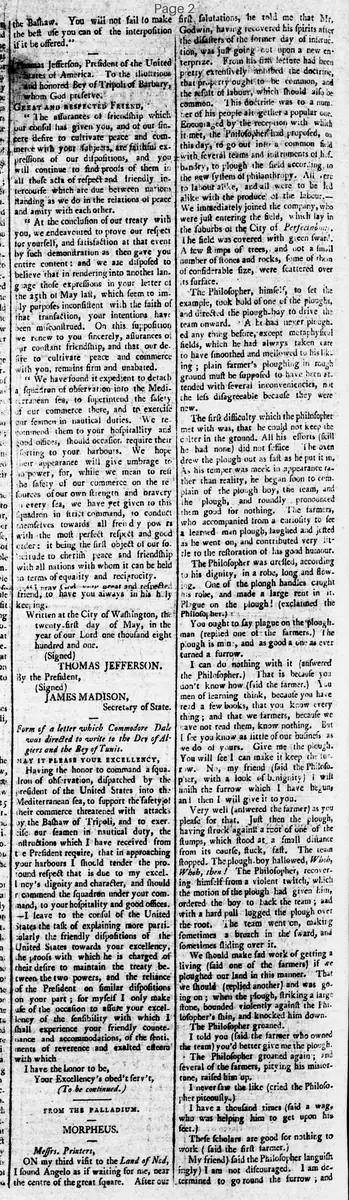
FROM THE PALLADIUM.
MORPHEUS.
Messrs. Printers,
ON my third visit to the Land of Nod, I found Angelo as if waiting for me, near the centre of the great square. After our first salutations, he told me that Mr. Godwin, having recovered his spirits after the disasters of the former day of instruction, was just going out upon a new enterprise. From his first lecture had been pretty extensively imbibed the doctrine that property ought to be common, and the fruits of labour, which should also be common. This doctrine was to a number of his people altogether a popular one. Encouraged by the reception with which it met, the Philosopher had proposed, on this day, to go out into a common field with several teams and instruments of husbandry, to plough the field according to the new system of philanthropy. All were to labour alike, and all were to be fed alike with the produce of the labour.
We immediately joined the company, who were just entering the field, which lay in the suburbs of the City of Perfection. The field was covered with green sward. A few stumps of trees, and not a small number of stones and rocks, some of them of considerable size, were scattered over its surface.
The Philosopher, himself, to set the example, took hold of one of the ploughs and directed the plough-boy to drive the team onward. As he had never ploughed any thing before, except metaphysical fields, which he had always taken care to have smoothed and mellowed to his liking; plain farmer's ploughing in rough ground must be opposed to have been attended with several inconveniencies, not the less disagreeable because they were new.
The first difficulty which the philosopher met with was, that he could not keep the coulter in the ground. All his efforts (skill he had none) did not suffice. The oxen drew the plough out as fast as he put it in. As his temper was meek in appearance rather than reality, he began soon to complain of the plough boy, the team, and the plough, and roundly pronounced them good for nothing. The farmers, who accompanied from a curiosity to see a learned man plough, laughed and jested as he went on, and contributed very little to the restoration of his good humour.
The Philosopher was attired, according to his dignity, in a robe, long and flowing. One of the plough handles caught his robe, and made a large rent in it.
Plague on the plough! (exclaimed the Philosopher.)
You ought to say plague on the ploughman (replied one of the farmers.) The plough is mine, and as good a one as ever turned a furrow.
I can do nothing with it (answered the Philosopher.) That is because you don't know how (said the farmer.) You men of learning think, because you have read a few books, that you know everything; and that we farmers, because we have not read them, know nothing. But I see you know as little of our business as we do of yours. Give me the plough. You will see I can make it keep the furrow.
No, my friend (said the Philosopher, with a look of benignity) I will finish the furrow which I have begun, and then I will give it to you.
Very well (answered the farmer) as you please for that. Just then the plough, having struck against a root of one of the stumps, which stood at a small distance from its course, stuck fast. The team stopped. The plough-boy hallowed. Whoa, Whoa, then! The Philosopher, recovering himself from a violent twitch, which the motion of the plough had given him, ordered the boy to back the team; and with a hard pull lugged the plough over the root. The team went on, making sometimes a breach in the sward, and sometimes sliding over it.
We should make bad work of getting a living (said one of the farmers) if we ploughed our land in this manner. That we should (replied another) and was going on; when the plough, striking a large stone, bounded violently against the Philosopher's shin, and knocked him down.
The Philosopher groaned.
I told you (said the farmer who owned the team) you'd better give me the plough.
The Philosopher groaned again; and several of the farmers, pitying his misfortune, raised him up.
I never saw the like (cried the Philosopher piteously.)
I have a thousand times (said a wag, who was helping him to get upon his feet.)
These scholars are good for nothing to work (said the first farmer.)
My friend (said the Philosopher languishingly) I am not discouraged. I am determined to go round the furrow; and taking hold of the plough again, bade the team go on. In the circuit he met with several other misadventures; but without any serious disaster arrived at the place whence he had set out.
There my friends (said he, smilingly) I have for you the example. We are all a band of brothers; all friends, all equals. Let us join heart and hand in one common cause: the promotion of the common good. Let us show the world a glorious pattern of philanthropy and equality. Let us begin the work of perfecting man. Henceforth be selfishness excluded from society. Henceforth be the Universe one great common stock, in one common garner.
Divine Philanthropy! the high attribute of Man; of Man, that Creature of Perfection.; that Child of Mental Energy.: born to live, and raise, and improve forever.
As the Philosopher was going on; his eye kindled, his hand was extended, and his mouth opened wider, for a sublimer display of philosophical eloquence, when, sad to tell: he happened to cast a look on his right hand, which he had extended in a graceful attitude almost before him, and saw a livid coloured spot of the size of half a dollar.--Mercy (cried he) What is this? My hand is mortified; and with a most malignant and rapid gangrene. It has covered one quarter of the hand already. I shall be a dead man before I reach home.
The tone in which this was spoken, the paleness of his countenance, and the staring of his eyes alarmed the crowd, who instantly thronged around him.
Let us see your hand (said the wag, with a look of much concern) let us see it Here it is, here it is (said the Philosopher, sadly) do you see the mortification?
Poh! (said the wag)-Why, Mr. Philosopher, it is nothing but a blood blister.
It is a mortification, (replied the Philosopher) I tell you.
And I (said the wag) tell you it is nothing but a blood blister. I have had fifty such on my own hands, and am not dead yet.
Are you certain, that it is nothing but a blood blister, my good friend?
it is nothing else (cried half a dozen voices at once.)
You have restored me to life, my good friends. I thought it had been a mortification; and, had that been the case, you know, as it spread so rapidly, it must have soon destroyed the energy of life.
You studied surgery, I suspect, (said the wag) under the same master, who taught you to plough.
Who will take the plough next (said the Philosopher.)
I (said the first farmer) I will show you how to manage a plough.
Accordingly he took it and went through the field like a man accustomed to the business. When he had returned, he offered it to another, who did the same. The other farmers also took the other ploughs and went their rounds, and all appeared to be in good humor.
[To be continued.]
MORPHEUS.
Messrs. Printers,
ON my third visit to the Land of Nod, I found Angelo as if waiting for me, near the centre of the great square. After our first salutations, he told me that Mr. Godwin, having recovered his spirits after the disasters of the former day of instruction, was just going out upon a new enterprise. From his first lecture had been pretty extensively imbibed the doctrine that property ought to be common, and the fruits of labour, which should also be common. This doctrine was to a number of his people altogether a popular one. Encouraged by the reception with which it met, the Philosopher had proposed, on this day, to go out into a common field with several teams and instruments of husbandry, to plough the field according to the new system of philanthropy. All were to labour alike, and all were to be fed alike with the produce of the labour.
We immediately joined the company, who were just entering the field, which lay in the suburbs of the City of Perfection. The field was covered with green sward. A few stumps of trees, and not a small number of stones and rocks, some of them of considerable size, were scattered over its surface.
The Philosopher, himself, to set the example, took hold of one of the ploughs and directed the plough-boy to drive the team onward. As he had never ploughed any thing before, except metaphysical fields, which he had always taken care to have smoothed and mellowed to his liking; plain farmer's ploughing in rough ground must be opposed to have been attended with several inconveniencies, not the less disagreeable because they were new.
The first difficulty which the philosopher met with was, that he could not keep the coulter in the ground. All his efforts (skill he had none) did not suffice. The oxen drew the plough out as fast as he put it in. As his temper was meek in appearance rather than reality, he began soon to complain of the plough boy, the team, and the plough, and roundly pronounced them good for nothing. The farmers, who accompanied from a curiosity to see a learned man plough, laughed and jested as he went on, and contributed very little to the restoration of his good humour.
The Philosopher was attired, according to his dignity, in a robe, long and flowing. One of the plough handles caught his robe, and made a large rent in it.
Plague on the plough! (exclaimed the Philosopher.)
You ought to say plague on the ploughman (replied one of the farmers.) The plough is mine, and as good a one as ever turned a furrow.
I can do nothing with it (answered the Philosopher.) That is because you don't know how (said the farmer.) You men of learning think, because you have read a few books, that you know everything; and that we farmers, because we have not read them, know nothing. But I see you know as little of our business as we do of yours. Give me the plough. You will see I can make it keep the furrow.
No, my friend (said the Philosopher, with a look of benignity) I will finish the furrow which I have begun, and then I will give it to you.
Very well (answered the farmer) as you please for that. Just then the plough, having struck against a root of one of the stumps, which stood at a small distance from its course, stuck fast. The team stopped. The plough-boy hallowed. Whoa, Whoa, then! The Philosopher, recovering himself from a violent twitch, which the motion of the plough had given him, ordered the boy to back the team; and with a hard pull lugged the plough over the root. The team went on, making sometimes a breach in the sward, and sometimes sliding over it.
We should make bad work of getting a living (said one of the farmers) if we ploughed our land in this manner. That we should (replied another) and was going on; when the plough, striking a large stone, bounded violently against the Philosopher's shin, and knocked him down.
The Philosopher groaned.
I told you (said the farmer who owned the team) you'd better give me the plough.
The Philosopher groaned again; and several of the farmers, pitying his misfortune, raised him up.
I never saw the like (cried the Philosopher piteously.)
I have a thousand times (said a wag, who was helping him to get upon his feet.)
These scholars are good for nothing to work (said the first farmer.)
My friend (said the Philosopher languishingly) I am not discouraged. I am determined to go round the furrow; and taking hold of the plough again, bade the team go on. In the circuit he met with several other misadventures; but without any serious disaster arrived at the place whence he had set out.
There my friends (said he, smilingly) I have for you the example. We are all a band of brothers; all friends, all equals. Let us join heart and hand in one common cause: the promotion of the common good. Let us show the world a glorious pattern of philanthropy and equality. Let us begin the work of perfecting man. Henceforth be selfishness excluded from society. Henceforth be the Universe one great common stock, in one common garner.
Divine Philanthropy! the high attribute of Man; of Man, that Creature of Perfection.; that Child of Mental Energy.: born to live, and raise, and improve forever.
As the Philosopher was going on; his eye kindled, his hand was extended, and his mouth opened wider, for a sublimer display of philosophical eloquence, when, sad to tell: he happened to cast a look on his right hand, which he had extended in a graceful attitude almost before him, and saw a livid coloured spot of the size of half a dollar.--Mercy (cried he) What is this? My hand is mortified; and with a most malignant and rapid gangrene. It has covered one quarter of the hand already. I shall be a dead man before I reach home.
The tone in which this was spoken, the paleness of his countenance, and the staring of his eyes alarmed the crowd, who instantly thronged around him.
Let us see your hand (said the wag, with a look of much concern) let us see it Here it is, here it is (said the Philosopher, sadly) do you see the mortification?
Poh! (said the wag)-Why, Mr. Philosopher, it is nothing but a blood blister.
It is a mortification, (replied the Philosopher) I tell you.
And I (said the wag) tell you it is nothing but a blood blister. I have had fifty such on my own hands, and am not dead yet.
Are you certain, that it is nothing but a blood blister, my good friend?
it is nothing else (cried half a dozen voices at once.)
You have restored me to life, my good friends. I thought it had been a mortification; and, had that been the case, you know, as it spread so rapidly, it must have soon destroyed the energy of life.
You studied surgery, I suspect, (said the wag) under the same master, who taught you to plough.
Who will take the plough next (said the Philosopher.)
I (said the first farmer) I will show you how to manage a plough.
Accordingly he took it and went through the field like a man accustomed to the business. When he had returned, he offered it to another, who did the same. The other farmers also took the other ploughs and went their rounds, and all appeared to be in good humor.
[To be continued.]
What sub-type of article is it?
Satire
Prose Fiction
What themes does it cover?
Political
Moral Virtue
What keywords are associated?
Satire
Philosopher
Godwin
Common Property
Plowing
Utopia
Philanthropy
Equality
What entities or persons were involved?
From The Palladium.
Literary Details
Title
Morpheus.
Author
From The Palladium.
Form / Style
Satirical Narrative
Key Lines
Plague On The Plough! (Exclaimed The Philosopher.)
You Ought To Say Plague On The Ploughman (Replied One Of The Farmers.)
Divine Philanthropy! The High Attribute Of Man; Of Man, That Creature Of Perfection.; That Child Of Mental Energy.: Born To Live, And Raise, And Improve Forever.
Mercy (Cried He) What Is This? My Hand Is Mortified; And With A Most Malignant And Rapid Gangrene.