Thank you for visiting SNEWPapers!
Sign up free
Editorial
December 6, 1872
Springfield Weekly Republican
Springfield, Hampden County, Massachusetts
What is this article about?
An editorial criticizes the U.S. government's proposed telegraph scheme, arguing it would expand federal power unnecessarily, fail to be profitable like the post office, risk political abuse, and set dangerous precedents, contrasting with private enterprise.
Clipping
OCR Quality
98%
Excellent
Full Text
The Government Telegraph Scheme.
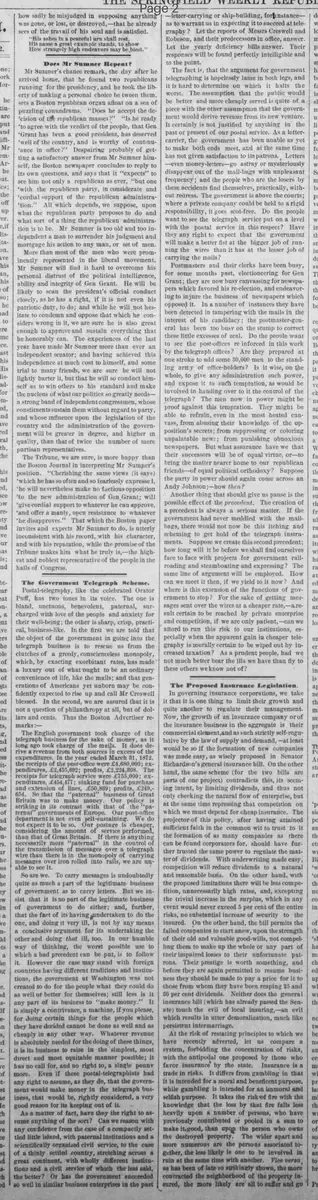
Postal-telegraphy, like the celebrated Orator Puff, has two tones in its voice. The one is bland, unctuous, benevolent, paternal, surcharged with love of the people and anxiety for their well-being: the other is sharp, crisp, practical, business-like. In the first we are told that the object of the government in going into the telegraph business is to rescue us from the clutches of a greedy, conscienceless monopoly, which, by exacting exorbitant rates, has made a luxury out of what ought to be an ordinary convenience of life, like the mails; and that generations of Americans yet unborn may be confidently expected to rise up and call Mr. Creswell blessed. In the second, we are assured that it is not a question of philanthropy at all, but of dollars and cents. Thus the Boston Advertiser remarks:
The English government took charge of the telegraph business for the sake of money, as it long ago took charge of the mails. It does derive a revenue from both sources in excess of the expenditures. In the year ended March 31, 1872, the receipts of the post-office were £4,680,000; expenditures, £2,455,692; profits, £2,224,308. The receipts for telegraph service were £755,000: expenditures, £454,477; sinking fund for purchase and extension of lines, £50,869: profits, £249,654. So that the "paternal" business of Great Britain was to make money. Our policy is striking in its contrast with that of the "paternal" governments of Europe. Our post-office department is not even self-sustaining. We do not expect it to be so. Our postage is cheaper, considering the amount of service performed, than that of Great Britain. If there is anything necessarily more "paternal" in the control of the transmission of messages over a telegraph wire than there is in the monopoly of carrying messages over iron rolled into rails, we are unable to see it.
So are we. To carry messages is undoubtedly quite as much a part of the legitimate business of government as to carry letters. But we insist that it is no part of the legitimate business of government to do either; and, further that the fact of its having undertaken to do the one, and doing it very ill, is not by any means a conclusive argument for its undertaking the other and doing that ill, too. In our humble way of thinking, the worst possible use to which a bad precedent can be put, is to follow it. However the case may stand with foreign countries having different traditions and institutions, the government at Washington was not created to do for the people what they could do as well or better for themselves; still less is it any part of its business to "make money." It is simply a contrivance, a machine, if you please, for doing certain things for the people which they have decided cannot be done as well and as cheaply in any other way. Whatever revenue is absolutely needed for the doing of these things, it is its business to raise in the simplest, most direct and most equitable manner possible: it has no call for, and no right to, a single penny more. Even if these postal-telegraphists had any right to assume, as they do, that the government would make money in the telegraph business, that would be, rightly considered, a very good reason for its keeping out of it. As a matter of fact, have they the right to assume anything of the sort? Can we reason with any confidence from the case of a compactly settled little island, with paternal institutions and a scientifically organized civil service, to the case of a thinly settled country, stretching across a great continent, with wholly different institutions and a civil service of which the less said the better? Or has the government succeeded so well in similar business enterprises in the past—letter-carrying or ship-building, for instance—as to warrant us in expecting it to succeed at telegraphy? Let the reports of Messrs. Creswell and Robeson, and their predecessors in office, answer. Let the yearly deficiency bills answer. Their responses will be found perfectly intelligible and to the point. The fact is, that the argument for government telegraphing is hopelessly lame in both legs, and it is hard to determine on which it halts the worst. The assumption that the public would be better and more cheaply served is quite of a piece with the other assumption that the government would derive revenue from its new venture. It certainly is not justified by anything in the past or present of our postal service. As a letter-carrier, the government has been unable as yet to make both ends meet, and at the same time has not given satisfaction to its patrons. Letters—even money-letters—go astray or mysteriously disappear out of the mail-bags with unpleasant frequency; and the people who are the losers by these accidents find themselves, practically, without redress. The government is above the courts; where a private company could be held to a rigid responsibility, it goes scot-free. Do the people want to see the telegraph service put on a level with the postal service in this respect? Have they any right to expect that the government will make a better fist at the bigger job of running the wires than it has at the lesser job of carrying the mails? Postmasters and their clerks have been busy, for some months past, electioneering for Gen. Grant; they are now busy canvassing for newspapers which favored his re-election, and endeavoring to injure the business of newspapers which opposed it. In a number of instances they have been detected in tampering with the mails in the interest of his candidacy; the postmaster-general has been too busy on the stump to correct these little excesses of zeal. Do the people want to see the post-offices reinforced in this work by the telegraph offices? Are they prepared at one stroke to add some 80,000 men to the standing army of office-holders? Is it wise, on the whole, to give any administration such power, and expose it to such temptation, as would be involved in handing over to it the control of the telegraph? The men now in power might be proof against this temptation. They might be able to refrain, even in the most heated canvass, from abusing their knowledge of the opposition's secrets; from suppressing or coloring unpalatable news; from punishing obnoxious newspapers. But what assurance have we that their successors will be of equal virtue, or—to bring the matter nearer home to our republican friends—of equal political orthodoxy? Suppose the party in power should again come across an Andy Johnson:—how then? Another thing that should give us pause is the possible effect of the precedent. The creation of a precedent is always a serious matter. If the government had never meddled with the mail-bags, there would not now be this itching and scheming to get hold of the telegraph instruments. Suppose we create this second precedent; how long will it be before we shall find ourselves face to face with projects for government railroading and steamboating and expressing? The same line of argument will be employed. How can we meet it then, if we yield to it now? And where is this extension of the functions of government to stop? For the sake of getting messages sent over the wires at a cheaper rate,—a result certain to be reached by private enterprise and competition, if we are only patient,—can we afford to run this risk to our institutions, especially when the apparent gain in cheaper telegraphy is morally certain to be wiped out by increased taxation? As a prudent people, had we not much better bear the ills we have than fly to these others we know not of?
Postal-telegraphy, like the celebrated Orator Puff, has two tones in its voice. The one is bland, unctuous, benevolent, paternal, surcharged with love of the people and anxiety for their well-being: the other is sharp, crisp, practical, business-like. In the first we are told that the object of the government in going into the telegraph business is to rescue us from the clutches of a greedy, conscienceless monopoly, which, by exacting exorbitant rates, has made a luxury out of what ought to be an ordinary convenience of life, like the mails; and that generations of Americans yet unborn may be confidently expected to rise up and call Mr. Creswell blessed. In the second, we are assured that it is not a question of philanthropy at all, but of dollars and cents. Thus the Boston Advertiser remarks:
The English government took charge of the telegraph business for the sake of money, as it long ago took charge of the mails. It does derive a revenue from both sources in excess of the expenditures. In the year ended March 31, 1872, the receipts of the post-office were £4,680,000; expenditures, £2,455,692; profits, £2,224,308. The receipts for telegraph service were £755,000: expenditures, £454,477; sinking fund for purchase and extension of lines, £50,869: profits, £249,654. So that the "paternal" business of Great Britain was to make money. Our policy is striking in its contrast with that of the "paternal" governments of Europe. Our post-office department is not even self-sustaining. We do not expect it to be so. Our postage is cheaper, considering the amount of service performed, than that of Great Britain. If there is anything necessarily more "paternal" in the control of the transmission of messages over a telegraph wire than there is in the monopoly of carrying messages over iron rolled into rails, we are unable to see it.
So are we. To carry messages is undoubtedly quite as much a part of the legitimate business of government as to carry letters. But we insist that it is no part of the legitimate business of government to do either; and, further that the fact of its having undertaken to do the one, and doing it very ill, is not by any means a conclusive argument for its undertaking the other and doing that ill, too. In our humble way of thinking, the worst possible use to which a bad precedent can be put, is to follow it. However the case may stand with foreign countries having different traditions and institutions, the government at Washington was not created to do for the people what they could do as well or better for themselves; still less is it any part of its business to "make money." It is simply a contrivance, a machine, if you please, for doing certain things for the people which they have decided cannot be done as well and as cheaply in any other way. Whatever revenue is absolutely needed for the doing of these things, it is its business to raise in the simplest, most direct and most equitable manner possible: it has no call for, and no right to, a single penny more. Even if these postal-telegraphists had any right to assume, as they do, that the government would make money in the telegraph business, that would be, rightly considered, a very good reason for its keeping out of it. As a matter of fact, have they the right to assume anything of the sort? Can we reason with any confidence from the case of a compactly settled little island, with paternal institutions and a scientifically organized civil service, to the case of a thinly settled country, stretching across a great continent, with wholly different institutions and a civil service of which the less said the better? Or has the government succeeded so well in similar business enterprises in the past—letter-carrying or ship-building, for instance—as to warrant us in expecting it to succeed at telegraphy? Let the reports of Messrs. Creswell and Robeson, and their predecessors in office, answer. Let the yearly deficiency bills answer. Their responses will be found perfectly intelligible and to the point. The fact is, that the argument for government telegraphing is hopelessly lame in both legs, and it is hard to determine on which it halts the worst. The assumption that the public would be better and more cheaply served is quite of a piece with the other assumption that the government would derive revenue from its new venture. It certainly is not justified by anything in the past or present of our postal service. As a letter-carrier, the government has been unable as yet to make both ends meet, and at the same time has not given satisfaction to its patrons. Letters—even money-letters—go astray or mysteriously disappear out of the mail-bags with unpleasant frequency; and the people who are the losers by these accidents find themselves, practically, without redress. The government is above the courts; where a private company could be held to a rigid responsibility, it goes scot-free. Do the people want to see the telegraph service put on a level with the postal service in this respect? Have they any right to expect that the government will make a better fist at the bigger job of running the wires than it has at the lesser job of carrying the mails? Postmasters and their clerks have been busy, for some months past, electioneering for Gen. Grant; they are now busy canvassing for newspapers which favored his re-election, and endeavoring to injure the business of newspapers which opposed it. In a number of instances they have been detected in tampering with the mails in the interest of his candidacy; the postmaster-general has been too busy on the stump to correct these little excesses of zeal. Do the people want to see the post-offices reinforced in this work by the telegraph offices? Are they prepared at one stroke to add some 80,000 men to the standing army of office-holders? Is it wise, on the whole, to give any administration such power, and expose it to such temptation, as would be involved in handing over to it the control of the telegraph? The men now in power might be proof against this temptation. They might be able to refrain, even in the most heated canvass, from abusing their knowledge of the opposition's secrets; from suppressing or coloring unpalatable news; from punishing obnoxious newspapers. But what assurance have we that their successors will be of equal virtue, or—to bring the matter nearer home to our republican friends—of equal political orthodoxy? Suppose the party in power should again come across an Andy Johnson:—how then? Another thing that should give us pause is the possible effect of the precedent. The creation of a precedent is always a serious matter. If the government had never meddled with the mail-bags, there would not now be this itching and scheming to get hold of the telegraph instruments. Suppose we create this second precedent; how long will it be before we shall find ourselves face to face with projects for government railroading and steamboating and expressing? The same line of argument will be employed. How can we meet it then, if we yield to it now? And where is this extension of the functions of government to stop? For the sake of getting messages sent over the wires at a cheaper rate,—a result certain to be reached by private enterprise and competition, if we are only patient,—can we afford to run this risk to our institutions, especially when the apparent gain in cheaper telegraphy is morally certain to be wiped out by increased taxation? As a prudent people, had we not much better bear the ills we have than fly to these others we know not of?
What sub-type of article is it?
Economic Policy
Infrastructure
Partisan Politics
What keywords are associated?
Government Telegraphy
Postal Service
Monopoly
Political Corruption
Precedent
Private Enterprise
Fiscal Policy
What entities or persons were involved?
Mr. Creswell
Gen. Grant
Andy Johnson
Boston Advertiser
English Government
Postmaster General
Messrs. Robeson
Editorial Details
Primary Topic
Opposition To Government Telegraph Scheme
Stance / Tone
Strongly Against Government Involvement In Telegraphy
Key Figures
Mr. Creswell
Gen. Grant
Andy Johnson
Boston Advertiser
English Government
Postmaster General
Messrs. Robeson
Key Arguments
Government Should Not Enter Telegraph Business As It Is Not Its Legitimate Role
Post Office Is Not Self Sustaining And Performs Poorly
Risk Of Political Abuse And Corruption In Telegraph Control
Setting Precedent For Further Government Expansion Into Private Sectors
Private Enterprise Will Achieve Cheaper Rates Through Competition
Comparison To British Success Is Invalid Due To Different Contexts