Thank you for visiting SNEWPapers!
Sign up free
Douglas Daily Dispatch
Douglas, Cochise County, Arizona
What is this article about?
Japanese Premier Baron Tanaka's conservative cabinet resigned to Emperor Hirohito on July 2 amid criticism over foreign policy, including the Kellogg Pact and the Chang Tso-lin assassination investigation. Liberal leader Yugo Hamaguchi is expected to form a new government.
Clipping
OCR Quality
Full Text
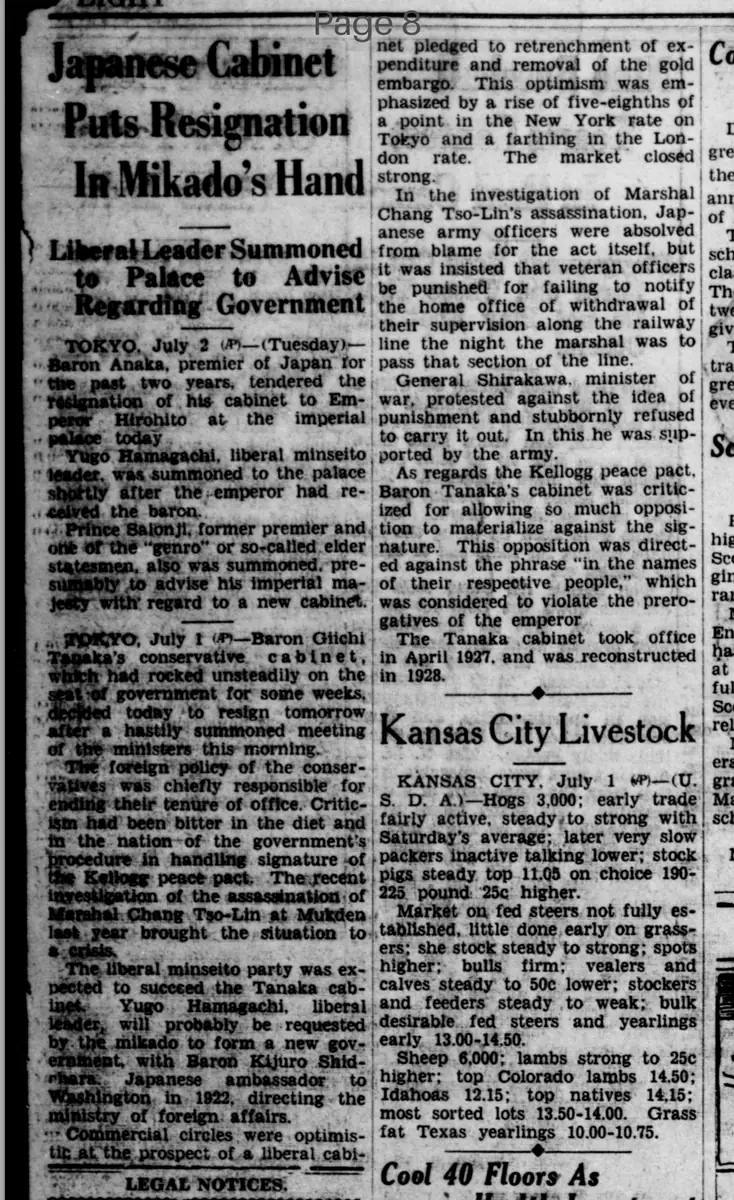
Liberal Leader Summoned to Palace to Advise Regarding Government
TOKYO, July 2 (P)—Baron Tanaka, premier of Japan for the past two years, tendered the resignation of his cabinet to Emperor Hirohito at the imperial palace today. Yugo Hamaguchi, liberal minseito leader, was summoned to the palace shortly after the emperor had received the baron. Prince Saionji, former premier and one of the "genro" or so-called elder statesmen, also was summoned, presumably to advise his imperial majesty with regard to a new cabinet.
TOKYO, July 1 (P)—Baron Giichi Tanaka's conservative cabinet which had rocked unsteadily on the seat of government for some weeks, decided today to resign tomorrow after a hastily summoned meeting of the ministers this morning. The foreign policy of the conservatives was chiefly responsible for ending their tenure of office. Criticism had been bitter in the diet and in the nation of the government's procedure in handling signature of the Kellogg peace pact. The recent investigation of the assassination of Marshal Chang Tso-lin at Mukden last year brought the situation to crisis.
The liberal minseito party was expected to succeed the Tanaka cabinet. Yugo Hamaguchi, liberal leader, will probably be requested by the mikado to form a new government, with Baron Kijuro Shidehara, Japanese ambassador to Washington in 1927, directing the ministry of foreign affairs. Commercial circles were optimistic at the prospect of a liberal cabinet.
Net pledged to retrenchment of expenditure and removal of the gold embargo. This optimism was emphasized by a rise of five-eighths of a point in the New York rate on Tokyo and a farthing in the London rate.
The market closed strong.
In the investigation of Marshal Chang Tso-lin's assassination, Japanese army officers were absolved from blame for the act itself, but it was insisted that veteran officers be punished for failing to notify the home office of withdrawal of their supervision along the railway line the night the marshal was to pass that section of the line. General Shirakawa, minister of war, protested against the idea of punishment and stubbornly refused to carry it out. In this he was supported by the army.
As regards the Kellogg peace pact, Baron Tanaka's cabinet was criticized for allowing so much opposition to materialize against the signature. This opposition was directed against the phrase "in the names of their respective people," which was considered to violate the prerogatives of the emperor.
The Tanaka cabinet took office in April 1927, and was reconstructed in 1928.
What sub-type of article is it?
What keywords are associated?
What entities or persons were involved?
Where did it happen?
Foreign News Details
Primary Location
Tokyo
Event Date
July 2
Key Persons
Outcome
resignation of the conservative cabinet; liberal minseito party expected to form new government with focus on retrenchment and removal of gold embargo; market optimism reflected in rising exchange rates.
Event Details
Baron Tanaka's cabinet resigned to Emperor Hirohito due to criticism over handling of the Kellogg peace pact signature and the investigation into Marshal Chang Tso-lin's assassination, which implicated army oversight failures. Yugo Hamaguchi summoned to advise on new cabinet; liberals anticipated to succeed with Baron Shidehara in foreign affairs.