Thank you for visiting SNEWPapers!
Sign up free
The Middlebury People's Press
Middlebury, Addison County, Vermont
What is this article about?
U.S. House debates and amends the Tariff Bill in Washington from July 12-16, adjusting duties on wool, iron, coal, hides, cotton, tea, coffee, and textiles through various motions and votes by members like Fillmore, Slade, and Everett.
Merged-components note: Merged sequential reports on congressional proceedings regarding the Tariff Bill.
Clipping
OCR Quality
Full Text
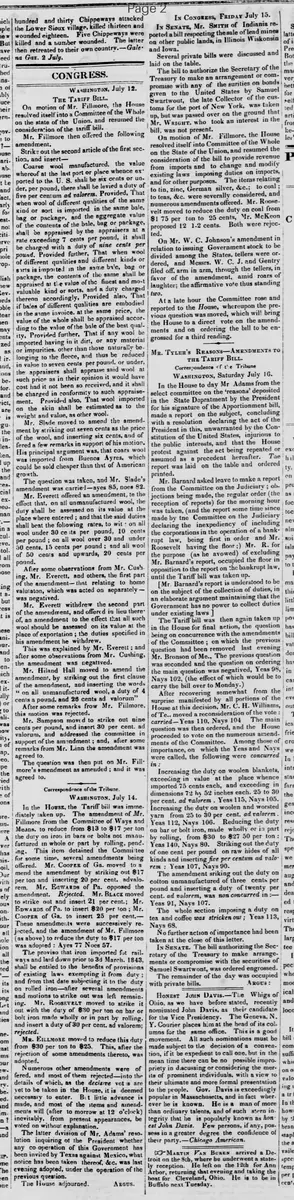
WASHINGTON, July 12.
The Tariff Bill.
On motion of Mr. Fillmore, the House resolved itself into a Committee of the Whole on the state of the Union, and resumed the consideration of the tariff bill.
Mr. Fillmore then offered the following amendment.
Strike out the second article of the first section, and insert—
Coarse wool manufactured, the value whereof at the last port or place whence exported to the U. S. shall be six cents or under, per pound, there shall be levied a duty of five per centum ad valorem. Provided, That under, per pound, there shall be levied a duty of. When wool of different qualities of the same kind or sort is imported in the same bale, bag or package, and the aggregate value of the contents of the bale, bag or package, shall be appraised by the appraisers at a rate exceeding 7 cents per pound, it shall. Pound. Provided further, That when wool be charged with a duty of nine cents per. Of different qualities and different kinds or sorts is imported in the same bale, bag or package, the contents of the same shall be appraised at the value of the finest and most valuable kind or sorts, and a duty charged thereon accordingly, Provided also, That in the same invoice, at the same price, the if bales of different qualities are embodied value of the whole shall be appraised according to the value of the bale of the best quality, Provided further, That if any wool be imported having in it dirt, or any material or impurities, other than those naturally belonging to the fleece, and thus be reduced in value to seven cents per pound, or under the appraisers shall appraise said wool at such price as in their opinion it would have cost had it not been so received, and it shall be charged in conformity to such appraisement. Provided also, That wool imported on the skin shall be estimated as to the weight and value, as other wool.
Mr. Slade moved to amend the amendment by striking out seven cents as the price of the wool, and inserting six cents, and offered a few remarks in support of his motion. His principal argument was, that coarse wool was imported from Buenos Ayres, which could be sold cheaper than that of American growth.
The question was taken, and Mr. Slade's amendment was carried—ayes 85, noes 82.
Mr. Everett offered an amendment, to the effect that, on all unmanufactured wool, the duty shall be assessed on its value at the place where entered; and that the said duties shall be at the following rates, to wit: on all wool under 30 cents per pound, 10 cents per pound; on all wool over 30 and under 50 cents, 15 cents per pound; and all wool of 50 cents and upwards, 20 cents per pound.
After some observations from Mr. Cushing, Mr. Everett, and others, the first part of the amendment—that relating to home valuation, which was acted on separately—was negatived.
Mr. Everett withdrew the second part of the amendment, and offered in lieu thereof, an amendment to the effect that all such wool should be assessed on its value at the place of exportation; the duties specified in his amendment he withdrew.
This was explained by Mr. Everett; and after some observations from Mr. Cushing, the amendment was negatived.
Mr. Hiland Hall moved to amend the amendment, by striking out the first clause of the amendment, and inserting the words "on all unmanufactured wool, a duty of 4 cents a pound, and 26 cents ad valorem"
After some remarks from Mr. Fillmore, this motion was rejected.
Mr. Sampson moved to strike out nine cents per pound, and insert 30 per cent. ad valorem, and addressed the committee in support of the amendment; and, after some remarks from Mr. Linn the amendment was agreed to.
The question was then put on Mr. Fillmore's amendment as amended; and it was agreed to.
Correspondence of the Tribune.
WASHINGTON, July 14.
In the House, the Tariff bill was immediately taken up. The amendment of Mr. Fillmore from the Committee of Ways and Means, to reduce from $30 to $17 per ton the duty on iron in bars or bolts not manufactured in whole or part by rolling, pending. This item detained the Committee for some time, several amendments being offered. Mr. Cooper of Ga. moved to amend the amendment by striking out $17 per ton and inserting 20 per cent. ad valorem. Mr. Edwards of Pa. opposed the amendment. Rejected. Mr. Black moved to strike out and insert 21 per cent.; Mr. Edwards of Pa. to insert $20 per ton; Mr. Cooper of Ga. to insert 25 per cent.—These amendments were successively rejected, and the amendment of Mr. Fillmore (as above) to reduce the duty to $17 per ton was adopted: Ayes 77 Noes 57.
The proviso that iron imported for rail roads and laid down prior to 3d March, 1843, shall be entitled to the benefits of provisions of existing laws exempting it from duty; and from that date subjecting it to the duty on rolled iron—after several amendments and motions to strike out was let remain.
Mr. Roosevelt moved to strike it out with the duty of 30 per ton on bar or bolt iron made wholly or in part by rolling and insert a duty of 30 per cent. ad valorem; rejected.
Mr. Fillmore moved to reduce this duty from $30 per ton to 25. This, after the rejection of some amendments thereto, was adopted.
Numerous other amendments were offered, and most of them rejected—into the details of which, as the decisive votes are yet to be taken in the House, it is deemed necessary to enter. But little advance is made, and most of the items and amendments will (after to-morrow at 12 o'clock) inevitably, from present appearances, be voted on without explanation.
The latter division of Mr. Adams' resolution inquiring of the President whether any co-operation of this Government has been invited by Texas against Mexico, what notice has been taken thereof, &c., was last evening adopted, under the operation of the previous question.
The House adjourned.
ARGUS.
In Congress, Friday July 15.
In Senate, Mr. Smith of Indiana reported a bill respecting the sale of lead mines on other public lands, in Illinois, Wisconsin and Iowa.
Several private bills were discussed and laid on the table.
The bill to authorize the Secretary of the Treasury to make an arrangement or compromise with any of the sureties on bonds given to the United States by Samuel Swartwout, the late Collector of the customs for the port of New York, was taken up, but was passed over on the ground that Mr. Wright, who took an interest in the bill, was not present.
On motion of Mr. Fillmore, the House resolved itself into Committee of the Whole on the State of the Union, and resumed the consideration of the bill to provide revenue from imports and to change and modify existing laws imposing duties on imports, and for other purposes. The items relating to tin, zinc, German silver, &c.; to coal; to teas, &c. were severally considered, and numerous amendments offered. Mr. Roosevelt moved to reduce the duty on coal from $1 75 per ton to 25 cents, Mr. McKeon proposed 12 1/2 cents. Both were rejected.
On Mr. W. C. Johnson's amendment in relation to issuing Government stock to be divided among the States, tellers were ordered, and Messrs. W. C. J. and Gentry filed off, arm in arm, through the tellers, in favor of the amendment, amid roars of laughter; the affirmative vote thus standing two.
At a late hour the Committee rose and reported to the House, whereupon the previous question was moved, which will bring the House to a direct vote on the amendments and on ordering the bill to be engrossed for a third reading.
Mr. Tyler's Reasons—Amendments to The Tariff Bill.
Correspondence of the Tribune
WASHINGTON, Saturday July 16.
In the House to day Mr Adams from the select committee on the 'reasons' deposited for his signature of the Apportionment bill, in the State Department by the President made a report on the subject, concluding with a resolution declaring the act of the President in this, unwarranted by the Constitution of the United States, injurious to the public interests, and that the House protest against the act being repeated or assumed as a precedent hereafter. The report was laid on the table and ordered printed.
Mr. Barnard asked leave to make a report from the Committee on the Judiciary; objections being made, the regular order (the reception of reports) for the morning hour was taken. (and the report some time since made by the Committee on the Judiciary declaring the inexpediency of including the corporations in the operation of a bankrupt law, being first in order and Mr. Roosevelt having the floor;) Mr. R. for the purpose (as he avowed) of excluding Mr. Barnard's report, occupied the floor in opposition to the report on the bankrupt law, until the Tariff bill was taken up.
[Mr. Barnard's report is understood to be on the subject of the collection of duties, in an elaborate argument maintaining that the Government has no power to collect duties under existing laws]
The Tariff bill was then again taken up in the House for final action, the question being on concurrence with the amendments of the Committee: on which the previous question had been removed last evening Mr. Bronson of Me., The previous question was seconded and the question on ordering the main question was negatived, Yeas 98. Nays 102, (the effect of which would be to carry the bill over to Monday.)
After recovering somewhat from the surprise manifested by all portions of the House at this decision, Mr. C. H. Williams of Te., moved a reconsideration of the vote: carried—Yeas 110, Nays 104. The main question was then ordered, and the House proceeded to vote on the numerous amendments of the Committee. Among those of importance, on which the Yeas and Nays were called, the following were concurred in:
Increasing the duty on woolen blankets, exceeding in value at the place whence imported 75 cents each, and exceeding in dimensions 72 by 52 inches each, 25 to 30 per cent. ad valorem. Yeas 115, Nays 105.
Increasing the duty on woolen and worsted yarn from 25 to 30 per cent. ad valorem. Yeas 112. Nays 106. Reducing the duty on bar or bolt iron, made wholly or in part by rolling, from $30 to $27 50 per ton: Yeas 140, Nays 80. Striking out the duty of one cent per pound on raw hides of all kinds and inserting five per centum ad valorem: Yeas 107. Nays 90.
The amendment striking out the duty on cotton unmanufactured of three cents per pound and inserting a duty of twenty per cent. ad valorem, was non concurred in:—Yeas 91. Nays 107.
The whole section imposing a duty on tea and coffee was stricken out; Yeas 113, Nays 68.
No further action of importance had been taken at the close of this letter.
In Senate. The bill authorizing the Secretary of the Treasury to make arrangements or compromise with the securities of Samuel Swartwout, was ordered engrossed.
The remainder of the day was occupied with private bills.
ARGUS.
What sub-type of article is it?
What keywords are associated?
What entities or persons were involved?
Where did it happen?
Story Details
Key Persons
Location
Washington
Event Date
July 12 To July 16
Story Details
Proceedings in the House of Representatives on the Tariff Bill, including amendments and votes on duties for coarse wool (reduced to six cents per pound threshold), iron (reduced to $17 per ton for bars or bolts, $25 per ton for rolled), coal, tea, coffee, raw hides, cotton, woolen blankets, and yarn; other bills discussed include those on lead mines, Swartwout sureties, apportionment, and bankrupt law.