Thank you for visiting SNEWPapers!
Sign up free
Story
May 24, 1803
The New Hampshire Gazette
Portsmouth, Rockingham County, New Hampshire
What is this article about?
A theological critique titled 'Remarks on Dr. Hemenway's discourse upon the divine institution of Water Baptism, No. II,' argues that Dr. Hemenway's work implies baptism is for believers only, not infants, by analyzing biblical examples like Cornelius and the Eunuch, highlighting defects in his interpretation.
Clipping
OCR Quality
95%
Excellent
Full Text
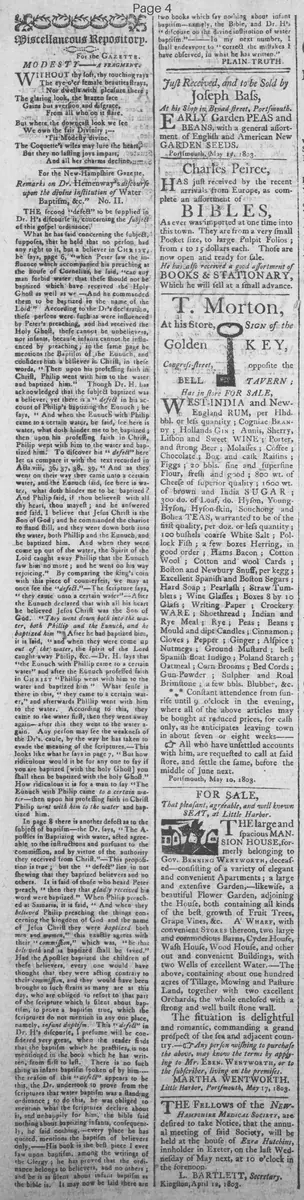
Remarks on Dr. Hemenway's discourse upon the divine institution of Water Baptism, &c. No. II.
THE second "defect" to be supplied in Dr. H's discourse is, concerning the subject of this gospel ordinance!! What he has said concerning the subject, supposes, that he held that no person had any right to it, but a believer in Christ, he says, page 6, "when Peter saw the influence which accompanied his preaching at the House of Cornelius, he said, 'can any man forbid water that these should not be baptized which have received the Holy Ghost as well as we.'—And he commanded them to be baptized in the name of the Lord" According to the Dr's declaration, these persons were such as were influenced by Peter's preaching, and had received the Holy Ghost, these cannot be unbelievers, nor infants, because infants cannot be influenced by preaching; in the same page he mentions the Baptism of the Eunuch, and considers him a believer in Christ, in these words, "Then upon his professing faith in Christ, Philip went with him to the water and baptized him." Though Dr. H. has acknowledged that the subject baptized was believer, yet there is a … defect in his account of Philip's baptizing the Eunuch ; he says, "And when the Eunuch with Philip came to a certain water, he said, 'lo here is water, what doth hinder me to be baptized;' then upon his professing faith in Christ, Philip went with him to the water and baptized him." To discover his "defect" here let us compare it with the text recorded in Acts viii, 36, 37, 38, 39, "And as they went on their way they came unto a certain water, and the Eunuch said, 'lo here is water, what doth hinder me to be baptized ?' And Philip said, 'if thou believest with all thy heart, thou mayest ;' and he answered and said, 'I believe that Jesus Christ is the Son of God;' and he commanded the chariot to stand still, and they went down both into the water, both Philip and the Eunuch, and he baptized him. And when they were come up out of the water, the Spirit of the Lord caught away Philip that the Eunuch saw him no more; and he went on his way rejoicing." By comparing the king's coin with this piece of counterfeit, we may at once see the "defect."—The scripture says, "they came unto a certain water"—After the Eunuch declared that with all his heart he believed Jesus Christ was the Son of God. "They went down both into the water, both Philip and the Eunuch, and he baptized him" After he had baptized him, it is said, "and when they were come up out of the water, the spirit of the Lord caught away Philip, &c."—Dr. H. says that "the Eunuch with Philip came to a certain water" and after the Eunuch professed faith in Christ "Philip went with him to the water and baptized him" What else is there in this, "they came to a certain water," and afterwards Philip went with him to the water. According to this, they came to the water first, then they went away again—after this they went to the water again. Any person may see the weakness of the Dr's. cause, by the way he has taken to evade the meaning of the scriptures.—This looks like what he says in page 7, "But how ridiculous would it be for any one to say if you are baptized [with the holy Ghost] you shall then be baptized with the holy Ghost." How ridiculous it is for a man to say "The Eunuch with Philip came to a certain water—then upon his professing faith in Christ Philip went with him to the water and baptized him."
In page 8 there is another defect as to the subject of baptism—the Dr. says, "The Apostles in Baptizing with water, acted agreeable to the instructions and pursuant to the commission, and by virtue of the authority they received from Christ."—This proposition is true ; but the "defect" lies in not showing that they baptized believers and no others. It is said of those who heard Peter preach, "then they that gladly received his word were baptized." When Philip preached at Samaria, it is said, "And when they believed Philip preaching the things concerning the kingdom of God and the name of Jesus Christ they were baptized both men and women," this exactly agrees with their "commission," which was, "he that believeth and is baptized shall be saved." Had the Apostles baptized the children of these believers, every one would have thought that, they were acting contrary to their commission, and they would have been brought to such straits as many are at this day, who are obliged to resort to that part of the scripture which is silent about baptism, to prove a baptism true, which the scriptures do not mention in any one place, namely, infant baptism. This "defect" in Dr. H's discourse, I presume will be considered very great, when the reader finds that the baptism which he practices, is not mentioned in the book which he has written, from first to last. There is no such thing as infant baptism spoken of by him--- the reason of this "defect" appears to be this, the Dr. undertook to prove from the scriptures that water baptism was a standing ordinance ; to do this, he was obliged to mention what the scriptures declare about it, and unhappily for him, the bible said nothing about baptizing infants, consequently, he said nothing,---every place he has quoted, mentions the baptism of believers only. --His book is the best piece I ever saw upon baptism, among the writings of the Clergy; he has proved that the ordinance belongs to believers, and no others ; and he is as silent about infant baptism as the bible is. It may now be said there are two books which have nothing about infant baptism---namely, the Bible, and Dr. H's "discourse on the divine institution of water baptism."
In my next number, I shall endeavour to "correct the mistakes I have observed, in what he has written."
PLAIN TRUTH
THE second "defect" to be supplied in Dr. H's discourse is, concerning the subject of this gospel ordinance!! What he has said concerning the subject, supposes, that he held that no person had any right to it, but a believer in Christ, he says, page 6, "when Peter saw the influence which accompanied his preaching at the House of Cornelius, he said, 'can any man forbid water that these should not be baptized which have received the Holy Ghost as well as we.'—And he commanded them to be baptized in the name of the Lord" According to the Dr's declaration, these persons were such as were influenced by Peter's preaching, and had received the Holy Ghost, these cannot be unbelievers, nor infants, because infants cannot be influenced by preaching; in the same page he mentions the Baptism of the Eunuch, and considers him a believer in Christ, in these words, "Then upon his professing faith in Christ, Philip went with him to the water and baptized him." Though Dr. H. has acknowledged that the subject baptized was believer, yet there is a … defect in his account of Philip's baptizing the Eunuch ; he says, "And when the Eunuch with Philip came to a certain water, he said, 'lo here is water, what doth hinder me to be baptized;' then upon his professing faith in Christ, Philip went with him to the water and baptized him." To discover his "defect" here let us compare it with the text recorded in Acts viii, 36, 37, 38, 39, "And as they went on their way they came unto a certain water, and the Eunuch said, 'lo here is water, what doth hinder me to be baptized ?' And Philip said, 'if thou believest with all thy heart, thou mayest ;' and he answered and said, 'I believe that Jesus Christ is the Son of God;' and he commanded the chariot to stand still, and they went down both into the water, both Philip and the Eunuch, and he baptized him. And when they were come up out of the water, the Spirit of the Lord caught away Philip that the Eunuch saw him no more; and he went on his way rejoicing." By comparing the king's coin with this piece of counterfeit, we may at once see the "defect."—The scripture says, "they came unto a certain water"—After the Eunuch declared that with all his heart he believed Jesus Christ was the Son of God. "They went down both into the water, both Philip and the Eunuch, and he baptized him" After he had baptized him, it is said, "and when they were come up out of the water, the spirit of the Lord caught away Philip, &c."—Dr. H. says that "the Eunuch with Philip came to a certain water" and after the Eunuch professed faith in Christ "Philip went with him to the water and baptized him" What else is there in this, "they came to a certain water," and afterwards Philip went with him to the water. According to this, they came to the water first, then they went away again—after this they went to the water again. Any person may see the weakness of the Dr's. cause, by the way he has taken to evade the meaning of the scriptures.—This looks like what he says in page 7, "But how ridiculous would it be for any one to say if you are baptized [with the holy Ghost] you shall then be baptized with the holy Ghost." How ridiculous it is for a man to say "The Eunuch with Philip came to a certain water—then upon his professing faith in Christ Philip went with him to the water and baptized him."
In page 8 there is another defect as to the subject of baptism—the Dr. says, "The Apostles in Baptizing with water, acted agreeable to the instructions and pursuant to the commission, and by virtue of the authority they received from Christ."—This proposition is true ; but the "defect" lies in not showing that they baptized believers and no others. It is said of those who heard Peter preach, "then they that gladly received his word were baptized." When Philip preached at Samaria, it is said, "And when they believed Philip preaching the things concerning the kingdom of God and the name of Jesus Christ they were baptized both men and women," this exactly agrees with their "commission," which was, "he that believeth and is baptized shall be saved." Had the Apostles baptized the children of these believers, every one would have thought that, they were acting contrary to their commission, and they would have been brought to such straits as many are at this day, who are obliged to resort to that part of the scripture which is silent about baptism, to prove a baptism true, which the scriptures do not mention in any one place, namely, infant baptism. This "defect" in Dr. H's discourse, I presume will be considered very great, when the reader finds that the baptism which he practices, is not mentioned in the book which he has written, from first to last. There is no such thing as infant baptism spoken of by him--- the reason of this "defect" appears to be this, the Dr. undertook to prove from the scriptures that water baptism was a standing ordinance ; to do this, he was obliged to mention what the scriptures declare about it, and unhappily for him, the bible said nothing about baptizing infants, consequently, he said nothing,---every place he has quoted, mentions the baptism of believers only. --His book is the best piece I ever saw upon baptism, among the writings of the Clergy; he has proved that the ordinance belongs to believers, and no others ; and he is as silent about infant baptism as the bible is. It may now be said there are two books which have nothing about infant baptism---namely, the Bible, and Dr. H's "discourse on the divine institution of water baptism."
In my next number, I shall endeavour to "correct the mistakes I have observed, in what he has written."
PLAIN TRUTH
What sub-type of article is it?
Theological Critique
Religious Debate
What themes does it cover?
Moral Virtue
Justice
What keywords are associated?
Water Baptism
Believers Baptism
Infant Baptism
Scriptural Critique
Theological Defect
What entities or persons were involved?
Dr. Hemenway
Peter
Cornelius
Philip
Eunuch
Story Details
Key Persons
Dr. Hemenway
Peter
Cornelius
Philip
Eunuch
Story Details
Critiques Dr. Hemenway's discourse for defects in discussing baptism subjects, arguing via biblical examples (Cornelius's household, Eunuch's baptism, Samaria) that only believers are baptized, not infants, and noting his silence on infant baptism aligns with scripture.