Thank you for visiting SNEWPapers!
Sign up free
Literary
January 14, 1932
The Bismarck Tribune
Bismarck, Mandan, Burleigh County, Morton County, North Dakota
What is this article about?
In Chapter XXIV of 'Three Kinds of Love' by Kay Cleaver Strahan, Cecily hesitates to set a wedding date with Barry due to family financial burdens and aversion to long engagements, preferring spontaneous marriage. Meanwhile, 15-year-old Mary-Frances recites romantic poetry to actor Earl Dearmount, who feels unworthy and reluctant to leave her as his troupe rests.
Clipping
OCR Quality
75%
Good
Full Text
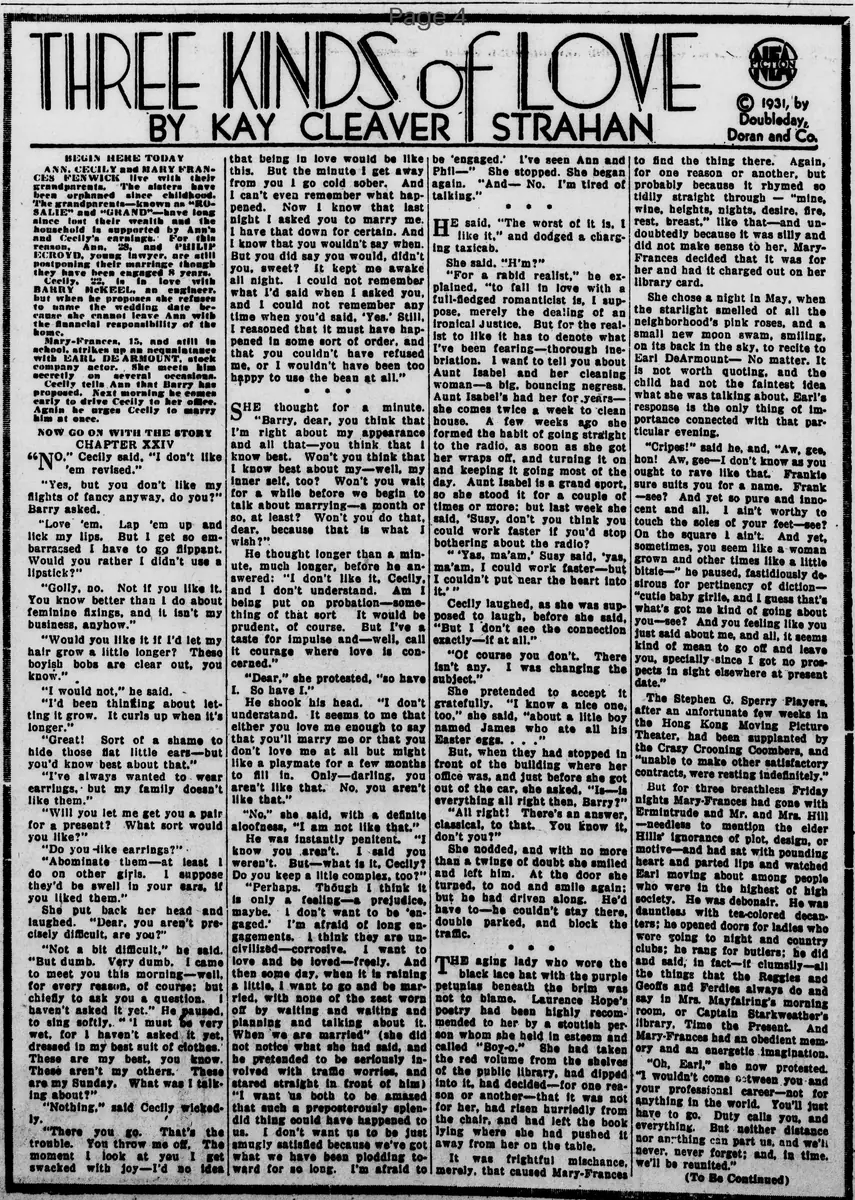
THREE KINDS OF LOVE
BY KAY CLEAVER STRAHAN
BEGINS TODAY
ANN, CECILY and MARY FRANCES FENWICK live with their grandparents. The sisters have been orphaned since childhood. The grandparents-known as "RO SALIE" and "GRAND"-have long since lost their wealth and the household is supported by Ann's and Cecily's earnings. For this reason,
Ann, 28, and Philip Eckroyd, young lawyer, are still postponing their marriage though they have been engaged 8 years.
Cecily is in love with BARRY McKEEL, an engineer, but when he proposes she refuses to name the wedding date because she cannot leave Ann with the financial responsibility of the home.
Mary-Frances, 15, not still in school, has struck up an acquaintance with KARL DEARMOUNT, stock company actor. She meets him secretly on several occasions.
Cecily tells Ann that Barry has proposed. Next morning he comes early to drive Cecily to her office. Again he urges Cecily to marry him at once.
NOW GO ON WITH THE STORY
CHAPTER XXIV
"No," Cecily said. "I don't like
'em revised."
"Yes, but you don't like my flights of fancy anyway, do you?"
Barry asked.
"Love 'em. Lap 'em up and lick my lips.
But I get so em-barrassed I have to go flippant.
Would you rather I didn't use a lipstick?"
"Golly, do. Not if you like it.
You know better than I do about feminine fixings, and it isn't my business, anyhow."
"Would you like it if I'd let my hair grow a little longer? These boyish bobs are clear out, you know."
"I would not," he said.
"I'd been thinking about letting it grow. It curls up when it's longer."
"Great! Sort of a shame to hide those flat little ears-but you'd know best about that."
"I've always wanted to wear earrings, but my family doesn't like them."
"Will you let me get you a pair for a present? What sort would you like?"
"Do you like earrings?"
"Abominate them-at least I do on other girls. I suppose they'd be swell in your ears, if you liked them."
She put back her head and laughed. "Dear, you aren't precisely difficult, are you?"
"Not a bit difficult," he said.
"But dumb. Very dumb. I came to meet you this morning-well, for every reason, of course; but chiefly to ask you a question. I haven't asked it yet." He paused, to sing softly, " 'I must be very wet, for I haven't asked it yet, dressed in my best suit of clothes. These are my best, you know. These aren't my others.' These are my Sunday. What was I telling about?"
"Nothing," said Cecily wickedly.
"There you go. That's the trouble. You throw me off. The moment I look at you I get swacked with joy-I'd no idea
that being in love would be like this. But the minute I get away from you I go cold sober, and I can't even remember what happened. Now I know that last night I asked you to marry me. I have that down for certain, and I know that you wouldn't say when. But you did say you would, didn't you, sweet? It kept me awake all night. I could not remember what I'd said when I asked you, and I could not remember any time when you'd said, 'Yes.' Still, I reasoned that it must have happened in some sort of order, and that you couldn't have refused me, or I wouldn't have been too happy to use the bean at all."
She thought for a minute.
"Barry, dear, you think that I'm right about my appearance and all that-you think that I know best. Won't you think that I know best about my-well, my inner self, too? Won't you wait for a while before we begin to talk about marrying-a month or so, at least? Won't you do that, dear, because that is what I wish?"
He thought longer than a minute, much longer, before he answered: "I don't like it, Cecily, and I don't understand. Am I being put on probation-something of that sort? It would be prudent, of course. But I've a taste for impulse and-well, call it courage where love is concerned."
"Dear," she protested, "so have I. So have I."
He shook his head.
"I don't understand. It seems to me that either you love me enough to say that you'll marry me or that you don't love me at all but might like a playmate for a few months to fill in. Only-darling, you aren't like that. No, you aren't like that."
"No," she said, with a definite aloofness, "I am not like that."
He was instantly penitent.
"I know you aren't. I said you weren't. But-what is it, Cecily? Do you keep a little complex, too?"
"Perhaps. Though I think it is only a feeling, a prejudice, maybe. I don't want to be 'engaged.' I'm afraid of long engagements. I think they are uncivilized-corrosive. I want to love and be loved-freely. And then come day, when it is raining a little, I want to go and be married, with none of the zest worn off by waiting and waiting and planning and talking about it. When we are married" (she did not notice what she had said, and he pretended to be seriously involved with traffic worries, and stared straight in front of him) "I want us both to be amazed that such a preposterously splendid thing could have happened to us. I don't want us to be just smugly satisfied because we've got what we have been plodding toward for so long. I'm afraid to
be 'engaged.' I've seen Ann and Phil-" She stopped. She began again.
"And- No. I'm tired of talking."
He said, "The worst of it is, I like it," and dodged a charging taxicab.
She said, "H'm?"
"For a rabid realist," he explained, "to fall in love with a full-fledged romanticist is, I suppose, merely the dealing of an ironical justice. But for the realist to like it has to denote what I've been fearing-thorough inebriation. I want to tell you about Aunt Isabel and her cleaning woman-a big, bouncing negress.
Aunt Isabel's had her for years- she comes twice a week to clean house. A few weeks ago she formed the habit of going straight to the radio, as soon as she got her wraps off, and turning it on and keeping it going most of the day. Aunt Isabel is a grand sport, so she stood it for a couple of times or more; but last week she said, 'Susy, don't you think you could work faster if you'd stop bothering about the radio?'
" 'Yas, ma'am,' Susy said, 'yas, ma'am, I could work faster but I couldn't put near the heart into it.'"
Cecily laughed, as she was supposed to laugh, before she said, "But I don't see the connection exactly-if at all."
"Of course you don't. There isn't any.
I was changing the subject."
She pretended to accept it gratefully.
"I know a nice one, too," she said, "about a little boy named James who ate all his Easter eggs.
But, when they had stopped in front of the building where her office was, and just before she got out of the car, she asked, "Is-is everything all right then, Barry?"
"All right! There's an answer, classical, to that. You know it, don't you?"
She nodded, and with no more than a twinge of doubt she smiled and left him. At the door she turned, to nod and smile again; but he had driven along. He'd have to-he couldn't stay there, double parked, and block the traffic.
THE aging lady who wore the black lace hat with the purple petunias beneath the brim was not to blame. Laurence Hope's poetry had been highly recommended to her by a stoutish person whom she held in esteem and called "Boy-o." She had taken the red volume from the shelves of the public library, had dipped into it, had decided-for one reason or another-that it was not for her, had risen hurriedly from the chair, and had left the book lying where she had pushed it away from her on the table.
It was frightful mischance, merely, that caused Mary
to find the thing there. Again, for one reason or another, but probably because it rhymed so tidily straight through - "mine, wine, heights, nights, desire, fire, rest, breast," like that-and undoubtedly because it was silly and did not make sense to her, Mary-Frances decided that it was for her and had it charged out on her library card.
She chose a night in May, when the starlight smelled of all the neighborhood's pink roses, and a small new moon swam, smiling, on its back in the sky, to recite to Earl DeArmount- No matter. It is not worth quoting, and the child had not the faintest idea what she was talking about. Earl's response is the only thing of importance connected with that particular evening.
"Cripes!" said he, and, "Aw, gee, hon! Aw, gee-I don't know as you ought to rave like that. Frankie sure suits you for a name. Frank-See? And yet so pure and innocent and all. I ain't worthy to touch the soles of your feet see? On the square I ain't. And yet, sometimes, you seem like a woman grown and other times like a little bitsie-" he paused, fastidiously desirous for pertinency of diction- "cutie baby girlie, and I guess that's what's got me kind of going about you see? And you feeling like you just said about me, and all, it seems kind of mean to go off and leave you, specially since I got no prospects in sight elsewhere at present date."
The Stephen G. Sperry Players, after an unfortunate few weeks in the Hong Kong Moving Picture Theater, had been supplanted by the Crazy Crooning Coombers, and "unable to make other satisfactory contracts, were resting indefinitely."
But for three breathless Friday nights Mary-Frances had gone with Ermintrude and Mr. and Mrs. Hill -needless to mention the elder Hills' ignorance of plot, design, or motive-and had sat with pounding heart and parted lips and watched Earl moving about among people who were in the highest of high society. He was debonair. He was dauntless with tea-colored decanters; he opened doors for ladies who were going to night and country clubs; he rang for butlers; he did and said; in fact-if clumsily-all the things that the Reggies and Geoffs and Ferdies always do and say in Mrs. Mayfairing's morning room, or Captain Starkweather's library. Time the Present. And Mary-Frances had an obedient memory and an energetic imagination.
"Oh, Earl," she now protested. "I wouldn't come between you-and your professional career-not for anything in the world. You'll just have to go. Duty calls you, and everything. But neither distance nor anything can part us, and we'll never, never forget; and, in time, we'll be reunited."
BY KAY CLEAVER STRAHAN
BEGINS TODAY
ANN, CECILY and MARY FRANCES FENWICK live with their grandparents. The sisters have been orphaned since childhood. The grandparents-known as "RO SALIE" and "GRAND"-have long since lost their wealth and the household is supported by Ann's and Cecily's earnings. For this reason,
Ann, 28, and Philip Eckroyd, young lawyer, are still postponing their marriage though they have been engaged 8 years.
Cecily is in love with BARRY McKEEL, an engineer, but when he proposes she refuses to name the wedding date because she cannot leave Ann with the financial responsibility of the home.
Mary-Frances, 15, not still in school, has struck up an acquaintance with KARL DEARMOUNT, stock company actor. She meets him secretly on several occasions.
Cecily tells Ann that Barry has proposed. Next morning he comes early to drive Cecily to her office. Again he urges Cecily to marry him at once.
NOW GO ON WITH THE STORY
CHAPTER XXIV
"No," Cecily said. "I don't like
'em revised."
"Yes, but you don't like my flights of fancy anyway, do you?"
Barry asked.
"Love 'em. Lap 'em up and lick my lips.
But I get so em-barrassed I have to go flippant.
Would you rather I didn't use a lipstick?"
"Golly, do. Not if you like it.
You know better than I do about feminine fixings, and it isn't my business, anyhow."
"Would you like it if I'd let my hair grow a little longer? These boyish bobs are clear out, you know."
"I would not," he said.
"I'd been thinking about letting it grow. It curls up when it's longer."
"Great! Sort of a shame to hide those flat little ears-but you'd know best about that."
"I've always wanted to wear earrings, but my family doesn't like them."
"Will you let me get you a pair for a present? What sort would you like?"
"Do you like earrings?"
"Abominate them-at least I do on other girls. I suppose they'd be swell in your ears, if you liked them."
She put back her head and laughed. "Dear, you aren't precisely difficult, are you?"
"Not a bit difficult," he said.
"But dumb. Very dumb. I came to meet you this morning-well, for every reason, of course; but chiefly to ask you a question. I haven't asked it yet." He paused, to sing softly, " 'I must be very wet, for I haven't asked it yet, dressed in my best suit of clothes. These are my best, you know. These aren't my others.' These are my Sunday. What was I telling about?"
"Nothing," said Cecily wickedly.
"There you go. That's the trouble. You throw me off. The moment I look at you I get swacked with joy-I'd no idea
that being in love would be like this. But the minute I get away from you I go cold sober, and I can't even remember what happened. Now I know that last night I asked you to marry me. I have that down for certain, and I know that you wouldn't say when. But you did say you would, didn't you, sweet? It kept me awake all night. I could not remember what I'd said when I asked you, and I could not remember any time when you'd said, 'Yes.' Still, I reasoned that it must have happened in some sort of order, and that you couldn't have refused me, or I wouldn't have been too happy to use the bean at all."
She thought for a minute.
"Barry, dear, you think that I'm right about my appearance and all that-you think that I know best. Won't you think that I know best about my-well, my inner self, too? Won't you wait for a while before we begin to talk about marrying-a month or so, at least? Won't you do that, dear, because that is what I wish?"
He thought longer than a minute, much longer, before he answered: "I don't like it, Cecily, and I don't understand. Am I being put on probation-something of that sort? It would be prudent, of course. But I've a taste for impulse and-well, call it courage where love is concerned."
"Dear," she protested, "so have I. So have I."
He shook his head.
"I don't understand. It seems to me that either you love me enough to say that you'll marry me or that you don't love me at all but might like a playmate for a few months to fill in. Only-darling, you aren't like that. No, you aren't like that."
"No," she said, with a definite aloofness, "I am not like that."
He was instantly penitent.
"I know you aren't. I said you weren't. But-what is it, Cecily? Do you keep a little complex, too?"
"Perhaps. Though I think it is only a feeling, a prejudice, maybe. I don't want to be 'engaged.' I'm afraid of long engagements. I think they are uncivilized-corrosive. I want to love and be loved-freely. And then come day, when it is raining a little, I want to go and be married, with none of the zest worn off by waiting and waiting and planning and talking about it. When we are married" (she did not notice what she had said, and he pretended to be seriously involved with traffic worries, and stared straight in front of him) "I want us both to be amazed that such a preposterously splendid thing could have happened to us. I don't want us to be just smugly satisfied because we've got what we have been plodding toward for so long. I'm afraid to
be 'engaged.' I've seen Ann and Phil-" She stopped. She began again.
"And- No. I'm tired of talking."
He said, "The worst of it is, I like it," and dodged a charging taxicab.
She said, "H'm?"
"For a rabid realist," he explained, "to fall in love with a full-fledged romanticist is, I suppose, merely the dealing of an ironical justice. But for the realist to like it has to denote what I've been fearing-thorough inebriation. I want to tell you about Aunt Isabel and her cleaning woman-a big, bouncing negress.
Aunt Isabel's had her for years- she comes twice a week to clean house. A few weeks ago she formed the habit of going straight to the radio, as soon as she got her wraps off, and turning it on and keeping it going most of the day. Aunt Isabel is a grand sport, so she stood it for a couple of times or more; but last week she said, 'Susy, don't you think you could work faster if you'd stop bothering about the radio?'
" 'Yas, ma'am,' Susy said, 'yas, ma'am, I could work faster but I couldn't put near the heart into it.'"
Cecily laughed, as she was supposed to laugh, before she said, "But I don't see the connection exactly-if at all."
"Of course you don't. There isn't any.
I was changing the subject."
She pretended to accept it gratefully.
"I know a nice one, too," she said, "about a little boy named James who ate all his Easter eggs.
But, when they had stopped in front of the building where her office was, and just before she got out of the car, she asked, "Is-is everything all right then, Barry?"
"All right! There's an answer, classical, to that. You know it, don't you?"
She nodded, and with no more than a twinge of doubt she smiled and left him. At the door she turned, to nod and smile again; but he had driven along. He'd have to-he couldn't stay there, double parked, and block the traffic.
THE aging lady who wore the black lace hat with the purple petunias beneath the brim was not to blame. Laurence Hope's poetry had been highly recommended to her by a stoutish person whom she held in esteem and called "Boy-o." She had taken the red volume from the shelves of the public library, had dipped into it, had decided-for one reason or another-that it was not for her, had risen hurriedly from the chair, and had left the book lying where she had pushed it away from her on the table.
It was frightful mischance, merely, that caused Mary
to find the thing there. Again, for one reason or another, but probably because it rhymed so tidily straight through - "mine, wine, heights, nights, desire, fire, rest, breast," like that-and undoubtedly because it was silly and did not make sense to her, Mary-Frances decided that it was for her and had it charged out on her library card.
She chose a night in May, when the starlight smelled of all the neighborhood's pink roses, and a small new moon swam, smiling, on its back in the sky, to recite to Earl DeArmount- No matter. It is not worth quoting, and the child had not the faintest idea what she was talking about. Earl's response is the only thing of importance connected with that particular evening.
"Cripes!" said he, and, "Aw, gee, hon! Aw, gee-I don't know as you ought to rave like that. Frankie sure suits you for a name. Frank-See? And yet so pure and innocent and all. I ain't worthy to touch the soles of your feet see? On the square I ain't. And yet, sometimes, you seem like a woman grown and other times like a little bitsie-" he paused, fastidiously desirous for pertinency of diction- "cutie baby girlie, and I guess that's what's got me kind of going about you see? And you feeling like you just said about me, and all, it seems kind of mean to go off and leave you, specially since I got no prospects in sight elsewhere at present date."
The Stephen G. Sperry Players, after an unfortunate few weeks in the Hong Kong Moving Picture Theater, had been supplanted by the Crazy Crooning Coombers, and "unable to make other satisfactory contracts, were resting indefinitely."
But for three breathless Friday nights Mary-Frances had gone with Ermintrude and Mr. and Mrs. Hill -needless to mention the elder Hills' ignorance of plot, design, or motive-and had sat with pounding heart and parted lips and watched Earl moving about among people who were in the highest of high society. He was debonair. He was dauntless with tea-colored decanters; he opened doors for ladies who were going to night and country clubs; he rang for butlers; he did and said; in fact-if clumsily-all the things that the Reggies and Geoffs and Ferdies always do and say in Mrs. Mayfairing's morning room, or Captain Starkweather's library. Time the Present. And Mary-Frances had an obedient memory and an energetic imagination.
"Oh, Earl," she now protested. "I wouldn't come between you-and your professional career-not for anything in the world. You'll just have to go. Duty calls you, and everything. But neither distance nor anything can part us, and we'll never, never forget; and, in time, we'll be reunited."
What sub-type of article is it?
Prose Fiction
What themes does it cover?
Love Romance
Social Manners
What keywords are associated?
Sisters
Engagement
Marriage
Romance
Family Responsibility
Poetry Recitation
Stock Actor
What entities or persons were involved?
By Kay Cleaver Strahan
Literary Details
Title
Chapter Xxiv
Author
By Kay Cleaver Strahan
Key Lines
"I Don't Want To Be 'Engaged.' I'm Afraid Of Long Engagements. I Think They Are Uncivilized Corrosive. I Want To Love And Be Loved Freely."
"Cripes!" Said He, And, "Aw, Gee, Hon! Aw, Gee I Don't Know As You Ought To Rave Like That."