Thank you for visiting SNEWPapers!
Sign up free
Literary
February 10, 1831
Litchfield Enquirer
Litchfield, Litchfield County, Connecticut
What is this article about?
This essay argues that education provides a crucial guard against the corrupting influence of bad examples, especially in youth when habits form easily. It emphasizes instilling virtue early to counteract natural inclinations toward evil, quoting proverbs on shaping character.
Clipping
OCR Quality
98%
Excellent
Full Text
ON EDUCATION,—NO.
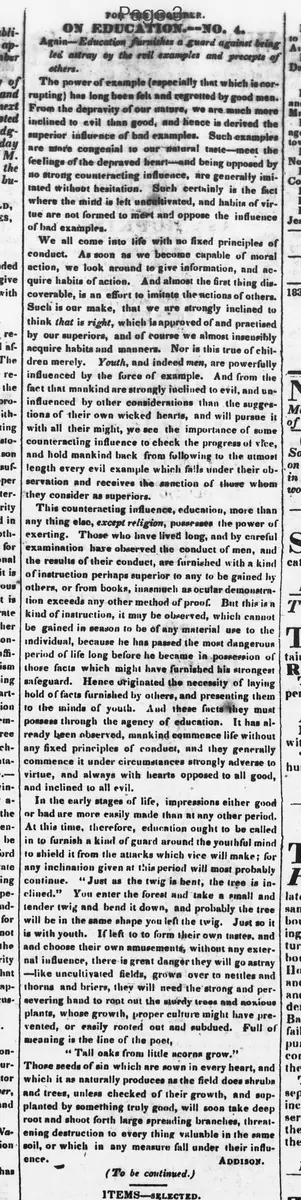
Again—Education furnishes a guard against being led astray by the evil examples and precepts of others.
The power of example (especially that which is corrupting) has long been felt and regretted by good men. From the depravity of our nature, we are much more inclined to evil than good, and hence is derived the superior influence of bad examples. Such examples are more congenial to our natural taste—meet the feelings of the depraved heart—and being opposed by no strong counteracting influence, are generally imitated without hesitation. Such certainly is the fact where the mind is left uncultivated, and habits of virtue are not formed to meet and oppose the influence of bad examples.
We all come into life with no fixed principles of conduct. As soon as we become capable of moral action, we look around to give information, and acquire habits of action. And almost the first thing discoverable, is an effort to imitate the actions of others. Such is our make, that we are strongly inclined to think that is right, which is approved of and practised by our superiors, and of course we almost insensibly acquire habits and manners. Nor is this true of children merely. Youth, and indeed men, are powerfully influenced by the force of example. And from the fact that mankind are strongly inclined to evil, and uninfluenced by other considerations than the suggestions of their own wicked hearts, and will pursue it with all their might, we see the importance of some counteracting influence to check the progress of vice, and hold mankind back from following to the utmost length every evil example which falls under their observation and receives the sanction of those whom they consider as superiors.
This counteracting influence, education, more than anything else, except religion, possesses the power of exerting. Those who have lived long, and by careful examination have observed the conduct of men, and the results of their conduct, are furnished with a kind of instruction perhaps superior to any to be gained by others, or from books, inasmuch as ocular demonstration exceeds any other method of proof. But this is a kind of instruction, it may be observed, which cannot be gained in season to be of any material use to the individual, because he has passed the most dangerous period of life long before he becomes in possession of those facts which might have furnished his strongest safeguard. Hence originated the necessity of laying hold of facts furnished by others, and presenting them to the minds of youth. And these facts they must possess through the agency of education. It has already been observed, mankind commence life without any fixed principles of conduct, and they generally commence it under circumstances strongly adverse to virtue, and always with hearts opposed to all good and inclined to all evil.
In the early stages of life, impressions either good or bad are more easily made than at any other period. At this time, therefore, education ought to be called in to furnish a kind of guard around the youthful mind to shield it from the attacks which vice will make; for any inclination given at this period will most probably continue. "Just as the twig is bent, the tree is inclined." You enter the forest and take a small and tender twig and bend it down, and probably the tree will be in the same shape you left the twig. Just so it is with youth. If left to form their own taste, and choose their own amusements, without any external influence, there is great danger they will go astray—like uncultivated fields, grown over to nettles and thorns and briers, they will need the strong and persevering hand to root out the sturdy trees and noxious plants, whose growth, proper culture might have prevented, or easily rooted out and subdued. Full of meaning is the line of the poet,
"Tall oaks from little acorns grow"
Those seeds of sin which are sown in every heart, and which it as naturally produces as the field does shrubs and trees, unless checked of their growth, and supplanted by something truly good, will soon take deep root and shoot forth large spreading branches, threatening destruction to every thing valuable in the same soil, or which in any measure fall under their influence.
Addison.
(To be continued.)
Again—Education furnishes a guard against being led astray by the evil examples and precepts of others.
The power of example (especially that which is corrupting) has long been felt and regretted by good men. From the depravity of our nature, we are much more inclined to evil than good, and hence is derived the superior influence of bad examples. Such examples are more congenial to our natural taste—meet the feelings of the depraved heart—and being opposed by no strong counteracting influence, are generally imitated without hesitation. Such certainly is the fact where the mind is left uncultivated, and habits of virtue are not formed to meet and oppose the influence of bad examples.
We all come into life with no fixed principles of conduct. As soon as we become capable of moral action, we look around to give information, and acquire habits of action. And almost the first thing discoverable, is an effort to imitate the actions of others. Such is our make, that we are strongly inclined to think that is right, which is approved of and practised by our superiors, and of course we almost insensibly acquire habits and manners. Nor is this true of children merely. Youth, and indeed men, are powerfully influenced by the force of example. And from the fact that mankind are strongly inclined to evil, and uninfluenced by other considerations than the suggestions of their own wicked hearts, and will pursue it with all their might, we see the importance of some counteracting influence to check the progress of vice, and hold mankind back from following to the utmost length every evil example which falls under their observation and receives the sanction of those whom they consider as superiors.
This counteracting influence, education, more than anything else, except religion, possesses the power of exerting. Those who have lived long, and by careful examination have observed the conduct of men, and the results of their conduct, are furnished with a kind of instruction perhaps superior to any to be gained by others, or from books, inasmuch as ocular demonstration exceeds any other method of proof. But this is a kind of instruction, it may be observed, which cannot be gained in season to be of any material use to the individual, because he has passed the most dangerous period of life long before he becomes in possession of those facts which might have furnished his strongest safeguard. Hence originated the necessity of laying hold of facts furnished by others, and presenting them to the minds of youth. And these facts they must possess through the agency of education. It has already been observed, mankind commence life without any fixed principles of conduct, and they generally commence it under circumstances strongly adverse to virtue, and always with hearts opposed to all good and inclined to all evil.
In the early stages of life, impressions either good or bad are more easily made than at any other period. At this time, therefore, education ought to be called in to furnish a kind of guard around the youthful mind to shield it from the attacks which vice will make; for any inclination given at this period will most probably continue. "Just as the twig is bent, the tree is inclined." You enter the forest and take a small and tender twig and bend it down, and probably the tree will be in the same shape you left the twig. Just so it is with youth. If left to form their own taste, and choose their own amusements, without any external influence, there is great danger they will go astray—like uncultivated fields, grown over to nettles and thorns and briers, they will need the strong and persevering hand to root out the sturdy trees and noxious plants, whose growth, proper culture might have prevented, or easily rooted out and subdued. Full of meaning is the line of the poet,
"Tall oaks from little acorns grow"
Those seeds of sin which are sown in every heart, and which it as naturally produces as the field does shrubs and trees, unless checked of their growth, and supplanted by something truly good, will soon take deep root and shoot forth large spreading branches, threatening destruction to every thing valuable in the same soil, or which in any measure fall under their influence.
Addison.
(To be continued.)
What sub-type of article is it?
Essay
What themes does it cover?
Moral Virtue
What keywords are associated?
Education
Evil Examples
Moral Virtue
Youthful Impressions
Bad Influence
Literary Details
Title
On Education,—No.
Subject
Guard Against Evil Examples Through Education
Form / Style
Prose Argument On Moral Formation
Key Lines
Just As The Twig Is Bent, The Tree Is Inclined.
Tall Oaks From Little Acorns Grow