Thank you for visiting SNEWPapers!
Sign up free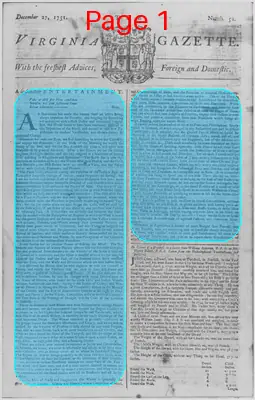
Literary
December 27, 1751
The Virginia Gazette
Richmond, Williamsburg, Richmond County, Virginia
What is this article about?
This essay reflects on humanity's innate desire for novelty, fulfilled by the world's seasonal changes. It celebrates winter's capacity to inspire awe, domestic joy, scholarly pursuits, and meaningful amusements, contrasting them with trivial games, and urges valuing time wisely.
Clipping
OCR Quality
98%
Excellent
Full Text
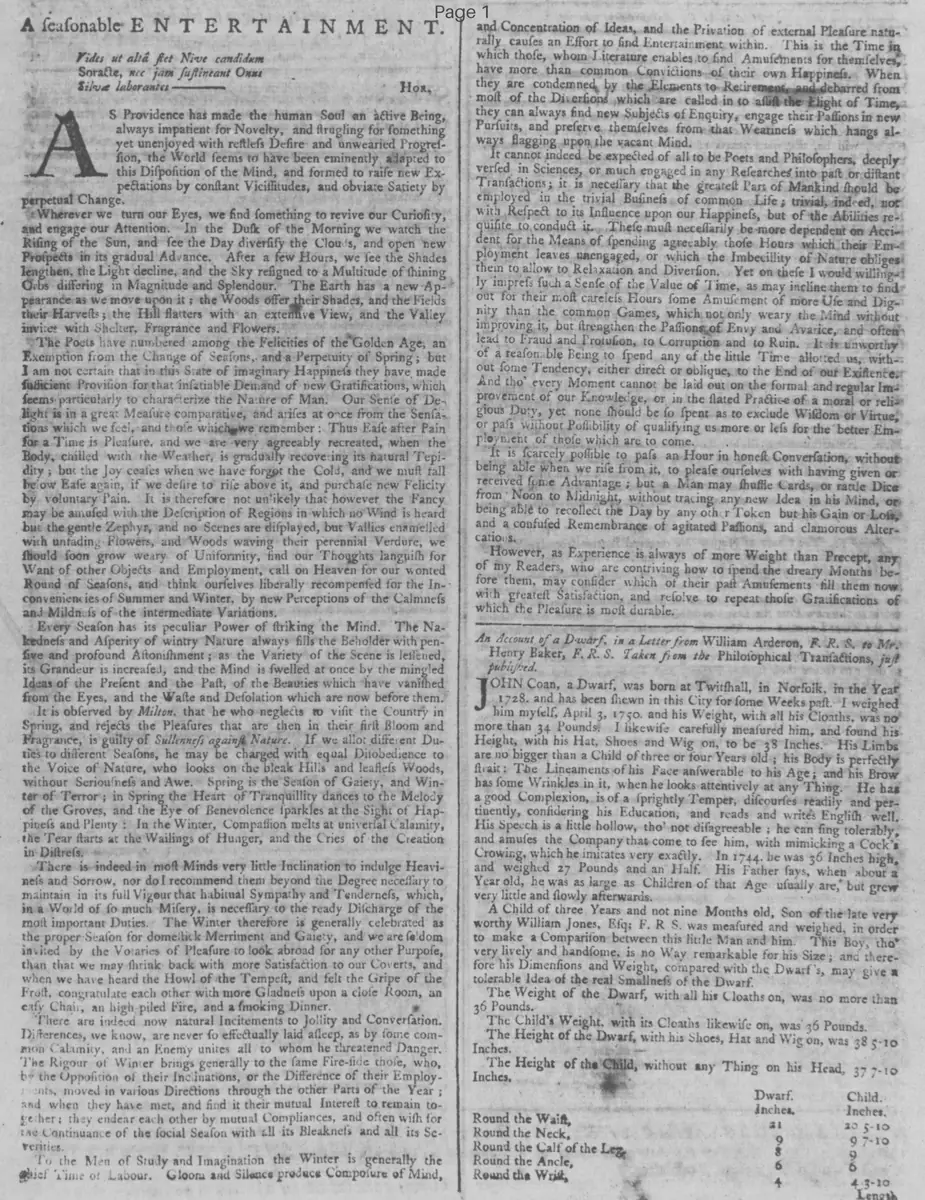
A seasonable ENTERTAINMENT.
Vides ut alia sit: Nive candidum
Soracte, nec jam sustineant onus
Silvae laborantes
Since Providence has made the human Soul an active Being,
always impatient for Novelty, and struggling for something
yet unenjoyed with restless Desire and unwearied Progression,
the World seems to have been eminently adapted to
this Disposition of the Mind, and formed to raise new Expectations
by constant Vicissitudes, and obviate Satiety by
perpetual Change,
Wherever we turn our Eyes, we find something to revive our Curiosity,
and engage our Attention. In the Dusk of the Morning we watch the
Rising of the Sun, and see the Day diversify the Clouds, and open new
Prospects in its gradual Advance. After a few Hours, we see the Shades
lengthen, the Light decline, and the Sky resigned to a Multitude of shining
Orbs differing in Magnitude and Splendour. The Earth has a new Appearance
as we move upon it; the Woods offer their Shades, and the Fields
their Harvests; the Hill flatters with an extensive View, and the Valley
invites with Shelter, Fragrance and Flowers.
The Poets have numbered among the Felicities of the Golden Age, an
Exemption from the Change of Seasons, and a Perpetuity of Spring; but
I am not certain that in this State of imaginary Happiness they have made
sufficient Provision for that insatiable Demand of new Gratifications, which
Seems particularly to characterize the Nature of Man. Our Sense of Delight
is in a great Measure comparative, and arises at once from the Sensations
which we feel, and those which we remember: Thus Ease after Pain
for a Time is Pleasure. and we are very agreeably recreated, when the
Body, chilled with the Weather, is gradually recovering its natural Temperature ;
but the Joy ceases when we have forgot the Cold, and we must fall
below Ease again, if we desire to rise above it, and purchase new Felicity
by voluntary Pain. It is therefore not unlikely that however the Fancy
may be amused with the Description of Regions in which no Wind is heard
but the gentle Zephyr, and no Scenes are displayed, but Vallies enamelled
with unfading Flowers, and Woods waving their perennial Verdure, we
should soon grow weary of Uniformity, find our Thoughts languish for
Want of other Objects and Employment, call on Heaven for our wonted
Round of Seasons, and think ourselves liberally recompensed for the Inconveniencies
of Summer and Winter, by new Perceptions of the Calmness
and Mildness of the intermediate Variations.
Every Season has its peculiar Power of striking the Mind. The Nakedness
and Asperity of wintry Nature always fills the Beholder with pensive
and profound Astonishment; as the Variety of the Scene is lessened,
its Grandeur is increased, and the Mind is swelled at once by the mingled
Ideas of the Present and the Past, of the Beauties which have vanished
from the Eyes, and the Waste and Desolation which are now before them.
It is observed by Milton, that he who neglects to visit the Country in
Spring, and rejects the Pleasures that are then in their first Bloom and
Fragrance, is guilty of Sullenness against Nature. If we allot different Duties
to different Seasons, he may be charged with equal Disobedience to
the Voice of Nature, who looks on the bleak Hills and leafless Woods,
without Seriousness and Awe. Spring is the Season of Gaiety, and Winter
of Terror ; in Spring the Heart of Tranquillity dances to the Melody
of the Groves, and the Eye of Benevolence sparkles at the Sight of Happiness
and Plenty : In the Winter, Compassion melts at universal Calamity,
the Tear starts at the Wailings of Hunger, and the Cries of the Creation
in Distress.
There is indeed in most Minds very little Inclination to indulge Heaviness
and Sorrow, nor do I recommend them beyond the Degree necessary to
maintain in its full Vigour that habitual Sympathy and Tenderness, which,
in a World of so much Misery, is necessary to the ready Discharge of the
most important Duties. The Winter therefore is generally celebrated as
the proper Season for domestick Merriment and Gaiety, and we are seldom
invited by the Votaries of Pleasure to look abroad for any other Purpose,
than that we may shrink back with more Satisfaction to our Coverts, and
when we have heard the Howl of the Tempest, and felt the Gripe of the
Frost, congratulate each other with more Gladness upon a close Room, an
easy Chair, an high piled Fire, and a smoking Dinner.
There are indeed now natural Incitements to Jollity and Conversation.
Differences, we know, are never so effectually laid asleep, as by some common
Calamity, and an Enemy unites all to whom he threatened Danger.
The Rigour of Winter brings generally to the same Fire-side those, who,
by the Opposition of their Inclinations, or the Difference of their Employments,
moved in various Directions through the other Parts of the Year;
and when they have met, and find it their mutual Interest to remain together;
they endear each other by mutual Compliances, and often wish for
the Continuance of the social Season with all its Bleakness and all its Severities.
To the Men of Study and Imagination the Winter is generally the
Chief Time of Labour.
Gloom and Silence produce Composure of Mind,
and Concentration of Ideas, and the Privation of external Pleasure naturally
causes an Effort to find Entertainment within. This is the Time in
which those, whom Literature enables to find Amusements for themselves,
have more than common Convictions of their own Happiness. When
they are condemned by the Elements to Retirement, and debarred from
most of the Diversions which are called in to assist the Flight of Time,
they can always find new Subjects of Enquiry, engage their Passions in new
Pursuits, and preserve themselves from that Weariness which hangs always
flagging upon the vacant Mind.
It cannot indeed be expected of all to be Poets and Philosophers, deeply
versed in Sciences, or much engaged in any Researches into past or distant
Transactions; it is necessary that the greatest Part of Mankind should be
employed in the trivial Business of common Life; trivial, indeed, not
with Respect to its Influence upon our Happiness, but of the Abilities required
to conduct it. These must necessarily be more dependent on Accident
for the Means of spending agreeably those Hours which their Employment
leaves unengaged, or which the Imbecility of Nature obliges
them to allow to Relaxation and Diversion. Yet on these I would willingly
impress such a Sense of the Value of Time, as may incline them to find
out for their most careless Hours some Amusement of more Use and Dignity
than the common Games, which not only weary the Mind without
improving it, but strengthen the Passions of Envy and Avarice, and often
lead to Fraud and Prostitution, to Corruption and to Ruin. It is unworthy
of a reasonable Being to spend any of the little Time allotted us, without
some Tendency. either direct or oblique, to the End of our Existence.
And tho' every Moment cannot be laid out on the formal and regular Improvement
of our Knowledge, or in the stated Practice of a moral or religious
Duty, yet none should be so spent as to exclude Wisdom or Virtue,
or pass without Possibility of qualifying us more or less for the better Employment
of those which are to come.
It is scarcely possible to pass an Hour in honest Conversation, without
being able when we rise from it, to please ourselves with having given or
received some Advantage ; but a Man may shuffle Cards, or rattle Dice
from Noon to Midnight, without tracing any new Idea in his Mind, or
being able to recollect the Day by any other Token but his Gain or Loss,
and a confused Remembrance of agitated Passions, and clamorous Altercations.
However, as Experience is always of more Weight than Precept, any
of my Readers, who are contriving how to spend the dreary Months before
them, may consider which of their past Amusements fill them now
with greatest Satisfaction, and resolve to repeat those Gratifications of
which the Pleasure is most durable.
Vides ut alia sit: Nive candidum
Soracte, nec jam sustineant onus
Silvae laborantes
Since Providence has made the human Soul an active Being,
always impatient for Novelty, and struggling for something
yet unenjoyed with restless Desire and unwearied Progression,
the World seems to have been eminently adapted to
this Disposition of the Mind, and formed to raise new Expectations
by constant Vicissitudes, and obviate Satiety by
perpetual Change,
Wherever we turn our Eyes, we find something to revive our Curiosity,
and engage our Attention. In the Dusk of the Morning we watch the
Rising of the Sun, and see the Day diversify the Clouds, and open new
Prospects in its gradual Advance. After a few Hours, we see the Shades
lengthen, the Light decline, and the Sky resigned to a Multitude of shining
Orbs differing in Magnitude and Splendour. The Earth has a new Appearance
as we move upon it; the Woods offer their Shades, and the Fields
their Harvests; the Hill flatters with an extensive View, and the Valley
invites with Shelter, Fragrance and Flowers.
The Poets have numbered among the Felicities of the Golden Age, an
Exemption from the Change of Seasons, and a Perpetuity of Spring; but
I am not certain that in this State of imaginary Happiness they have made
sufficient Provision for that insatiable Demand of new Gratifications, which
Seems particularly to characterize the Nature of Man. Our Sense of Delight
is in a great Measure comparative, and arises at once from the Sensations
which we feel, and those which we remember: Thus Ease after Pain
for a Time is Pleasure. and we are very agreeably recreated, when the
Body, chilled with the Weather, is gradually recovering its natural Temperature ;
but the Joy ceases when we have forgot the Cold, and we must fall
below Ease again, if we desire to rise above it, and purchase new Felicity
by voluntary Pain. It is therefore not unlikely that however the Fancy
may be amused with the Description of Regions in which no Wind is heard
but the gentle Zephyr, and no Scenes are displayed, but Vallies enamelled
with unfading Flowers, and Woods waving their perennial Verdure, we
should soon grow weary of Uniformity, find our Thoughts languish for
Want of other Objects and Employment, call on Heaven for our wonted
Round of Seasons, and think ourselves liberally recompensed for the Inconveniencies
of Summer and Winter, by new Perceptions of the Calmness
and Mildness of the intermediate Variations.
Every Season has its peculiar Power of striking the Mind. The Nakedness
and Asperity of wintry Nature always fills the Beholder with pensive
and profound Astonishment; as the Variety of the Scene is lessened,
its Grandeur is increased, and the Mind is swelled at once by the mingled
Ideas of the Present and the Past, of the Beauties which have vanished
from the Eyes, and the Waste and Desolation which are now before them.
It is observed by Milton, that he who neglects to visit the Country in
Spring, and rejects the Pleasures that are then in their first Bloom and
Fragrance, is guilty of Sullenness against Nature. If we allot different Duties
to different Seasons, he may be charged with equal Disobedience to
the Voice of Nature, who looks on the bleak Hills and leafless Woods,
without Seriousness and Awe. Spring is the Season of Gaiety, and Winter
of Terror ; in Spring the Heart of Tranquillity dances to the Melody
of the Groves, and the Eye of Benevolence sparkles at the Sight of Happiness
and Plenty : In the Winter, Compassion melts at universal Calamity,
the Tear starts at the Wailings of Hunger, and the Cries of the Creation
in Distress.
There is indeed in most Minds very little Inclination to indulge Heaviness
and Sorrow, nor do I recommend them beyond the Degree necessary to
maintain in its full Vigour that habitual Sympathy and Tenderness, which,
in a World of so much Misery, is necessary to the ready Discharge of the
most important Duties. The Winter therefore is generally celebrated as
the proper Season for domestick Merriment and Gaiety, and we are seldom
invited by the Votaries of Pleasure to look abroad for any other Purpose,
than that we may shrink back with more Satisfaction to our Coverts, and
when we have heard the Howl of the Tempest, and felt the Gripe of the
Frost, congratulate each other with more Gladness upon a close Room, an
easy Chair, an high piled Fire, and a smoking Dinner.
There are indeed now natural Incitements to Jollity and Conversation.
Differences, we know, are never so effectually laid asleep, as by some common
Calamity, and an Enemy unites all to whom he threatened Danger.
The Rigour of Winter brings generally to the same Fire-side those, who,
by the Opposition of their Inclinations, or the Difference of their Employments,
moved in various Directions through the other Parts of the Year;
and when they have met, and find it their mutual Interest to remain together;
they endear each other by mutual Compliances, and often wish for
the Continuance of the social Season with all its Bleakness and all its Severities.
To the Men of Study and Imagination the Winter is generally the
Chief Time of Labour.
Gloom and Silence produce Composure of Mind,
and Concentration of Ideas, and the Privation of external Pleasure naturally
causes an Effort to find Entertainment within. This is the Time in
which those, whom Literature enables to find Amusements for themselves,
have more than common Convictions of their own Happiness. When
they are condemned by the Elements to Retirement, and debarred from
most of the Diversions which are called in to assist the Flight of Time,
they can always find new Subjects of Enquiry, engage their Passions in new
Pursuits, and preserve themselves from that Weariness which hangs always
flagging upon the vacant Mind.
It cannot indeed be expected of all to be Poets and Philosophers, deeply
versed in Sciences, or much engaged in any Researches into past or distant
Transactions; it is necessary that the greatest Part of Mankind should be
employed in the trivial Business of common Life; trivial, indeed, not
with Respect to its Influence upon our Happiness, but of the Abilities required
to conduct it. These must necessarily be more dependent on Accident
for the Means of spending agreeably those Hours which their Employment
leaves unengaged, or which the Imbecility of Nature obliges
them to allow to Relaxation and Diversion. Yet on these I would willingly
impress such a Sense of the Value of Time, as may incline them to find
out for their most careless Hours some Amusement of more Use and Dignity
than the common Games, which not only weary the Mind without
improving it, but strengthen the Passions of Envy and Avarice, and often
lead to Fraud and Prostitution, to Corruption and to Ruin. It is unworthy
of a reasonable Being to spend any of the little Time allotted us, without
some Tendency. either direct or oblique, to the End of our Existence.
And tho' every Moment cannot be laid out on the formal and regular Improvement
of our Knowledge, or in the stated Practice of a moral or religious
Duty, yet none should be so spent as to exclude Wisdom or Virtue,
or pass without Possibility of qualifying us more or less for the better Employment
of those which are to come.
It is scarcely possible to pass an Hour in honest Conversation, without
being able when we rise from it, to please ourselves with having given or
received some Advantage ; but a Man may shuffle Cards, or rattle Dice
from Noon to Midnight, without tracing any new Idea in his Mind, or
being able to recollect the Day by any other Token but his Gain or Loss,
and a confused Remembrance of agitated Passions, and clamorous Altercations.
However, as Experience is always of more Weight than Precept, any
of my Readers, who are contriving how to spend the dreary Months before
them, may consider which of their past Amusements fill them now
with greatest Satisfaction, and resolve to repeat those Gratifications of
which the Pleasure is most durable.
What sub-type of article is it?
Essay
What themes does it cover?
Nature
Seasonal Cycle
Moral Virtue
What keywords are associated?
Seasons
Winter
Novelty
Human Nature
Time Value
Amusements
Moral Reflection
Domestic Joy
Literary Details
Title
A Seasonable Entertainment.
Subject
Reflections On Seasons, Novelty, And Winter Amusements
Key Lines
Since Providence Has Made The Human Soul An Active Being, Always Impatient For Novelty, And Struggling For Something Yet Unenjoyed With Restless Desire And Unwearied Progression,
Every Season Has Its Peculiar Power Of Striking The Mind.
Spring Is The Season Of Gaiety, And Winter Of Terror ;
It Is Unworthy Of A Reasonable Being To Spend Any Of The Little Time Allotted Us, Without Some Tendency. Either Direct Or Oblique, To The End Of Our Existence.
Resolve To Repeat Those Gratifications Of Which The Pleasure Is Most Durable.