Thank you for visiting SNEWPapers!
Sign up free
Alexandria Gazette & Daily Advertiser
Alexandria, Virginia
What is this article about?
In the House of Lords on July 10, Earl of Liverpool moved to defer the second reading of the bill against the Queen until August 17 to allow attendance of four Judges. Earl Grey and others suggested providing the Queen with charges and witness lists for earlier preparation and delay. The motion was agreed, with orders to notify the Queen and her counsel, and to summon absent peers.
Clipping
OCR Quality
Full Text
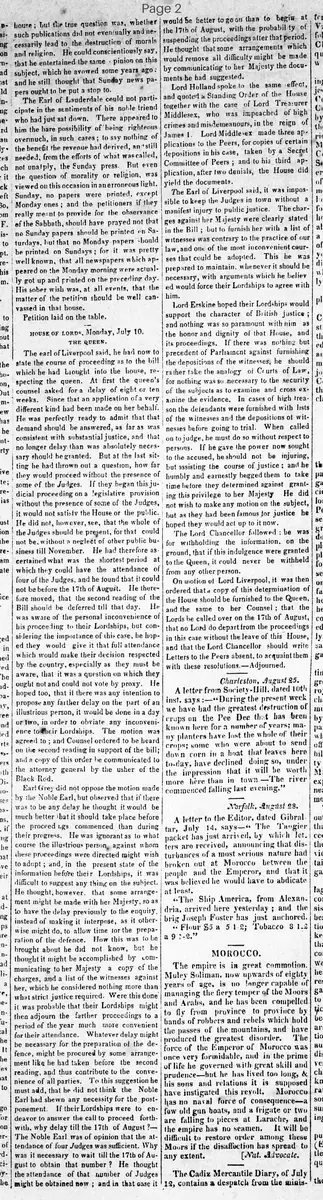
THE QUEEN.
The earl of Liverpool said, he had now to state the course of proceeding as to the bill which he had brought into the house, respecting the queen. At first the queen's counsel asked for a delay of eight or ten weeks. Since that an application of a very different kind had been made on her behalf. He was perfectly ready to admit that that demand should be answered, as far as was consistent with substantial justice, and that no longer delay than was absolutely necessary should be granted. But at the last sitting he had thrown out a question, how far they would proceed without the presence of some of the Judges. If they began this judicial proceeding on a legislative provision without the presence of some of the Judges, it would not satisfy the House or the public. He did not, however, see, that the whole of the Judges should be present, for that could not be, without a neglect of other public business till November. He had therefore ascertained what was the shortest period at which they could have the attendance of four of the Judges. and he found that it could not be before the 17th of August. He therefore moved, that the second reading of the Bill should be deferred till that day. He was aware of the personal inconvenience of his proceeding to their Lordships, but considering the importance of this case, he hoped they would give it that full attendance which would make their decision respected by the country, especially as they must be aware, that it was a question on which they ought not and could not vote by proxy. He hoped too, that if there was any intention to propose any farther delay on the part of an illustrious person, it would be done in a day or two, in order to obviate any inconvenience to their Lordships. The motion was agreed to ; and Counsel ordered to be heard on the second reading in support of the bill: and a copy of this order be communicated to the attorney general by the usher of the Black Rod.
Earl Grey did not oppose the motion made by the Noble Earl, but observed that if there was to be any delay he thought it would be much better that it should take place before the proceedings commenced than during their progress. He was ignorant as to what course the illustrious person against whom these proceedings were directed might wish to adopt; and. in the present state of the information before their Lordships, it was difficult to suggest any thing on the subject. He thought, however. that some arrangement might be made with her Majesty, so as to have the delay previously to the enquiry. instead of making it interpose, as it otherwise might do, to allow time for the preparation of the defence. How this was to be brought about he did not know, but he thought it might be accomplished by communicating to her Majesty a copy of the charges, and a list of the witnesses against her, which he considered nothing more than what strict justice required. Were this done it was probable that their Lordships might then adjourn the farther proceedings to a period of the year much more convenient for their attendance. Whatever delay might be necessary for the preparation of the defence, might be procured by some arrangement like he had taken before the second reading, and thus contribute to the convenience of all parties. To this suggestion he must add, that he did not think the Noble Earl had shewn any necessity for the postponement. If their Lordships were to endeavor to answer the call to proceed forthwith. why delay till the 17th of August ?- The Noble Earl was of opinion that the attendance of four Judges was sufficient. Why was it necessary to wait till the 17th of August to obtain that number? He thought the attendance of that number of Judges might be obtained now ; and in that case it would be better to go on than to begin at the 17th of August, with the probability of suspending the proceedings after that period.
He thought that some arrangements which would remove all difficulty might be made by communicating to her Majesty the documents he had suggested.
Lord Holland spoke to the same effect, and quoted a Standing Order of the House together with the case of Lord Treasurer Middlesex, who was impeached of high crimes and misdemeanours, in the reign of James 1. Lord Middlesex made three applications to the Peers, for copies of certain depositions in his case, taken by a Secret Committee of Peers ; and to his third application, after two denials, the House did yield the documents.
The Earl of Liverpool said, it was impossible to keep the Judges in town without a manifest injury to public justice. The charges against her Majesty were clearly stated in the Bill ; but to furnish her with a list of witnesses was contrary to the practice of our law, and out of the most inconvenient courses that could be adopted. This he was prepared to maintain. whenever it should be necessary, with arguments which he believed would force their Lordships to agree with him.
Lord Erskine hoped their Lordships would support the character of British justice; and nothing was so paramount with him as the honor and dignity of that House, and its proceedings. If there was nothing but precedent of Parliament against furnishing the depositions of the witnesses. he should rather take the analogy of Courts of Law, for nothing was so necessary to the security of the subjects as to examine and cross examine the evidence. In cases of high treason the defendants were furnished with lists of the witnesses and the depositions of witnesses before going to trial. When called on to judge, he must do so without respect to persons. If he gave the power now sought to the accused, he should not be injuring, but assisting the course of justice: and he humbly and earnestly begged them to take time before they determined against granting this privilege to her Majesty He did not wish to make any motion on the subject, but as they had been famous for justice he hoped they would act up to it now.
The Lord Chancellor followed : he was for withholding the information. on the ground, that if this indulgence were granted to the Queen, it could never be withheld from any other person.
On motion of Lord Liverpool, it was then ordered that a copy of this determination of the House should be furnished to the Queen, and the same to her Counsel; that the Lords be called over on the 17th of August that no Lord do depart from the proceedings in this case without the leave of this House, and that the Lord Chancellor should write Letters to the Peers absent. to acquaint them with these resolutions.--Adjourned
What sub-type of article is it?
What keywords are associated?
What entities or persons were involved?
Where did it happen?
Foreign News Details
Primary Location
House Of Lords
Event Date
Monday, July 10
Key Persons
Outcome
motion to defer second reading of the bill until august 17 agreed to; counsel ordered to be heard; copy of order communicated to attorney general; determination furnished to queen and her counsel; lords to be called over on august 17; no lord to depart without leave; lord chancellor to write to absent peers.
Event Details
Debate on proceeding with bill respecting the Queen: Earl of Liverpool moved deferral to August 17 for four Judges' attendance, emphasizing importance and full attendance. Earl Grey suggested pre-proceeding delay by providing Queen with charges and witness list for defense preparation. Lord Holland cited historical precedent. Liverpool opposed witness list as contrary to law. Lord Erskine advocated for justice by analogy to courts. Lord Chancellor favored withholding information for consistency.