Thank you for visiting SNEWPapers!
Sign up free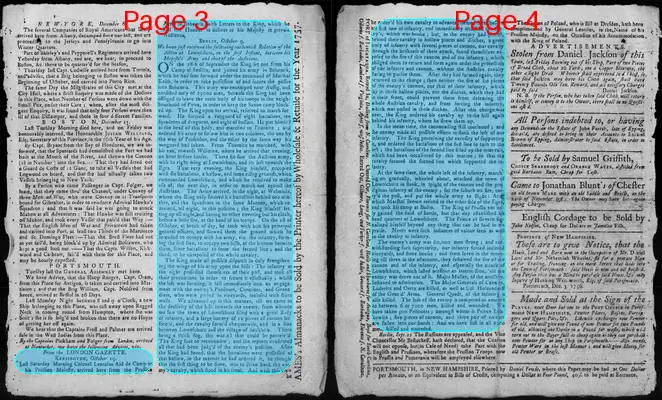
The New Hampshire Gazette
Portsmouth, Rockingham County, New Hampshire
What is this article about?
On October 1, the King of Prussia's army of 25,000 defeated a 60,000-strong Austrian force at Lowoschitz in Bohemia, capturing the town, taking 500 prisoners including Prince Lobkowitz, 5 cannons, and 3 colors. Prussian losses: 2,900; Austrian: 6-7,000 killed/wounded.
Merged-components note: Direct textual continuation of the detailed account of the battle at Lowoschitz from page 3 to page 4.
Clippings
1 of 2
OCR Quality
Full Text
Kensington, October 19.
Last Saturday Morning Colonel Lentulus, Aide de Camp to his Prussian Majesty, arrived here from the Prussian Army in Bohemia, with Letters to the King, which he had the Honour to deliver to his Majesty in private Audience.
BERLIN, October 9.
We have just received the following authentick Relation of the Action at Lowoschitz, on the first Instant, between his Majesty's Army and that of the Austrians.
On the 28th of September the King set out from his Camp at Sedlitz, and joined his army in Bohemia, which he had sent forward under the command of Marshal Keith, in order to take possession of and secure the passes into Bohemia. This army was encamped near Aueig, and consisted only of 25000 men, because the King had been obliged to leave the main body of his troops in the neighbourhood of Pirna, in order to keep the Saxon camp blocked up. The King upon his arrival, resolved to march forward. He formed a vanguard of eight battalions, ten squadrons of dragoons, and eight of hussars. He put himself at the head of this body, and marched to Tournitz; and ordered his army to follow him in two columns, the one by the way of Procobot, and the other by the same way his vanguard had taken. From Tournitz he marched, with his van, towards Welmina, where he arrived that evening, an hour before sunset. There he saw the Austrian army, with its right wing at Lowoschitz, and its left towards the Egra. That very evening, the King himself, occupied with six battalions, a hollow, and some rising grounds, which commanded Lowoschitz, and which he resolved to make use of, the next day, in order to march out against the Austrians. The Army arrived, in the night, at Welmina, where the King only formed his battalions behind one another, and the squadrons in the same Manner, which remained, all night, in this position; the King himself sitting up all night, and having no other covering but his cloak, before a little fire, at the head of his troops. On the 1st of October, at break of day, he took with him his principal general officers, and shewed them the ground which he intended to occupy with his army, viz the infantry, forming the first line, to occupy two hills, at the bottom betwixt them, some battalions to form the second line; and the third, to be composed of the whole cavalry.
The King made all possible dispatch in duly strengthening the wings of his army upon the hills: The infantry at the right possessed themselves of their post, and took all their precautions in order to secure it effectually: whilst the left was forming, it fell immediately into an engagement with the enemy's Pandours, Croatians, and Grenadiers, who were posted in vineyards, enclosed with stone walls. We advanced up in this manner, till we came to the declivity of the hill towards the enemy, from whence we saw the town of Lowoschitz filled with a great Body of infantry, and a large battery of 12 pieces of cannon before it, and the cavalry formed chequerwise, and in a line between Lowoschitz and the village of Sanchirz. There being a thick fog, this was all that could be perceived. The King sent to reconnoitre; and the reports confirmed all that had been judged of the enemy's position. After the King had found, that the battalions were possessed of that hollow, in the manner he had ordered it, he thought that the first thing to be done, was to drive back the enemy's cavalry, which stood in his front. And with this view
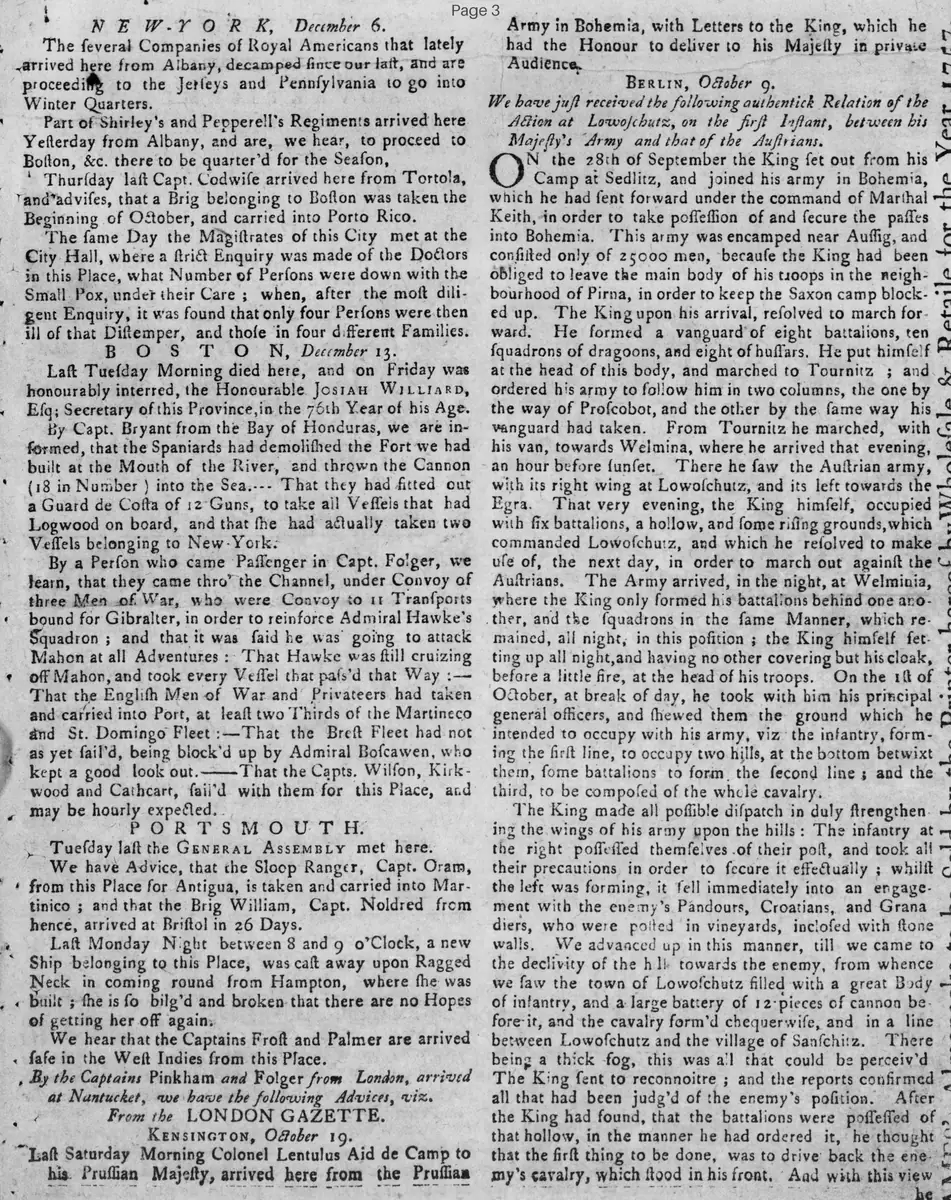
He order'd his own cavalry to advance, formed them before his first line of infantry, and immediately attacked the enemy's, which was broke; but, as the enemy had placed, behind their cavalry in hollow places and ditches, a great body of infantry with several pieces of cannon, our cavalry through the briskness of their attack, found themselves exposed to the fire of this cannon and of the infantry; which obliged them to return and form again under the protection of our infantry and cannon, without the Austrian cavalry daring to pursue them. After they had formed again, they returned to the charge; then neither the fire of 30 pieces of the enemy's cannon, nor that of their infantry, which lay in those hollow places, nor the ditches, which they had in their front, could prevent them from defeating the whole Austrian cavalry, and from forcing the infantry, which was posted in those ditches. After this charge was over, the King ordered his cavalry up to the hill again behind his infantry, where he drew them up. In the mean time, the cannonading still continued; and the enemy made all possible efforts to flank the left of our infantry. The King perceiving the necessity of supporting it, and ordered the battalions of the first line to turn to the left: the battalions of the second line filled up the intervals which had been occasioned by this motion: so that the cavalry formed the second line which supported the infantry. At the same time, the whole left of the infantry, marching on gradually, wheeled about, attacked the town of Lowoschitz in flank, in spite of the cannon and the prodigious infantry of the enemy; set the suburb on fire, carry'd the post, and put the whole army to flight: After which Marshal Brown retired to the other side of the Elbe, and took his camp at Budin. The King of Prussia not only gained the field of battle, but that day established his head quarters at Lowoschitz. The Prince of Bevern signalized himself beyond any thing that can be said in his praise. Never were such instances of valour seen as well in the cavalry as infantry. The enemy's army was 60,000 men strong; and notwithstanding such superiority, our infantry forced enclosed vineyards, and stone houses; and from seven in the morning till three in the afternoon, they sustained the fire of the cannon and of the infantry, and especially the attack of Lowoschitz, which lasted without an intermission, till the enemy was driven out of it. Major Muller, of the artillery, behaved to admiration. The Major Generals of Cavalry, Luderitz and Oertz are killed, as well as Col. Holzendorff of the Gens d' Arms. General Quadt, of the infantry is also killed. The loss of the enemy is computed to amount to between 6 or 7000 men, killed and wounded. - We have taken 500 Prisoners; amongst whom is Prince Lobkowitz; five pieces of cannon, and three pair of colours are fallen into our hands: And we have lost in all 2900 men, killed and wounded.
What sub-type of article is it?
What keywords are associated?
What entities or persons were involved?
Where did it happen?
Foreign News Details
Primary Location
Lowoschitz, Bohemia
Event Date
1st Of October
Key Persons
Outcome
prussian losses: 2900 killed and wounded. austrian losses: 6000-7000 killed and wounded, 500 prisoners including prince lobkowitz, 5 pieces of cannon, 3 pair of colours captured. prussians victorious, established headquarters at lowoschitz; austrians retreated across the elbe to budin.
Event Details
The King of Prussia joined his 25,000-man army in Bohemia on September 28, marching to confront the Austrian army near Lowoschitz. On October 1, despite fog and numerical inferiority, Prussian forces under the King's command defeated Austrian cavalry and infantry, captured Lowoschitz after intense fighting, and routed the enemy army led by Marshal Brown.