Thank you for visiting SNEWPapers!
Sign up free
Lynchburg Virginian
Lynchburg, Virginia
What is this article about?
A letter from Notoway, Virginia, published in the Southern Planter on April 29, 1846, advises on optimal wheat harvesting time to maximize flour quality and yield, citing reports from Gen. Harmon and Mr. John Hannam, and sharing a personal experiment showing losses from early cutting.
Clipping
OCR Quality
Full Text
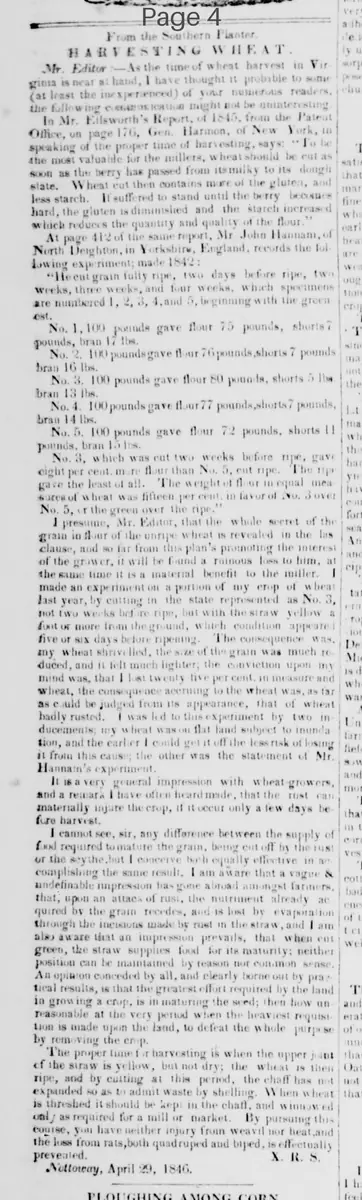
HARVESTING WHEAT.
Mr. Editor—As the time of wheat harvest in Virginia is near at hand, I have thought it probable to offer (at least the mere perusal) of your numerous readers,
the following extract as something that might be interesting
In Mr. Ellsworth's Report, 1845, from the Patent
Office, on page 110, Gen. Harmon, of New York, in
speaking of the proper time of harvesting, says: "In the most valuable for the millers, wheat should be cut as
soon as the berry has passed from its milky to its dough
state. Wheat cut then contains more of the gluten, and
less starch. If suffered to stand until the berry becomes
hard, the gluten is diminished and the starch increased
which reduces the quantity and quality of the flour."
At page 412 of the same report, Mr. John Hannam, of
North Deighton, in Yorkshire, England, records the fol-
lowing experiment; made 1842:
"I cut grain fully ripe, two days before ripe, two
weeks, three weeks, and four weeks, which specimens
are numbered 1, 2, 3, 4, and 5, beginning with the ripest.
No. 1. 100 pounds gave flour 75 pounds, shorts 7
pounds, bran 17 lbs
No. 2. 100 pounds gave flour 76 pounds, shorts 7 pounds
bran 16 lbs.
No. 3. 100 pounds gave flour 80 pounds, shorts 5 lbs
bran 13 lbs
No. 4. 100 pounds gave flour 77 pounds, shorts 7 pounds,
bran 14 lbs.
No. 5. 100 pounds gave flour 72 pounds, shorts 11
pounds, bran 15 lbs.
No. 3, which was cut two weeks before ripe, gave
eight per cent. more flour than No. 5, cut ripe. The No.
3 gave the least of all. The weight of flour in equal mea-
sures of wheat was fifteen per cent in favor of No. 3 over
No. 5, or the green over the ripe.
I presume, Mr. Editor, that the whole secret of the
grain in favor of the unripe wheat is revealed in the last
clause, and so far from this plan's promoting the interest
of the grower, it will be found a ruinous loss to him, at
the same time it is a material benefit to the miller. I
made an experiment on a portion of my crop of wheat
last year, by cutting in the state represented as No. 3,
not two weeks before ripe, but with the straw yellow a
foot or more from the ground, which condition separates
five or six days before ripening. The consequence was.
my wheat shrivelled, the size of the grain was much re-
duced, and it felt much lighter, the conviction upon my
mind was, that I had lost twenty five per cent in quantity and
wheat, the consequence accruing to the wheat was, as far
as could be judged from its appearance, that of wheat
badly rusted. I was led to this experiment by two in-
ducements. wet wheat was in flat land subject to inundation,
and the earlier I could get it off the less risk of losing
it from this cause the other was the statement of Mr.
Hannam's experiment
It is a very general impression with wheat growers,
and a remark I have often heard made, that the rust can
not materially injure the crop, if it occur only a few days be-
fore harvest.
I cannot see, sir, any difference between the supply of
food required to mature the grain, being cut off by the rust
of the scythe, but I conceive both equally effective in ac-
complishing the same result. I am aware that a vague and
undefinable impression has gone abroad among farmers.
that, upon an attack of rust, the nutriment already ac-
quired by the grain recedes, and is lost by evaporation
through the incisions made by rust in the straw, and I am
also aware that an impression prevails, that when cut
green, the straw supplies food for its maturity; neither
position can be maintained by reason nor common sense.
An opinion conceded by all, and clearly borne out by prac-
tical results, is that the greatest effort required by the land
in growing a crop, is in maturing the seed; then how un-
reasonable at the very period when the heaviest requisi-
tion is made upon the land, to defeat the whole purpose
by removing the crop.
The proper time for harvesting is when the upper joint
of the straw is yellow, but not dry; the wheat is then
ripe, and by cutting at this period, the chaff has not
expanded so as to admit waste by shelling. When wheat
is threshed it should be kept in the chaff, and winnowed
only as required for a mill or market. By pursuing this
course, you have neither injury from weather nor heat, and
the loss from rats, both quadruped and biped, is effectually
prevented.
X.R.S.
Notoway, April 29, 1846
What sub-type of article is it?
What keywords are associated?
What entities or persons were involved?
Where did it happen?
Domestic News Details
Primary Location
Notoway, Virginia
Event Date
April 29, 1846
Key Persons
Event Details
Letter advising Virginia wheat farmers on optimal harvesting time, citing 1845 Patent Office report by Gen. Harmon recommending cutting when berry passes from milky to dough state for better gluten and flour quality, and Mr. Hannam's 1842 experiment showing higher flour yield from earlier cuts but arguing it benefits millers more than growers; author shares personal experiment with losses from early cutting leading to shriveled, rusted grain; recommends cutting when upper straw joint is yellow but not dry, and storing in chaff to prevent losses.