Thank you for visiting SNEWPapers!
Sign up free
Editorial
March 16, 1916
The Logan Republican
Logan, Cache County, Utah
What is this article about?
Editorial opposes a New York court ruling permitting theaters to bar disliked critics, warning it endangers press access, public protection from poor entertainment, and broader free speech, urging legislative safeguards against such restrictions.
Clipping
OCR Quality
98%
Excellent
Full Text
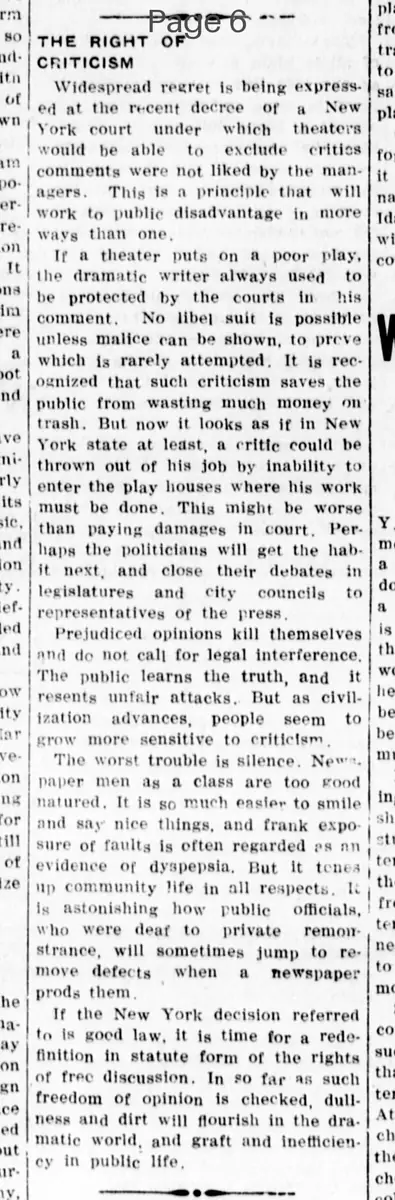
THE RIGHT OF CRITICISM
Widespread regret is being expressed at the recent decree of a New York court under which theaters would be able to exclude critics whose comments were not liked by the managers. This is a principle that will work to public disadvantage in more ways than one.
If a theater puts on a poor play the dramatic writer always used to be protected by the courts in his comment. No libel suit is possible unless malice can be shown, to prove which is rarely attempted. It is recognized that such criticism saves the public from wasting much money on trash. But now it looks as if in New York state at least, a critic could be thrown out of his job by inability to enter the play houses where his work must be done. This might be worse than paying damages in court. Perhaps the politicians will get the habit next, and close their debates in legislatures and city councils to representatives of the press.
Prejudiced opinions kill themselves and do not call for legal interference. The public learns the truth, and it resents unfair attacks. But as civilization advances, people seem to grow more sensitive to criticism. The worst trouble is silence. Newspaper men as a class are too good natured. It is so much easier to smile and say nice things, and frank exposure of faults is often regarded as an evidence of dyspepsia. But it tones up community life in all respects. It is astonishing how public officials, who were deaf to private remonstrance, will sometimes jump to remove defects when a newspaper prods them.
If the New York decision referred to is good law, it is time for a redefinition in statute form of the rights of free discussion. In so far as such freedom of opinion is checked, dullness and dirt will flourish in the dramatic world, and graft and inefficiency in public life.
Widespread regret is being expressed at the recent decree of a New York court under which theaters would be able to exclude critics whose comments were not liked by the managers. This is a principle that will work to public disadvantage in more ways than one.
If a theater puts on a poor play the dramatic writer always used to be protected by the courts in his comment. No libel suit is possible unless malice can be shown, to prove which is rarely attempted. It is recognized that such criticism saves the public from wasting much money on trash. But now it looks as if in New York state at least, a critic could be thrown out of his job by inability to enter the play houses where his work must be done. This might be worse than paying damages in court. Perhaps the politicians will get the habit next, and close their debates in legislatures and city councils to representatives of the press.
Prejudiced opinions kill themselves and do not call for legal interference. The public learns the truth, and it resents unfair attacks. But as civilization advances, people seem to grow more sensitive to criticism. The worst trouble is silence. Newspaper men as a class are too good natured. It is so much easier to smile and say nice things, and frank exposure of faults is often regarded as an evidence of dyspepsia. But it tones up community life in all respects. It is astonishing how public officials, who were deaf to private remonstrance, will sometimes jump to remove defects when a newspaper prods them.
If the New York decision referred to is good law, it is time for a redefinition in statute form of the rights of free discussion. In so far as such freedom of opinion is checked, dullness and dirt will flourish in the dramatic world, and graft and inefficiency in public life.
What sub-type of article is it?
Press Freedom
Legal Reform
What keywords are associated?
Press Freedom
Theater Criticism
New York Court
Free Discussion
Public Criticism
Legal Interference
What entities or persons were involved?
New York Court
Theater Managers
Public Officials
Newspaper Men
Editorial Details
Primary Topic
Opposition To New York Court Decree Excluding Theater Critics
Stance / Tone
Strongly Supportive Of Critics Rights And Free Discussion
Key Figures
New York Court
Theater Managers
Public Officials
Newspaper Men
Key Arguments
Theater Managers Should Not Exclude Critics Whose Comments They Dislike
Criticism Protects The Public From Poor Plays And Is Safeguarded Against Libel Unless Malice Is Proven
Excluding Critics Could Lead To Job Loss And Extend To Politicians Barring Press From Debates
Prejudiced Opinions Self Destruct Without Legal Interference, But Silence Is More Harmful
Frank Criticism Improves Community Life And Prompts Officials To Address Defects
The Decision Necessitates Statutory Redefinition Of Free Discussion Rights To Prevent Dullness And Graft