Thank you for visiting SNEWPapers!
Sign up free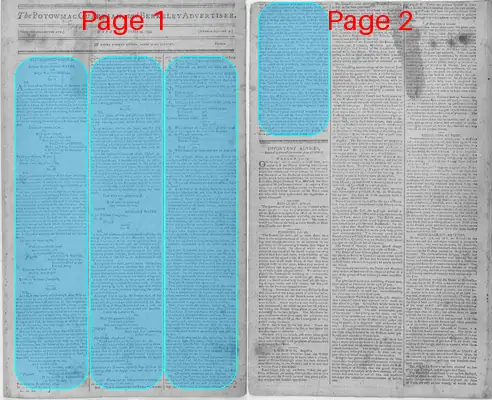
The Patowmac Guardian, And Berkeley Advertiser
Martinsburg, Shepherdstown, Berkeley County, Jefferson County, West Virginia
What is this article about?
Historical correspondence from August 1794 between U.S. General Anthony Wayne and British Major William Campbell at Fort Miamis amid the Northwest Indian War, demanding British withdrawal from U.S. territory; includes prisoner interrogations detailing Indian and British forces and plans. (248 characters)
Merged-components note: This is a continuation of the narrative correspondence and examinations between Wayne and Campbell, spanning pages 1 and 2. Relabeled to 'story' as it forms a full narrative article on US military events.
Clippings
1 of 2
OCR Quality
Full Text
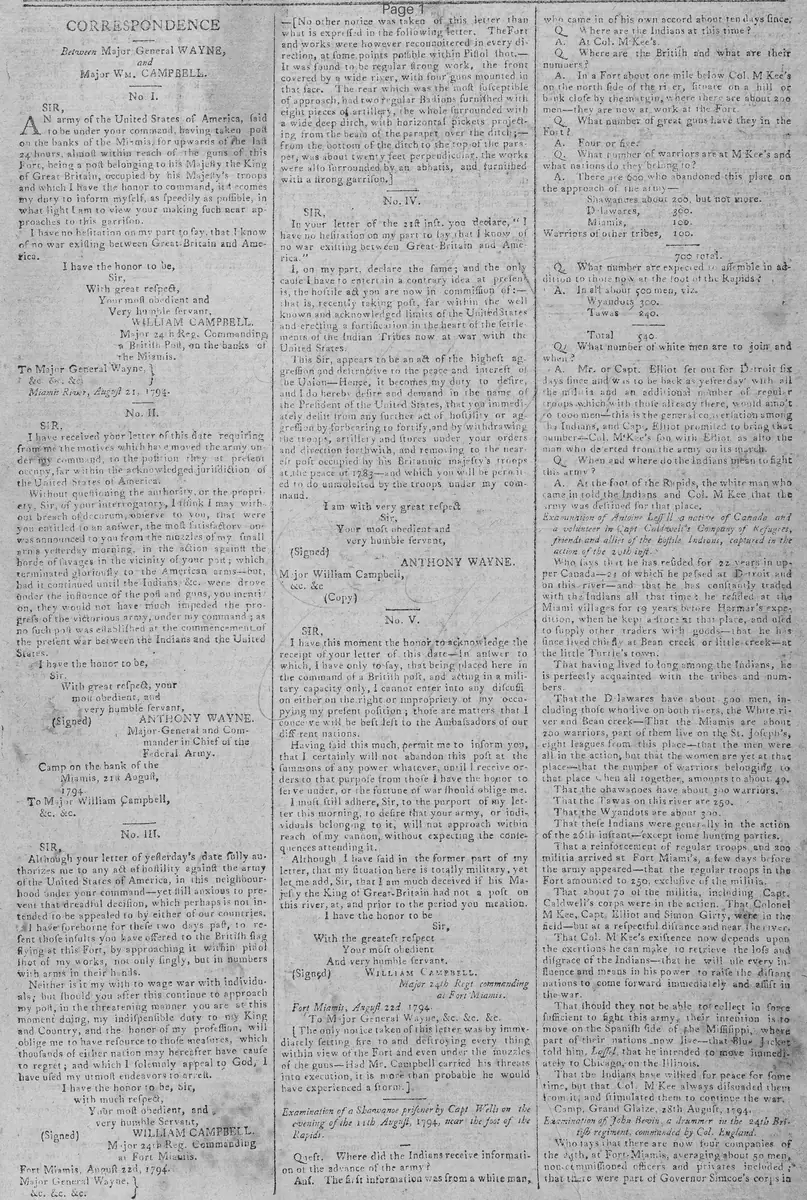
Between Major General Wayne
and
Major WM. CAMPBELL.
SIR,
The army of the United States of America, having taken post
on the banks of the Miamis, for upwards of the last
two hours almost within reach of the guns of this
Fort, being a post belonging to his Majesty the King
of Great Britain, occupied by his Majesty's troops
and which I have the honor to command, it becomes
my duty to inform myself, as speedily as possible, in
what light I am to view your making such near ap-
proaches to this garrison. Sir,
I have no hesitation on my part to say, that I know
of no war existing between Great Britain and Ame-
rica.
I have the honor to be,
Sir,
With great respect,
Your most obedient and
Very humble servant,
WILLIAM CAMPBELL,
Major 24th Regt. Commanding
a British Post, on the banks of
The Miamis.
To Major General Wayne,
&c. &c. &c.
Miamis River, August 21, 1794.
No. II.
SIR,
I have received your letter of this date requiring
from me the motives which have moved the army un-
der my command, to the position they at present
occupy, far within the acknowledged jurisdiction of
the United States of America.
Without questioning the authority, or the propriety,
Sir, of your interrogatory, I think I may with-
out breach of decorum, observe to you
that were
you entitled to an answer, the most satisfactory one
was announced to you from the muzzles of my small
arms yesterday morning, in the action against the
horde of savages in the vicinity of your post; which
terminated gloriously to the American arms—but,
had it continued until the Indians, &c. were drove
under the influence of the post and guns, you mention
on, they would not have much impeded the pro-
gress of the victorious army, under my command; as
no such post was established at the commencement of
the present war between the Indians and the United
States.
I have the honor to be.
Sir
With great respect, your
most obedient, and
very humble servant.
(Signed)
ANTHONY WAYNE
Major General and Commander in Chief of the
Federal Army
Camp on the bank of the
Miamis, 21 August.
To Major William Campbell
&c. &c.
No. III
SIR,
Although your letter of yesterday's date fully au-
thorizes me to any act of hostility against the army
of the United States of America, in this neighbour-
hood under your command—yet still anxious to pre-
vent that dreadful decision, which perhaps is not in-
tended to be appealed to by either of our countries.
I have foreborne for these two days past, to re-
sent those insults you have offered to the British flag
flying at this Fort, by approaching it within pistol
shot of my works, not only singly, but in numbers
with arms in their hands.
Neither is it my wish to wage war with individu-
als; but should you after this continue to approach
my post, in the threatening manner you are at this
moment doing, my indispensable duty to my King
and Country, and the honor of my profession, will
oblige me to have recourse to those measures, which
thousands of either nation may hereafter have cause
to regret; and which I solemnly appeal to God, I
have used my utmost endeavors to arrest.
I have the honor to be, Sir.
with much respect:
Your most obedient, and
very humble Servant,
(Signed)
WILLIAM CAMPBELL
Major 24th Regt. Commanding
at Fort Miamis.
Fort Miamis August 22d, 1794
Major General Wayne, &c.
No. IV.
-[No other notice was taken of this letter than
what is expressed in the following letter. The Fort
and works were however reconnoitered in every di-
rection, at some points possible within pistol shot.—
It was found to be regular strong work, the front
covered by a wide river, with four guns mounted in
that face. The rear which was the most susceptible
of approach, had two regular Bastions furnished with
eight pieces of artillery, the whole surrounded with
a wide deep ditch, with horizontal pickets project-
ing from the beam of the parapet over the ditch—
from the bottom of the ditch to the top of the para-
per, was about twenty feet perpendicular, the works
were also surrounded by an abattis, and furnished
with a strong garrison.]
SIR,
In your letter of the 21st inst. you declare, "I
have no hesitation on my part to say that I know of
no war existing between Great Britain and Ame-
rica."
I, on my part, declare the same; and the only
cause I have to entertain a contrary idea at present
is, the hostile act you are now in commission of:—
that is, recently taking post far within the well
known and acknowledged limits of the United States
and erecting a fortification in the heart of the settlements of the Indian Tribes now at war with the
United States.
This Sir, appears to be an act of the highest ag-
gression and destructive to the peace and interest of
the Union—Hence, it becomes my duty to desire,
and I do hereby desire and demand in the name of
the President of the United States, that you immedi-
ately desist from any further act of hostility or ag-
gression by forbearing to fortify, and by withdrawing
the troops, artillery and stores under your orders
and direction forthwith, and removing to the near-
est post occupied by his Britannic majesty's troops
at the peace of 1783—and which you will be permitted to do unmolested by the troops under my com-
mand.
I am with very great respect
Sir,
Your most obedient and
very humble servant,
(Signed)
ANTHONY WAYNE.
To Major William Campbell,
&c. &c.
(Copy)
No. V.
SIR,
I have this moment the honor to acknowledge the
receipt of your letter of this date—In answer to
which, I have only to say, that being placed here in
the command of a British post, and acting in a mili-
tary capacity only, I cannot enter into any discussion either on the right or impropriety of my occu-
pying my present position; those are matters that I
conceive will be best left to the Ambassadors of our
different nations.
Having said this much, permit me to inform you,
that I certainly will not abandon this post at the
summons of any power whatever, until I receive or-
ders to that purpose from those I have the honor to
serve under, or the fortune of war should oblige me.
I must still adhere, Sir, to the purport of my let-
ter this morning, to desire that your army, or indi-
viduals belonging to it, will not approach within
reach of my cannon, without expecting the conse-
quences attending it.
Although I have said in the former part of my
letter, that my Situation here is totally military, yet
let me add, Sir, that I am much deceived if his Ma-
jesty the King of Great Britain had not a post on
this river, at, and prior to the period you mention.
I have the honor to be
Sir,
With the greatest respect
Your most obedient
And very humble servant.
(Signed)
WILLIAM CAMPBELL.
Major 24th Regt commanding
at Fort Miamis.
Fort Miamis, August 22d. 1794.
To Major General Wayne, &c. &c. &c.
The only notice taken of this letter was by imme-
diately setting fire to and destroying every thing
within view of the Fort and even under the muzzles
of the guns—Had Mr. Campbell carried his threats
into execution, it is more than probable he would
have experienced a storm.]
Examination of a Shawanoe prisoner by Capt Wells on the
evening of the 20th August, 1794, near the foot of the
Rapids.
Ques. Where did the Indians receive informati-
on of the advance of the army?
Ans. The first information was from a white man,
who came in of his own accord about ten days since.
Where are the Indians at this time?
A.
At Col. McKee's.
Where are the British and what are their
numbers?
A. In a Fort about one mile below Col. McKee's
on the north side of the river, situate on a hill or
bank close by the margin, where there are about 200
men—they are now at work at the Fort.
What number of great guns have they in the
Fort?
Four or five.
What number of warriors are at McKee's and
what nations do they belong to?
A. There are 500 who abandoned this place on
the approach of the army—
Shawanese about 200, but not more
Delawares,
Miamis,
Warriors of other tribes,
100 total.
What number are expected to assemble in ad-
dition to those now at the foot of the Rapids
In all about 900 men, viz
Wyandots 200.
Tawas 240.
Total.
Ques.
What number of white men are to join and
when?
A. Mr. or Capt. Elliott set out for Detroit six
days since and was to be back as yesterday with all
the militia and an additional number of regular
troops which with those already there, would amount
to 1000 men—this is the general conversation among
the Indians, and Capt. Elliott promised to bring that
number—Col. McKee's Son with Elliott as also the
man who deserted from the army on its march.
Q.
When and where do the Indians mean to fight
this army?
A. At the foot of the Rapids, the white man who
came in told the Indians and Col. McKee that the
army was destined for that place.
Examination of Antoine Leflino natite of Canada and
a volunteer in Capt Caldwell's Company of Refugees,
friends and allies of the hostile Indians, captured in the
action of the 20th inst.
Who says that he has resided for 22 years in up-
per Canada—21 of which he passed at Detroit and
on this river—and that he has constantly traded
with the Indians all that time: he resided at the
Miami villages for five years before Harmar's expe-
dition, when he kept a store at that place, and used
to supply other traders with goods—that he has
since lived chiefly at Bean creek or little-creek—
at
the little Turtle's town.
That having lived so long among the Indians, he
is perfectly acquainted with the tribes and num-
bers.
That the Delawares have about 900 men. in-
cluding those who live on both rivers, the White ri-
ver and Bean creek—That the Miamis are about
200 warriors, part of them live on the St. Joseph's,
eight leagues from this place—that the men were
all in the action, but that the women are yet at that
place—that the number of warriors belonging to
that place when all together, amounts to about 40.
That the Shawanese have about 900 warriors.
That the Tawas on this river are 250.
That the Wyandots are about 200.
That these Indians were generally in the action
of the 20th instant—except some hunting parties.
That a reinforcement of regular troops and 200
militia arrived at Fort Miamis, a few days before
the army appeared—that the regular troops in the
Fort amounted to 250, exclusive of the militia.
That about 70 of the militia, including Capt.
Caldwell's corps were in the action. That Colonel
McKee, Capt. Elliott and Simon Girty, were in the
field—but at a respectful distance and near the river.
That Col. McKee's existence now depends upon
the exertions he can make to retrieve the loss and
disgrace of the Indians—that he will use every in-
fluence and means in his power to raise the distant
nations to come forward immediately and aid in
the war.
That should they not be able to collect in force
sufficient to fight this army, their intention is to
move on the Spanish Side of the Mississippi, where
part of their nations now live—that Blue Jacket
told him, himself, that he intended to move immediately to Chicago, on the Illinois.
That the Indians have wished for peace for some
time, but that Col. McKee always dissuaded them
from it; and stimulated them to continue the war.
Camp, Grand Glaize. 28th August, 1794.
Examination of John Beoin, a drummer in the 24th Bri-
tish regiment, commanded by Col. England.
Who lays that there are now four companies of
the 24th, at Fort Miamis, averaging about 50 men.
non-commissioned officers and privates included;
that there were part of Governor Simcoe's corps in
the garrison, together with about sixty Canadians ; that the whole number of men actually in the garrison including officers, &c. exceeded 200-- That the number of Indians, Canadians, &c. in the action were at least 2000, according to the report made by Col. McKee and Captain Elliot, to Major Campbell, after the action, who declared in his presence that there were actually that number engaged.-- That there were four nine-pounders, two large howitzers, and six six pounders mounted on the fort, and two swivels, and well supplied with ammunition. That the Indians were regularly supplied with provisions drawn from the British magazine in the garrison, by Col. McKee. That a deserter from the American army arrived at the fort about eight days before the army made its appearance, who gave information to Major Campbell, that the object of the American war was to take that post and garrison ; that General Wayne told the troops not to be uneasy about provisions, that there was plenty in the British garrison. That Governor Simcoe was expected at that place every hour, in consequence of an express sent to Niagara after the arrival of the deserter, but had not arrived when he came away; That the distance from Fort Miami to Detroit is sixty miles, which is generally performed in two days. That the militia of Detroit and its vicinity, amounts to near 2000: that a Col. Baubee commands them: that McKee is also a Colonel of militia, that a Lieut. Silve of the British regiment is in the Indian department, and acts as Secretary to Col. McKee. That Capt. Rimberry of the same regiment is also in the Indian department. That he saw a great number of wounded Indians pass the fort, but did not know what number was killed, that the retiring Indians appeared much dejected, and much altered to what they were in the morning before the action; that he knew of one company of volunteers commanded by a Capt. Caldwell, and white men, and armed with British muskets and bayonets, who were in the action.
What sub-type of article is it?
What themes does it cover?
What keywords are associated?
What entities or persons were involved?
Where did it happen?
Story Details
Key Persons
Location
Fort Miamis On The Banks Of The Miami River
Event Date
August 20 28, 1794
Story Details
Correspondence between Major General Anthony Wayne and Major William Campbell regarding the American army's approach to British-held Fort Miamis during the Indian war, including demands for withdrawal and threats of hostility. Includes examinations of Shawanoe prisoner, Antoine Leflino, and John Beoin revealing Indian and British forces, alliances, and intentions.