Thank you for visiting SNEWPapers!
Sign up free
The Massachusetts Spy, And Worcester County Advertiser
Worcester, Worcester County, Massachusetts
What is this article about?
Historical account of the Continental Congress proceedings in 1776, from May resolutions recommending colonial governments to the adoption of the Declaration of Independence on July 4, including key figures, committees, and voting details that secured unanimity.
Clipping
OCR Quality
Full Text
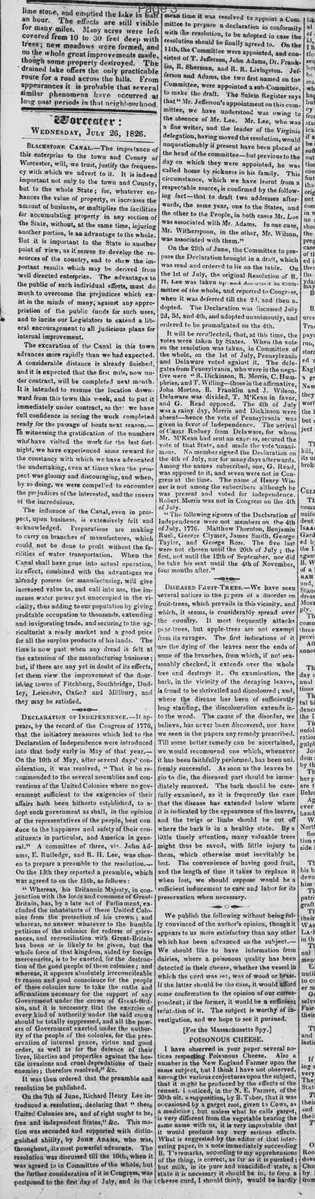
"Whereas his Britannic Majesty, in conjunction with the lords and commons of Great-Britain, has, by a late act of Parliament, excluded the inhabitants of these United Colonies from the protection of his crown: And whereas, no answer whatever to the humble petitions of the colonies for redress of grievances, and reconciliation with Great-Britain, has been or is likely to be given, but the whole force of that kingdom, aided by foreign mercenaries, is to be exerted for the destruction of the good people of these colonies; and whereas, it appears absolutely irreconcileable to reason and good conscience for the people of these colonies now to take the oaths and affirmations necessary for the support of any Government under the crown of Great-Britain, and it is necessary that the exercise of every kind of authority under the said crown should be totally suppressed, and all the powers of Government exerted under the authority of the people of the colonies, for the preservation of internal peace, virtue and good order, as well as for the defence of their lives, liberties and properties against the hostile invasions and cruel depredations of their enemies: therefore resolved," &c.
It was then ordered that the preamble and resolution be published.
On the 7th of June, Richard Henry Lee introduced a resolution, declaring that "these United Colonies are, and of right ought to be, free and independent States," &c. This motion was seconded and supported with distinguished ability, by John Adams, who was, throughout, its most powerful advocate. The resolution was discussed till the 10th, when it was agreed to in Committee of the whole, but the further consideration of it in Congress, was postponed to the first day of July, and in the mean time it was resolved to appoint a Committee to prepare a declaration in conformity with the resolution, to be adopted in case the resolution should be finally agreed to. On the 11th, the Committee were appointed, and consisted of T. Jefferson, John Adams, Dr. Franklin, R. Sherman, and R. R. Livingston. Jefferson and Adams, the two first named on the Committee, were appointed a sub-Committee, to make the draft. The Salem Register says that "Mr. Jefferson's appointment on this committee, we have understood was owing to the absence of Mr. Lee. Mr. Lee, who was a fine writer, and the leader of the Virginia delegation, having moved the resolution, would unquestionably if present have been placed at the head of the committee—but previous to the day on which they were appointed, he was called home by sickness in his family. This circumstance, which we have learnt from a respectable source, is confirmed by the following fact—that to draft two addresses afterwards, the same year, one to the States, and the other to the People, in both cases Mr. Lee was associated with Mr. Adams. In one case, Mr. Witherspoon, in the other, Mr. Wilson, was associated with them."
On the 28th of June, the Committee to prepare the Declaration brought in a draft, which was read and ordered to lie on the table. On the 1st of July, the original Resolution of R. H. Lee was taken up and discussed in Committee of the whole, and reported to Congress, when it was deferred till the 2d, and then adopted. The Declaration was discussed July 2d, 3d, and 4th, and adopted unanimously, and ordered to be promulgated on the 4th.
It will be recollected, that, at this time, the votes were taken by States. When the vote on the resolution was taken, in Committee of the whole, on the 1st of July, Pennsylvania and Delaware voted against it. The delegates from Pennsylvania, who were in the negative were "R. Dickinson, R. Morris, C. Humphries, and T. Willing—those in the affirmative, John Morton, B. Franklin and J. Wilson." Delaware was divided, T. M'Keen in favor, and G. Read opposed. The 4th of July was a rainy day, Morris and Dickinson were absent—hence the vote of Pennsylvania was given in favor of Independence. The arrival of Caesar Rodney from Delaware, for whom Mr. M'Keen had sent an express, secured the vote of that State, and made the vote unanimous. No member signed the Declaration on the 4th of July, nor for many days afterwards. Among the names subscribed, one, G. Read, was opposed to it, and seven were not in Congress at the time. The name of Henry Wisner is not among the subscribers although he was present and voted for independence. Robert Morris was not in Congress on the 4th of July.
"The following signers of the Declaration of Independence were not members on the 4th of July, 1776. Matthew Thornton, Benjamin Rush, George Clymer, James Smith, George Taylor, and George Ross. The five last were not chosen until the 20th of July; the first, not until the 12th of September, nor did he take his seat until the 4th of November, four months after."
What sub-type of article is it?
What themes does it cover?
What keywords are associated?
What entities or persons were involved?
Where did it happen?
Story Details
Key Persons
Location
Congress Of The United Colonies
Event Date
1776
Story Details
Proceedings in the Continental Congress from May 1776 resolutions on colonial governments, June introduction of independence resolution by R. H. Lee, committee drafting by Jefferson and Adams, discussions and adoption on July 2-4, with voting details ensuring unanimity despite initial opposition from Pennsylvania and Delaware.