Thank you for visiting SNEWPapers!
Sign up free
Fayetteville Observer
Fayetteville, Lincoln County, Tennessee
What is this article about?
John S. Dye of New York introduces a new method for detecting counterfeit and altered bank notes in his publication 'Dye's Wall Street Broker.' He describes genuine and spurious bills in multiple languages and provides seven detailed rules for examination, pledging to redeem undetected counterfeits at full value.
Merged-components note: Direct continuation of the article on detecting counterfeit notes.
Clipping
OCR Quality
Full Text
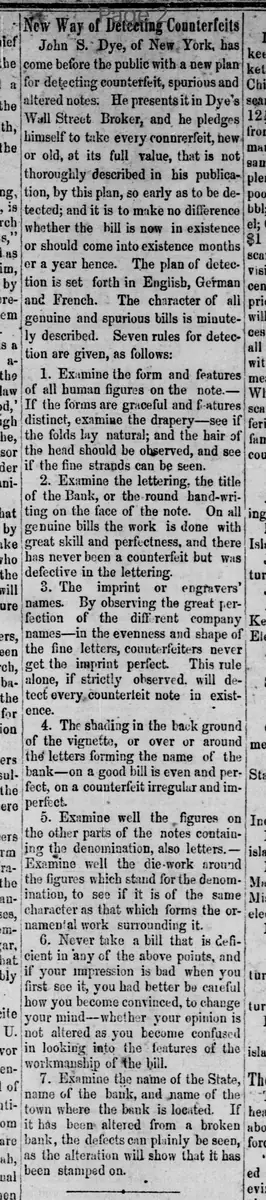
John S. Dye, of New York, has come before the public with a new plan for detecting counterfeit, spurious and altered notes. He presents it in Dye's Wall Street Broker, and he pledges himself to take every counterfeit, new or old, at its full value, that is not thoroughly described in his publication, by this plan, so early as to be detected; and it is to make no difference whether the bill is now in existence or should come into existence months or a year hence. The plan of detection is set forth in English, German and French. The character of all genuine and spurious bills is minutely described. Seven rules for detection are given, as follows:
1. Examine the form and features of all human figures on the note. If the forms are graceful and features distinct, examine the drapery--see if the folds lay natural; and the hair of the head should be observed, and see if the fine strands can be seen.
2. Examine the lettering, the title of the Bank, or the round hand-writing on the face of the note. On all genuine bills the work is done with great skill and perfectness, and there has never been a counterfeit but was defective in the lettering.
3. The imprint or engravers names. By observing the great perfection of the different company names--in the evenness and shape of the fine letters, counterfeiters never get the imprint perfect. This rule alone, if strictly observed, will detect every counterfeit note in existence.
4. The shading in the back ground of the vignette, or over or around the letters forming the name of the bank--on a good bill is even and perfect, on a counterfeit irregular and imperfect.
5. Examine well the figures on the other parts of the notes containing the denomination, also letters. Examine well the die-work around the figures which stand for the denomination, to see if it is of the same character as that which forms the ornamental work surrounding it.
6. Never take a bill that is deficient in any of the above points, and if your impression is bad when you first see it, you had better be careful how you become convinced, to change your mind--whether your opinion is not altered as you become confused in looking into the features of the workmanship of the bill.
7. Examine the name of the State, name of the bank, and name of the town where the bank is located. If it has been altered from a broken bank, the defects can plainly be seen, as the alteration will show that it has been stamped on.
What sub-type of article is it?
What themes does it cover?
What keywords are associated?
What entities or persons were involved?
Where did it happen?
Story Details
Key Persons
Location
New York
Story Details
John S. Dye presents a new plan in 'Dye's Wall Street Broker' for detecting counterfeit, spurious, and altered notes, described in English, German, and French, with seven rules focusing on figures, lettering, imprints, shading, figures, general advice, and alterations.