Thank you for visiting SNEWPapers!
Sign up free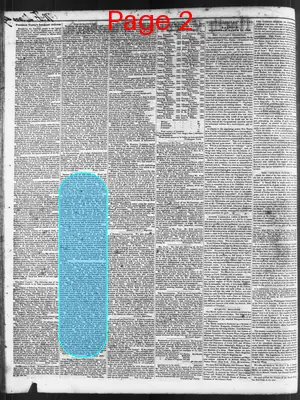
The North Carolina Standard
Raleigh, Wake County, North Carolina
What is this article about?
Secret history of the Mexican Protocol: US Commissioners Clifford and Sevier arrived in Queretaro as the treaty passed the Mexican Senate. Facing opposition, they pressured Provisional President Pena y Pena and Secretary Rosas to sign the treaty before the June 1 armistice expired, issuing a protocol as protection against war party backlash.
Clipping
OCR Quality
Full Text
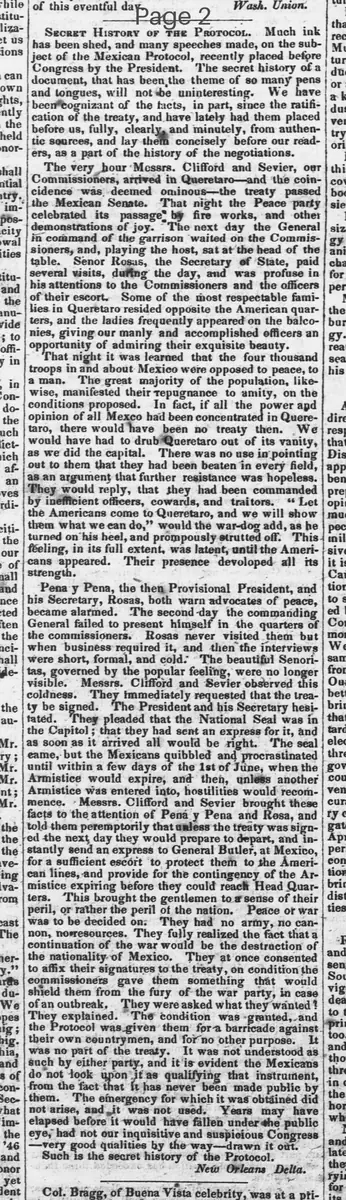
The very hour Messrs. Clifford and Sevier, our Commissioners, arrived in Queretaro—and the coincidence was deemed ominous—the treaty passed the Mexican Senate. That night the Peace party celebrated its passage by fire works, and other demonstrations of joy. The next day the General in command of the garrison waited on the Commissioners, and, playing the host, sat at the head of the table. Senor Rosas, the Secretary of State, paid several visits, during the day, and was profuse in his attentions to the Commissioners and the officers of their escort. Some of the most respectable families in Queretaro resided opposite the American quarters, and the ladies frequently appeared on the balconies, giving our manly and accomplished officers an opportunity of admiring their exquisite beauty.
That night it was learned that the four thousand troops in and about Mexico were opposed to peace, to a man. The great majority of the population, likewise, manifested their repugnance to amity, on the conditions proposed. In fact, if all the power and opinion of all Mexico had been concentrated in Queretaro, there would have been no treaty then. We would have had to drub Queretaro out of its vanity, as we did the capital. There was no use in pointing out to them that they had been beaten in every field, as an argument that further resistance was hopeless. They would reply, that they had been commanded by inefficient officers, cowards, and traitors. "Let the Americans come to Queretaro, and we will show them what we can do," would the war-dog add, as he turned on his heel, and pompously strutted off. This feeling, in its full extent, was latent, until the Americans appeared. Their presence developed all its strength.
Pena y Pena, the then Provisional President, and his Secretary, Rosas, both warm advocates of peace, became alarmed. The second day the commanding General failed to present himself in the quarters of the commissioners. Rosas never visited them but when business required it, and then the interviews were short, formal, and cold. The beautiful Senoritas, governed by the popular feeling, were no longer visible. Messrs. Clifford and Sevier observed this coldness. They immediately requested that the treaty be signed. The President and his Secretary hesitated. They pleaded that the National Seal was in the Capitol; that they had sent an express for it, and as soon as it arrived all would be right. The seal came, but the Mexicans quibbled and procrastinated until within a few days of the 1st of June, when the Armistice would expire, and then, unless another Armistice was entered into, hostilities would recommence.
Messrs. Clifford and Sevier brought these facts to the attention of Pena y Pena and Rosas, and told them peremptorily that unless the treaty was signed the next day they would prepare to depart, and instantly send an express to General Butler, at Mexico, for a sufficient escort to protect them to the American lines, and provide for the contingency of the Armistice expiring before they could reach Head Quarters. This brought the gentlemen to a sense of their peril, or rather the peril of the nation. Peace or war was to be decided on. They had no army, no cannon, no resources. They fully realized the fact that a continuation of the war would be the destruction of the nationality of Mexico. They at once consented to affix their signatures to the treaty, on condition the commissioners gave them something that would shield them from the fury of the war party, in case of an outbreak. They were asked what they wanted? They explained. The condition was granted, and the Protocol was given them for a barricade against their own countrymen, and for no other purpose. It was no part of the treaty. It was not understood as such by either party, and it is evident the Mexicans do not look upon it as qualifying that instrument, from the fact that it has never been made public by them. The emergency for which it was obtained did not arise, and it was not used. Years may have elapsed before it would have fallen under the public eye, had not our inquisitive and suspicious Congress—very good qualities by the way—drawn it out.
Such is the secret history of the Protocol.
New Orleans Delta.
What sub-type of article is it?
What keywords are associated?
What entities or persons were involved?
Where did it happen?
Foreign News Details
Primary Location
Queretaro
Event Date
Within A Few Days Of The 1st Of June
Key Persons
Outcome
treaty signed; protocol issued as protection against war party but not part of treaty and never used publicly by mexicans.
Event Details
US Commissioners Clifford and Sevier arrived in Queretaro coinciding with treaty passage in Mexican Senate. Facing opposition from troops and population, peace advocates Pena y Pena and Rosas hesitated but signed under pressure before armistice expiration, receiving a protocol as safeguard.