Thank you for visiting SNEWPapers!
Sign up free
Constitutional Whig
Richmond, Virginia
What is this article about?
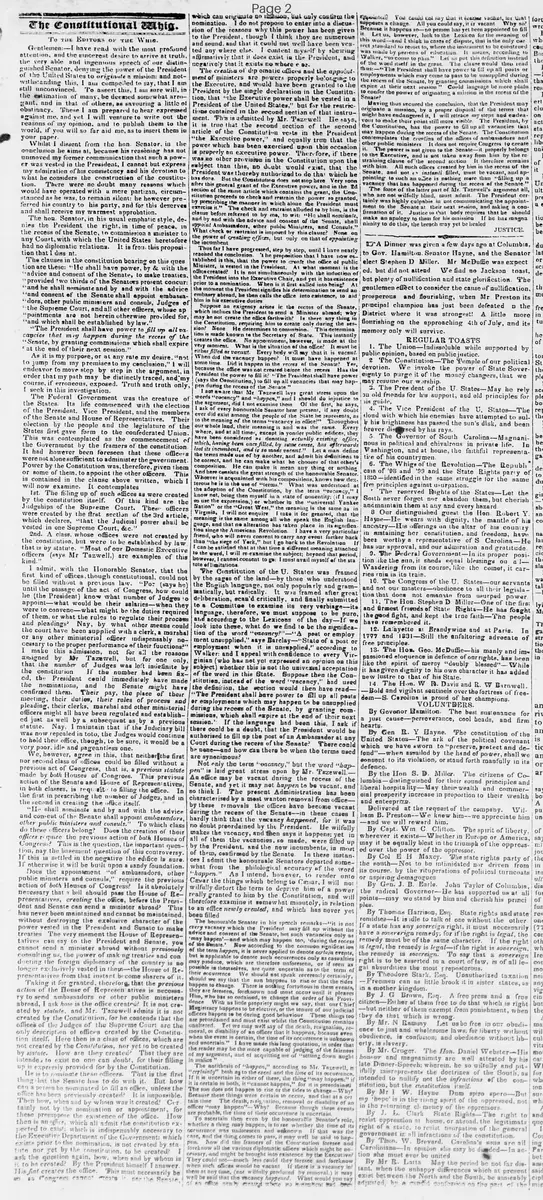
A letter to the editors of The Constitutional Whig dissents from Senator Tazewell's speech denying the President's authority to appoint a minister during Senate recess in peacetime to a new diplomatic relation. The author argues that the President can create such offices and fill resulting vacancies under the Constitution, emphasizing executive powers and lexical interpretations.
Clipping
OCR Quality
Full Text
TO THE EDITORS OF THE WHIG.
Gentlemen:--I have read with the most profound attention, and the sincerest desire to arrive at truth, the very able and ingenious speech of our distinguished Senator, denying the power of the President of the United States to originate a mission: and notwithstanding this, I am compelled to say, that I am still unconvinced. To assert this, I am sure will, in the estimation of many, be deemed somewhat arrogant, and in that of others, as savouring a little of obstinacy. These I am prepared to hear expressed against me, and yet I will venture to write out the reasons of my opinion, and to publish them to the world, if you will so far aid me, as to insert them in your paper.
Whilst I dissent from the hon. Senator, in the conclusion he aims at, because his reasoning has not unmoved my former communication that such a power was vested in the President, I cannot but express my admiration of his consistency and his devotion to what he considers the construction of the constitution. There were no doubt many reasons which would have operated with a mere partizan, circumstanced as he was, to remain silent: he however preferred his country to his party, and for this deserves and shall receive my warmest approbation.
The hon. Senator, in his usual emphatic style, denies the President the right, in time of peace, in the recess of the Senate, to commission a minister to any Court, with which the United States heretofore had no diplomatic relations. It is from this proposition that I dissent.
The clauses in the constitution bearing on this question are these: "He shall have power, by & with the advice and consent of the Senate, to make treaties, provided two thirds of the Senators present concur: and he shall nominate and by and with the advice and consent of the Senate shall appoint ambassadors, other public ministers and consuls, Judges of the Supreme Court, and all other officers, whose appointments are not herein otherwise provided for, and which shall be established by law."
"The President shall have power to fill up all vacancies that may happen during the recess of the Senate, by granting commissions which shall expire at the end of their next session."
As it is my purpose, or at any rate my desire, "not to jump from my premises to my conclusion," I will endeavor to move step by step in the argument, in order that my path may be distinctly traced, and my course, if erroneous, exposed. Truth and truth only I seek in this investigation.
The Federal Government was the creature of the States. Its life commenced with the election of the President, Vice President, and the members of the Senate and House of Representatives. Their election by the people and the legislature of the States first gave form to the confederated Union.
This was contemplated as the commencement of the Government by the framers of the constitution. It had however been foreseen that these officers were not alone sufficient to administer the government. Power by the Constitution was, therefore, given them or some of them, to appoint the other officers. This is contained in the clause above written, which I will now examine. It contemplates
1st. The filling up of such offices as were created by the constitution itself. Of this kind are the Judgeships of the Supreme Court. These officers were created by the first section of the 3rd article, which declares, "that the Judicial power shall be vested in one Supreme Court, &c."
2nd. A class, whose offices were not created by the constitution, but were to be established by law that is by statute. "Most of our Domestic Executive officers (says Mr Tazwell,) are examples of this kind."
I admit, with the Honorable Senator, that the first kind of offices, though constitutional, could not be filled without a previous law. "For (says he) until the passage of the act of Congress, how could he (the President) know what number of Judges to appoint--what would be their salaries--when they were to convene--what might be the duties required of them, or what the rules to regulate their process and pleadings? Nay, by what other means could the court have been supplied with a clerk, a marshal or any other ministerial officer indispensably necessary to the proper performance of their functions?"
I make this admission, not for all the reasons assigned by Mr Tazewell, but for one only, that the number of Judges was left indefinite by the constitution.
If the number had been fixed, the President could immediately have made the nominations, and the Senate might have confirmed them. Their pay, the place of their meeting, their duties, their rules of process and pleading, their clerks, marshal and other ministerial officers might all have been regulated and established just as well by a subsequent as by a previous statute. Nay, I maintain that if the Judiciary bill was now repealed in toto, the Judges would continue to hold their office, though, to be sure, it would be a very poor, idle and pageantless one.
We, however, agree in this, that neither the first nor second class of offices could be filled without a previous act of Congress, that is, a previous statute made by both Houses of Congress. This previous action of the Senate and House of Representatives, in both classes, is requisite to filling the office. In the first in prescribing the number of Judges, and in the second in creating the office itself.
"He shall nominate and by and with the advice and consent of the Senate shall appoint ambassadors, other public ministers and consuls." To which class do these officers belong? Does the creation of their offices require the previous action of both Houses of Congress? This is the question, the important question, nay the basement question of this controversy.
If this is settled in the negative the edifice is sure. If otherwise it will be built upon a sandy foundation.
Does the appointment "of ambassadors, other public ministers and consuls," require the previous action of both Houses of Congress? Is it absolutely necessary that a bill should pass the House of Representatives, creating the office, before the President and Senate can send a minister abroad? This has never been maintained and cannot be maintained, without destroying the exclusive character of the power vested in the President and Senate to make treaties. The very moment the House of Representatives can say to the President and Senate, you cannot send a minister abroad without previously consulting us, the power of making treaties and conducting the foreign diplomacy of the country is no longer exclusively vested in them--the House of Representatives from that instant become sharers of it.
Taking it for granted, therefore, that the previous action of the House of Representatives is necessary to send ambassadors or other public ministers abroad, I ask how is the office created? It is not created by statute, and Mr. Tazewell admits it is not created by the Constitution, for he contends that the offices of the Judges of the Supreme Court are the only description of officers created by the Constitution itself. Here then is a class of offices, which are not created by the Constitution, nor yet to be created by statute. How are they created? That they are intended to exist no one can doubt, for their filling up is expressly provided for by the Constitution.
He is to nominate these officers. That is the first thing that the Senate has to do with it. But how can a person be nominated to fill an office, unless the office has been previously created? It is impossible. Then how, when and by whom was it created? Certainly not by the nomination or appointment, for these presuppose the existence of the office. How then is an office, which all admit the constitution expected to exist; which is indispensably necessary to the Executive Department of the Government: which exists prior to the nomination, is not created by statute nor yet by the constitution, to be created? I ask the question again, how, when and by whom is it to be created? By the President himself I answer. His fiat creates the office. This must necessarily be so as Congress cannot nominate nor the Senate.
which can originate no mission, but only confirm the nomination. I do not propose to enter into a discussion of the reasons why this power has been given to the President, though I think they are numerous and sound, and that it could not well have been vested any where else. I content myself by showing affirmatively that it does exist in the President, and negatively that it exists no where else.
The creation of diplomatic offices and the appointment of ministers are powers properly belonging to the Executive, and would have been granted to the President by the single declaration in the Constitution, that "the Executive power shall be vested in a President of the United States," but for the restrictions contained in the second section of that instrument. This is admitted by Mr. Tazewell. He says, it is true that the second section of the second article of the Constitution vests in the President "the Executive power," and equally true that the power which has been exercised upon this occasion is properly an executive power. Therefore, if there was no other provision in the Constitution upon the subject than this, no doubt would exist, that the President was thereby authorized to do that which he has done. But the Constitution does not stop here. Very soon after this general grant of the Executive power, and in the 2d section of the same article which contains the grant, the Constitution proceeds to check and restrain the power so granted, by prescribing the manner in which alone the President must exercise it." The check and restraint alluded to by him, is the clause before referred to by me, to wit: "He shall nominate, and by and with the advice and consent of the Senate, shall appoint Ambassadors, other public Ministers, and Consuls."
What check or restraint is imposed by this clause? None on the power of creating offices, but only on that of appointing the incumbent.
Thus far I have progressed, step by step, until I have nearly reached the conclusion. The proposition that I have now established is this, that the power to create the office of public Minister, is vested in the President. At what moment is the office created? It is not simultaneously with the induction of the President into the Executive Chair, and yet it has existence prior to a nomination. When is it first called into being? At the moment the President signifies his determination to send an embassy abroad, he then calls the office into existence, to aid him in his executive duties.
Suppose an exigency arises in the recess of the Senate, which inclines the President to send a Minister abroad; why may not create the office forthwith? Is there any thing in the Constitution, requiring him to create only during the session? None. He determines to commission. This determination is made known to the Secretary of State. This instantly creates the office. No appointment, however, is made at the very moment.
What is the situation of the office? It must be either filled or vacant. Every body will say that it is vacant. When did the vacancy happen? It must have happened at some time. Did it happen in the recess of the Senate? because the office was not created before the recess President the power to fill it? "The President shall have power (says the Constitution,) to fill up all vacancies that may happen during the recess of the Senate."
Has the Yes, I am aware that Mr Tazewell lays great stress upon the words "vacancy" and "happen." and I the argument, did I not examine them should do injustice to Of the first, he says,
I ask of every honourable Senator here present, if any doubt ever did exist among the people of the State he represents, as to the meaning of the terms "vacancy in office?" our whole land, their meaning is and was the same. Every where, and at all times, except in yonder public edifices, they Throughout have been considered as denoting actually existing office, which, having been once filled, by some cause, has afterwards lost its incumbent, and is so made vacant."
Let a man define the terms made use of by another, and admit his definitions to be correct, and he can make what he chooses of that other's composition. He can make it mean any thing or nothing And here consists the great strength of the honourable Senator. Whoever is acquainted with his compositions, knows how dexterous he is in the use of "terms." What was understood at the adoption of the Constitution, by the term "vacancy," I know not, being then myself in a state of nonentity: (if I may so use the expression,) or whether in the "universal Yankee Nation" or the "Great West," the meaning is the same as in Virginia, I will not enquire.
I take it for granted, that the meaning is the same among all who speak the English language, and that no alteration has taken place in its signification since the American Revolution. I have a very particular friend, who will never consent to carry any event further back than "the siege of York," but I go back to the Revolution. If I can be satisfied that at that time a different meaning attached to the word, I will re-examine the subject; beyond that period, however, I cannot consent to go: I must avail myself of the statute of limitations.
The Constitution of the U. States was framed by the sages of the land by those who understood the English language, not only popularly and grammatically, but radically. It was framed after great deliberation, scanned critically, and finally submitted to a Committee to examine its very verbiage--its language, therefore, we must suppose to be pure, and according to the Lexicons of the day. If we look into these, what do we find to be the signification of the word "vacancy?" "A post or employment unsupplied," says Barclay--"State of a post or employment when it is unsupplied," according to Walker: and I appeal with confidence to every Virginian (who has not yet expressed an opinion on this subject) whether this is not the universal acceptation of the word in this State. Suppose then the Constitution, instead of the word "vacancy," had used the definition, the section would then have read--
"The President shall have power to fill up all posts or employments which may happen to be unsupplied during the recess of the Senate, by granting commissions, which shall expire at the end of their next session." If the language had been this, I ask if there could be a doubt, that the President would be authorised to fill up the post of an Ambassador at any Court during the recess of the Senate? There could be none--and how can there be when the terms used are synonymous?
Not only the term "vacancy," but the word "happen" is laid great stress upon by Mr. Tazewell. An office may be vacant during the recess of the Senate, and yet it may not happen to be vacant, and so think I. The present Administration has been characterised by a most wanton removal from office-- by these removals the offices have become vacant during the recess of the Senate--in these cases I hardly think that the vacancy happened, for it was no doubt preordained by the President. He wilfully makes the vacancy, and then says it happens; yet in all of them the vacancies, so made, were filled up by the President, and the new incumbents, in most of them, confirmed by the Senate. In these instances I admit the honourable Senators departed somewhat from the philological accuracy of the word "happen." As I intend, however, to render unto Caesar the things which belong to Caesar, I will not wilfully distort the term to deprive him of a power really granted to him by the Constitution, and will therefore examine it somewhat minutely, in relation to an office newly created, and which has never yet been filled.
The honourable Senator in his speech remarks--"it is not every vacancy which the President may fill up without the advice and consent of the Senate, but such vacancies only as 'may happen'--and which may happen too, 'during the recess of the Senate.' Now according to the common signification of the term happen, it is never applied to denote certain events, but is applicable to denote such occurrences only as casualties may produce, which are therefore unforeseen, or if seen as possible in themselves, are quite uncertain as to the time of their occurrence. We should not speak reverently certainly, should we say that the sun happens to rise or that the tides happen to change. There is nothing fortuitous in these events, they are foreseen, foreknown and must occur until it pleases Him, who has so ordained, to change the order of his Providence. With as little propriety might we say, that our Chief Magistracy happens to be elective, or the tenure of our judicial officers happen to be during good behaviour. These things too are preordained and must exist whilst the Constitution remains unaltered. Yet we may well say of the death, resignation, removal, or disability of an officer that it happens, because even when the event is certain, the time of its occurrence is unknown and uncertain." I have made this long quotation, in order that the reader may be the more capable of judging of the fairness of my argument, and of acquitting me of "setting down aught in malice."
The antithesis of "happen," according to Mr. Tazewell, is "certainty" both as to the event and the time of its occurrence. If it is uncertain in either of these, the thing "may happen:" if it is certain in both, it "cannot happen," for it is preordained. The sun does not happen to rise or the tides to change--Why? Because these things were certain to occur, and that at a certain time. The death, resignation, removal or disability of an officer "may happen"--Why? Because though these events are probable, the time of their occurrence is uncertain.
To ascertain then even by the honourable Senator's rule, whether a thing may happen, is to see whether the time of its occurrence was unforeseen and unknown. If that was the case, and the thing comes to pass, it may well be said to happen. Now did the framers of the Constitution foresee and foreknow all the various diplomatic offices which might be necessary, and might be brought into existence by the Executive? They could not--much less could they foresee and foreknow when such offices would be vacant. If there is a vacancy in them at any time, (not wilfully produced by removal.) it may well be said that the vacancy happened. What would you say of an office newly created where no appointment had filled You could not say it became vacant, for what supposes a change. All you could say, it is vacant why so? Because it happens so--no person has yet been appointed to fill it Let us however look to the Lexicon for the meaning of this word--and I think in cases of dispute, that is the only correct standard to resort to, where the instrument to be construed was made by persons of education. It means, according to Walker, "to come to pass."
Let us put this definition instead of the word itself in the grant. The clause would then read thus:--"The President shall have power to fill up all posts or employments which may come to pass to be unsupplied during the recess of the Senate, by granting commissions which shall expire at their next session" Could language be more plain to confer the power of originating a mission in the recess of the Senate?
Having thus secured the conclusion, that the President may originate a mission, by a proper disposal of the terms that might have endangered it, I will retrace my steps and endeavour to make their point still more visible. The President, by the Constitution, has the power to fill up all vacancies that may happen during the recess of the Senate. The Constitution contemplates the creation of the offices of ambassadors and other public ministers. It does not require Congress to create it. The power is not given to the Senate--it properly belongs to the Executive, and is not taken away from him by the restraining clause of the second section. It therefore remains with him. All such offices created by him in the recess of the Senate, and not instantly filled, must be vacant, and appointing to such an office is nothing more than "filling up a vacancy that has happened during the recess of the Senate."
The force of the latter part of Mr. Tazewell's argument all, who are not wilfully blind, must admit. The President certainly was highly culpable in not communicating the appointment to the Senate at their next session, and asking a confirmation of it. Justice to that body requires that he should make an apology to them for his omission. If he has magnanimity to do this, the breach may yet be healed.
JUSTICE.
What sub-type of article is it?
What themes does it cover?
What keywords are associated?
What entities or persons were involved?
Letter to Editor Details
Author
Justice.
Recipient
Editors Of The Whig
Main Argument
the president possesses the constitutional power to create diplomatic offices and appoint ministers during the senate's recess in peacetime to establish new relations, dissenting from senator tazewell's denial of this authority; such appointments fill vacancies that 'happen' per the constitution's recess clause.
Notable Details