Thank you for visiting SNEWPapers!
Sign up free
Editorial
March 25, 1841
Rutland Herald
Rutland, Rutland County, Vermont
What is this article about?
Sermon by Rev. Wm. Mitchell at North Church, Rutland, on May 14 national fast day, interpreting President Harrison's death as divine judgment reminding rulers ('gods') of mortality, critiquing political idolatry and national sins, calling for repentance and reliance on God.
Merged-components note: These three components form a continuous sermon on the death of President Harrison, fitting as a single editorial piece.
Clipping
OCR Quality
95%
Excellent
Full Text
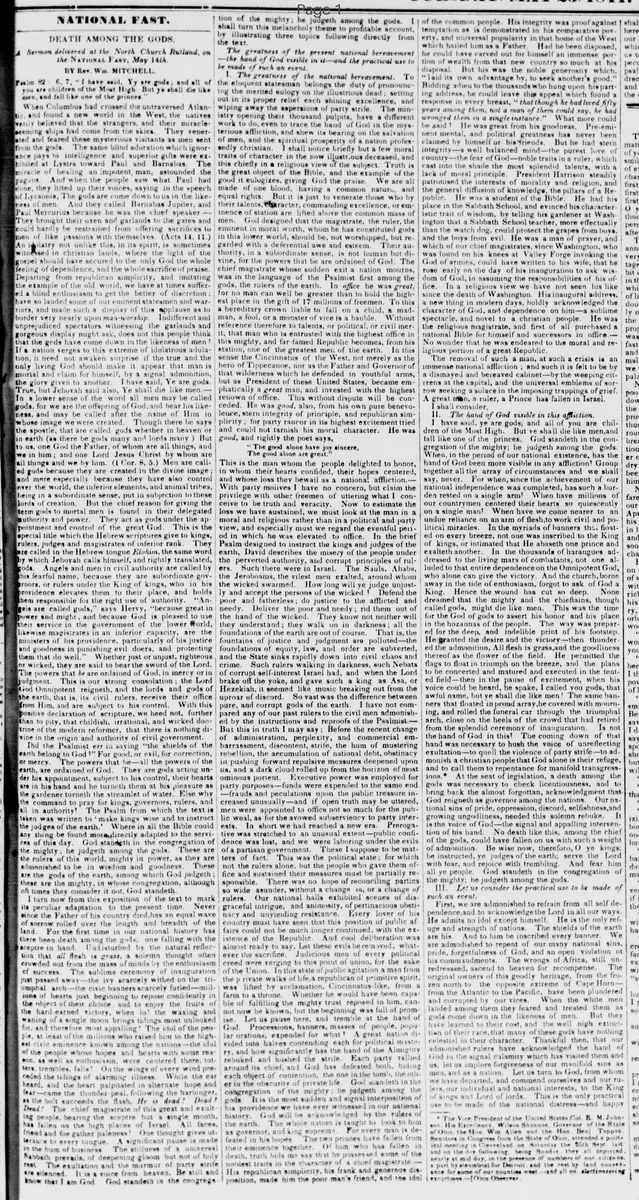
DEATH AMONG THE GODS.
Sermon delivered at the North Church Rutland, on the National Fast, May 14th.
BY REV. WM. MITCHELL.
Psalm 82:6, 7, "I have said, Ye are gods; and all of you are children of the Most High. But ye shall die like men, and fall like one of the princes."
When Columbus had crossed the untraversed Atlantic, and found a new world in the West, the natives verily believed that the strangers, and their miracle-working ships had come from the skies. They venerated and feared these mysterious visitants as men sent from the gods. The same blind adoration which ignorance pays to intelligence and superior gifts were exhibited at Lystra toward Paul and Barnabas. The miracle of healing an impotent man, astounded the pagans. And when the people saw what Paul had done, they lifted up their voices, saying in the speech of Lycaonia, The gods are come down to us in the likeness of men. And they called Barnabas Jupiter, and Paul Mercurius because he was the chief speaker. They brought their oxen and garlands to the gates and could hardly be restrained from offering sacrifices to men of like passions with themselves. (Acts 14, 11.)
An idolatry not unlike this, in its spirit, is sometimes witnessed in christian lands, where the light of the gospel should have secured to the only God the whole feeling of dependence, and the whole sacrifice of praise. Departing from republican simplicity, and imitating the example of the old world, we have at times suffered a blind enthusiasm to get the better of discretion: have so lauded some of our eminent statesmen and warriors, and made such a display of this applause as to border very nearly upon man-worship. Indifferent and unprejudiced spectators witnessing the garlands and gorgeous display might ask, does not this people think that the gods have come down in the likeness of men?
If a nation verges to this extreme of idolatrous adulation, it need not awaken surprise if the true and the only living God should make it appear that man is mortal and claim for himself, by a signal admonition, the glory given to another. I have said, Ye are gods. True, but Jehovah said also, Ye shall die like men.
In a lower sense of the word all men may be called gods, for we are the offspring of God, and bear his likeness, and may be called after the name of Him in whose image we were created. Though there be says the apostle, that are called gods whether in heaven or in earth (as there be gods many and lords many) But to us, one God the Father, of whom are all things, and we in him; and one Lord Jesus Christ by whom are all things and we by him. (1 Cor. 8. 5.) Men are called gods because they are created in the divine image: and more especially because they have also control over the world, the inferior elements, and animal tribes, being in a subordinate sense, put in subjection to these lords of creation. But the chief reason for giving the term gods to mortal men is found in their delegated authority and power. They act as gods under the appointment and control of the great God. This is the special title which the Hebrew scriptures give to kings, rulers, judges and magistrates of inferior rank. They are called in the Hebrew tongue Elohim, the same word by which Jehovah calls himself, and rightly translated, gods. Angels and men in civil authority are called by this fearful name, because they are subordinate governors, or rulers under the King of kings, who in his providence elevates them to their place, and holds them responsible for the right use of authority. "Angels are called gods," says Hervey, "because great in power and might, and because God is pleased to use their service in the government of the lower world, likewise magistrates in an inferior capacity, are the ministers of his providence, particularly of his justice and goodness in punishing evil doers, and protecting them that do well." Whether just or unjust, righteous or wicked, they are said to bear the sword of the Lord. The powers that be are ordained of God, in mercy or in judgment. This is our strong consolation: the Lord God Omnipotent reigneth, and the lords and gods of the earth, that is, its civil rulers, receive their office from Him, and are subject to his control. With this positive declaration of scripture, we heed not, further than to pity, that childish, irrational, and wicked doctrine of the modern reformer, that there is nothing divine in the origin and authority of civil government.
Did the Psalmist err in saying "the shields of the earth belong to God?" For good, or evil, for correction, or mercy. The powers that be—all the powers of the earth, are ordained of God. They are gods acting under his appointment, subject to his control, their hearts are in his hand and he turneth them at his pleasure as the gardener turneth the streamlet of water. Else why the command to pray for kings, governors, rulers, and all in authority! The Psalm from which the text is taken was written to 'make kings wise and to instruct the judges of the earth.' Where in all the Bible could any thing be found more directly adapted to the services of this day. God standeth in the congregation of the mighty; he judgeth among the gods. These are the rulers of this world. mighty in power, as they are admonished to be in wisdom and goodness. These are the gods of the earth, among which God judgeth: these are the mighty, in whose congregation, although often times they consider it not, God standeth.
I turn now from this exposition of the text to mark its peculiar adaptation to the present time. Never since the Father of his country died, has an equal wave of sorrow rolled over the length and breadth of the land. For the first time in our national history has there been death among the gods. one falling with the sceptre in his hand. Undisturbed by the natural reflection that all flesh is grass. a solemn thought often crowded out from the mass of minds by the enthusiasm of success The sublime ceremony of inauguration just passed away—the ivy scarcely withered on the triumphal arch—the civic banners scarcely furled—millions of hearts just beginning to repose confidently in the object of their choice and to enjoy the fruits of the hard-earned victory, when lo, the waxing and waning of a single moon brings tidings most unlooked for, and therefore most appalling. The idol of the people, at least of the millions who raised him to the highest civic eminence known among the nations—the idol of the people whose hopes and hearts with some reason, as well as enthusiasm. were centered there, totters. trembles. falls! On the wings of every wind preceded the tidings of alarming illness. While the ear heard, and the heart palpitated in alternate hope and fear—came the thunder peal, following the harbinger, as the bolt succeeds the flash. He is dead! Dead? Dead! The chief magistrate of this great and exulting people, bearing the sceptre but a single month, has fallen on the high places of Israel. All faces, friend and foe gather paleness. One thought gives utterance to every tongue. A significant pause is made in the hum of business. The stillness of a universal Sabbath prevails, of deepening gloom but not of holy rest. The exultation and the murmur of party strife are silenced. It is a voice from heaven. Be still and know that I am God God standeth in the congregation of the mighty: he judgeth among the gods. I shall turn this melancholy theme to profitable account, by illustrating three topics following directly from the text.
The greatness of the present national bereavement—the hand of God visible in it—and the practical use to be made of such an event.
I. The greatness of the national bereavement. To the eloquent statesman belongs the duty of pronouncing the merited eulogy on the illustrious dead: setting out in its proper relief each shining excellence, and wiping away the aspersions of party strife. The ministry opening their thousand pulpits, have a different work to do, even to trace the hand of God in the mysterious affliction, and shew its bearing on the salvation of men, and the spiritual prosperity of a nation professedly christian. I shall notice briefly but a few moral traits of character in the now illustrious deceased, and this chiefly in a religious view of the subject. Truth is the great object of the Bible, and the example of the good it eulogizes, giving God the praise. We are all made of one blood, having a common nature, and equal rights. But it is just to venerate those who by their talents, character, commanding excellence, or eminence of station are lifted above the common mass of men. God designed that the magistrate, the ruler, the eminent in moral worth, whom he has constituted gods in this lower world, should be, not worshipped, but regarded with a deferential awe and esteem.' Their authority, in a subordinate sense, is not human but divine, for the powers that be are ordained of God. The chief magistrate whose sudden exit a nation mourns, was in the language of the Psalmist first among the gods, the rulers of the earth. In office he was great, for no man can well be greater than to hold the highest place in the gift of 17 millions of freemen. To this a hereditary crown liable to fall on a child, a madman, a fool, or a monster of vice is a bauble. Without reference therefore to talents, or political, or civil merit, that man who is entrusted with the highest office in this mighty, and far-famed Republic becomes, from his station, one of the greatest men of the earth. In this sense the Cincinnatus of the West, not merely as the hero of Tippecanoe, nor as the Father and Governor of that wilderness which he defended in youthful arms, but as President of these United States, became emphatically a great man, and invested with the highest renown of office. This without dispute will be conceded. He was good, also, from his own pure benevolence, stern integrity of principle, and republican simplicity; for party rancor in its highest excitement tried and could not tarnish his moral character. He was good, and rightly the poet says,
"The good alone have joy sincere,
The good alone are great."
This is the man whom the people delighted to honor, in whom their hearts confided, their hopes centered, and whose loss they bewail as a national affliction.— With party motives I have no concern, but claim the privilege with other freemen of uttering what I conceive to be truth and veracity. Now to estimate the loss we have sustained, we must look at the man in a moral and religious rather than in a political and party view, and especially must we regard the eventful period in which he was elevated to office. In the brief Psalm designed to instruct the kings and judges of the earth, David describes the misery of the people under the perverted authority, and corrupt principles of rulers. Such there were in Israel. The Sauls, Ahabs, the Jeroboams, the vilest men exalted, around whom the wicked swarmed. How long will ye judge unjustly and accept the persons of the wicked? Defend the poor and fatherless; do justice to the afflicted and needy. Deliver the poor and needy: rid them out of the hand of the wicked. They know not neither will they understand; they walk on in darkness; all the foundations of the earth are out of course. That is, the fountains of justice and judgment are polluted—the foundations of equity, law, and order are subverted, and the State sinks rapidly down into civil chaos and crime. Such rulers walking in darkness, such Nebuchadnezzars of corrupt self-interest Israel had, and when the Lord brake off the yoke, and gave such a king as Asa, or Hezekiah. it seemed like music breaking out from the uproar of discord. So vast was the difference between pure, and corrupt gods of the earth. I have not compared any of our past rulers to the civil men admonished by the instructions and reproofs of the Psalmist.— But this in truth I may say : Before the recent change of administration, perplexity, and commercial embarrassment, discontent, strife, the hum of mustering rebellion, the accumulation of national debt, obstinacy in pushing forward repulsive measures deepened upon us, and a dark cloud rolled up from the horizon of most ominous portent. Executive power was employed for party purposes—funds were expended to the same end—frauds and peculations upon the public treasure increased unusually—and if open truth may be uttered, men were appointed to office not so much for the public weal, as for the avowed subserviency to party interests. In short we had reached a new era. Prerogative was stretched to an unusual extent—public confidence was lost, and we were laboring under the evils of a partisan government. These I suppose to be matters of fact." This was the political state: for which not the rulers alone. but the people who gave them office and sustained their measures must be partially responsible. There was no hope of reconciling parties so wide asunder, without a change in, or a change of rulers. Our national halls exhibited scenes of disgraceful intrigue, and animosity, of pertinacious obstinacy and unyielding resistance. Every lover of his country must have seen that this position of public affairs could not be much longer continued. with the existence of the Republic. And cool deliberation was almost ready to say, Let these evils be removed, whatever the sacrifice. Judicious men of every political creed were verging to this point of union, for the sake of the Union. In this state of public agitation a man from the private walks of life, a republican of primitive spirit, was lifted by acclamation, Cincinnatus-like, from a farm to a throne. Whether he would have been capable of fulfilling the mighty trust reposed in him, cannot now be known, but the beginning was full of promise. Let us pause here, and tremble at the hand of God. Processions, banners, masses of people, popular orations. expended for what' A great nation divided into halves contending each for political mastery, and how significantly has the hand of the Almighty rebuked and hushed the strife. Each party rallied around its chief, and God has defeated both, hiding each object of contention. the one in the tomb, the other in the obscurity of private life. God standeth in the congregation of the mighty : he judgeth among the gods It is the most sudden and signal interposition of his providence we have ever witnessed in our national history. God will be acknowledged by the rulers of the earth. The whole nation is taught to look to him as governor, and king supreme. For every man is defeated in his hopes The two princes have fallen from their eminence together. Of him who has fallen in death, truth bids me say that he possessed some of the noblest traits in the character of a chief magistrate— His republican simplicity, his frank and generous disposition, made him the poor man's friend, and the idol
of the common people. His integrity was proof against temptation as is demonstrated in his comparative poverty, and universal popularity in that home of the West which hailed him as a Father. Had he been disposed, he could have carved out for himself an immense portion of wealth from that new country so much at his disposal. But his was the noble generosity which,
"laid its own advantage by, to seek another's good."
Bidding adieu to the thousands who hung upon his parting address, he could leave this appeal which found a response in every breast, "that though he had lived fifty years among them, not a man of them could say, he had wronged them in a single instance." What more could be said! He was great from his goodness. Pre-eminent mental, and political greatness has never been claimed by himself or his friends. But he had stern integrity—a well balanced mind—the purest love of country—the fear of God—noble traits in a ruler, which cast into the shade the most splendid talents, with a lack of moral principle. President Harrison steadily patronized the interests of morality and religion, and the general diffusion of knowledge, the pillars of a Republic. He was a student of the Bible. He had his place in the Sabbath School, and evinced his characteristic trait of wisdom. by telling his gardener at Washington that a Sabbath School teacher, more effectually than the watch dog, could protect the grapes from boys. and the boys from evil. He was a man of prayer, and which of our chief magistrates, since Washington, who was found on his knees at Valley Forge invoking the God of armies, could have written to his wife, that he rose early on the day of his inauguration to ask wisdom of God, in assuming the responsibilities of his office. In a religious view we have not seen his like since the death of Washington. His inaugural address, a new thing in modern days, boldly acknowledged the character of God, and dependence on him—a sublime spectacle. and novel to a christian people. He was the religious magistrate, and first of all purchased a national Bible for himself and successors in office,— No wonder that he was endeared to the moral and religious portion of a great Republic.
The removal of such a man, at such a crisis is an immense national affliction ; and such it is felt to be by a dismayed and bereaved cabinet—by the weeping citizens at the capital, and the universal emblems of sorrow seeking a solace in the imposing trappings of grief. A great man, a ruler, a Prince has fallen in Israel.
I shall consider,
II. The hand of God visible in this affliction.
I have said, ye are gods; and all of you are children of the Most High. But ye shall die like men, and fall like one of the princes. God standeth in the congregation of the mighty; he judgeth among the gods.
When, in the period of our national existence, has the hand of God been more visible in any affliction? Group together all the array of circumstances and we shall say, never. For when, since the achievement of our national independence was completed, has such a burden rested on a single arm? When have millions of our countrymen centered their hearts so quiescently on a single man? When have we come nearer to an undue reliance on an arm of flesh, to work civil and political miracles. In the myriads of banners that floated on every breeze, not one was inscribed to the King of kings, or intimated that He abaseth one prince and exalteth another. In the thousands of harangues addressed to the living mass of combatants, not one alluded to that entire dependence on the Omnipotent God. who alone can give the victory. And the church, borne away in the tide of enthusiasm, forgot to ask of God a King. Hence the wound has cut so deep. None dreamed that the mighty and the chieftains, though called gods. might die like men. This was the time for the God of gods to assert his honor and his place in the huzzas of the people. The way was prepared for the deep. and indelible print of his footstep. He granted the desire and the victory—then thundered the admonition, All flesh is grass, and the goodness thereof as the flower of the field. He permitted the flags to float in triumph on the breeze, and the plans to be concerted and matured and executed in the tented field—then in the pause of excitement, when his voice could be heard, he spake, I called you gods, that awful name. but ye shall die like men' The same banners that floated in proud array, he covered with mourning, and rolled the funeral car through the triumphal arch, close on the heels of the crowd that had retired from the splendid ceremony of inauguration. Is not the hand of God in this? The coming down of that hand was necessary to hush the voice of unreflecting exultation—to quell the violence of party strife—to admonish a christian people that God alone is their refuge, and to call them to repentance for manifold transgressions. At the seat of legislation, a death among the gods was necessary to check licentiousness. and to bring back the almost forgotten, acknowledgment that God reigneth as governor among the nations. Our national sins of pride, oppression, discord, selfishness, and growing ungodliness, needed this solemn rebuke. It is the voice of God—the signal and appalling intervention of his hand. No death like this. among the chief of the gods, could have fallen on us with such a weight of admonition. Be wise now. therefore, O ye kings: be instructed, ye judges of the earth; serve the Lord with fear, and rejoice with trembling. And fear him all ye people. God standeth in the congregation of the mighty; he judgeth among the gods.
III. Let us consider the practical use to be made of such an event.
First, we are admonished to refrain from all self dependence, and to acknowledge the Lord in all our ways. He admits no idol except himself. He is the only refuge and strength of nations. The shields of the earth are his. And to him be inscribed every banner. We are admonished to repent of our many national sins, pride, forgetfulness of God, and an open violation of his commandments. The wrongs of Africa, still unredressed, ascend to heaven for recompense. The original owners of this goodly heritage. from the frozen north to the opposite extreme of Cape Horn—from the Atlantic to the Pacific. have been plundered and corrupted by our vices. When the white men landed among them they feared and treated them as gods come down in the likeness of men. But they have learned to their cost, and the well nigh extinction of their race, that many of these gods have nothing celestial in their character.' Thankful then. that our admonished rulers have acknowledged the hand of God in the signal calamity which has visited them and us. let us implore forgiveness of our manifold sins as men, and as a nation. Let us turn to God, from whom we have departed, and commend ourselves and our rulers, our individual and national interests, to the King of kings and Lord of lords. This is the only practical use to be made of the national distress—and happy
Sermon delivered at the North Church Rutland, on the National Fast, May 14th.
BY REV. WM. MITCHELL.
Psalm 82:6, 7, "I have said, Ye are gods; and all of you are children of the Most High. But ye shall die like men, and fall like one of the princes."
When Columbus had crossed the untraversed Atlantic, and found a new world in the West, the natives verily believed that the strangers, and their miracle-working ships had come from the skies. They venerated and feared these mysterious visitants as men sent from the gods. The same blind adoration which ignorance pays to intelligence and superior gifts were exhibited at Lystra toward Paul and Barnabas. The miracle of healing an impotent man, astounded the pagans. And when the people saw what Paul had done, they lifted up their voices, saying in the speech of Lycaonia, The gods are come down to us in the likeness of men. And they called Barnabas Jupiter, and Paul Mercurius because he was the chief speaker. They brought their oxen and garlands to the gates and could hardly be restrained from offering sacrifices to men of like passions with themselves. (Acts 14, 11.)
An idolatry not unlike this, in its spirit, is sometimes witnessed in christian lands, where the light of the gospel should have secured to the only God the whole feeling of dependence, and the whole sacrifice of praise. Departing from republican simplicity, and imitating the example of the old world, we have at times suffered a blind enthusiasm to get the better of discretion: have so lauded some of our eminent statesmen and warriors, and made such a display of this applause as to border very nearly upon man-worship. Indifferent and unprejudiced spectators witnessing the garlands and gorgeous display might ask, does not this people think that the gods have come down in the likeness of men?
If a nation verges to this extreme of idolatrous adulation, it need not awaken surprise if the true and the only living God should make it appear that man is mortal and claim for himself, by a signal admonition, the glory given to another. I have said, Ye are gods. True, but Jehovah said also, Ye shall die like men.
In a lower sense of the word all men may be called gods, for we are the offspring of God, and bear his likeness, and may be called after the name of Him in whose image we were created. Though there be says the apostle, that are called gods whether in heaven or in earth (as there be gods many and lords many) But to us, one God the Father, of whom are all things, and we in him; and one Lord Jesus Christ by whom are all things and we by him. (1 Cor. 8. 5.) Men are called gods because they are created in the divine image: and more especially because they have also control over the world, the inferior elements, and animal tribes, being in a subordinate sense, put in subjection to these lords of creation. But the chief reason for giving the term gods to mortal men is found in their delegated authority and power. They act as gods under the appointment and control of the great God. This is the special title which the Hebrew scriptures give to kings, rulers, judges and magistrates of inferior rank. They are called in the Hebrew tongue Elohim, the same word by which Jehovah calls himself, and rightly translated, gods. Angels and men in civil authority are called by this fearful name, because they are subordinate governors, or rulers under the King of kings, who in his providence elevates them to their place, and holds them responsible for the right use of authority. "Angels are called gods," says Hervey, "because great in power and might, and because God is pleased to use their service in the government of the lower world, likewise magistrates in an inferior capacity, are the ministers of his providence, particularly of his justice and goodness in punishing evil doers, and protecting them that do well." Whether just or unjust, righteous or wicked, they are said to bear the sword of the Lord. The powers that be are ordained of God, in mercy or in judgment. This is our strong consolation: the Lord God Omnipotent reigneth, and the lords and gods of the earth, that is, its civil rulers, receive their office from Him, and are subject to his control. With this positive declaration of scripture, we heed not, further than to pity, that childish, irrational, and wicked doctrine of the modern reformer, that there is nothing divine in the origin and authority of civil government.
Did the Psalmist err in saying "the shields of the earth belong to God?" For good, or evil, for correction, or mercy. The powers that be—all the powers of the earth, are ordained of God. They are gods acting under his appointment, subject to his control, their hearts are in his hand and he turneth them at his pleasure as the gardener turneth the streamlet of water. Else why the command to pray for kings, governors, rulers, and all in authority! The Psalm from which the text is taken was written to 'make kings wise and to instruct the judges of the earth.' Where in all the Bible could any thing be found more directly adapted to the services of this day. God standeth in the congregation of the mighty; he judgeth among the gods. These are the rulers of this world. mighty in power, as they are admonished to be in wisdom and goodness. These are the gods of the earth, among which God judgeth: these are the mighty, in whose congregation, although often times they consider it not, God standeth.
I turn now from this exposition of the text to mark its peculiar adaptation to the present time. Never since the Father of his country died, has an equal wave of sorrow rolled over the length and breadth of the land. For the first time in our national history has there been death among the gods. one falling with the sceptre in his hand. Undisturbed by the natural reflection that all flesh is grass. a solemn thought often crowded out from the mass of minds by the enthusiasm of success The sublime ceremony of inauguration just passed away—the ivy scarcely withered on the triumphal arch—the civic banners scarcely furled—millions of hearts just beginning to repose confidently in the object of their choice and to enjoy the fruits of the hard-earned victory, when lo, the waxing and waning of a single moon brings tidings most unlooked for, and therefore most appalling. The idol of the people, at least of the millions who raised him to the highest civic eminence known among the nations—the idol of the people whose hopes and hearts with some reason, as well as enthusiasm. were centered there, totters. trembles. falls! On the wings of every wind preceded the tidings of alarming illness. While the ear heard, and the heart palpitated in alternate hope and fear—came the thunder peal, following the harbinger, as the bolt succeeds the flash. He is dead! Dead? Dead! The chief magistrate of this great and exulting people, bearing the sceptre but a single month, has fallen on the high places of Israel. All faces, friend and foe gather paleness. One thought gives utterance to every tongue. A significant pause is made in the hum of business. The stillness of a universal Sabbath prevails, of deepening gloom but not of holy rest. The exultation and the murmur of party strife are silenced. It is a voice from heaven. Be still and know that I am God God standeth in the congregation of the mighty: he judgeth among the gods. I shall turn this melancholy theme to profitable account, by illustrating three topics following directly from the text.
The greatness of the present national bereavement—the hand of God visible in it—and the practical use to be made of such an event.
I. The greatness of the national bereavement. To the eloquent statesman belongs the duty of pronouncing the merited eulogy on the illustrious dead: setting out in its proper relief each shining excellence, and wiping away the aspersions of party strife. The ministry opening their thousand pulpits, have a different work to do, even to trace the hand of God in the mysterious affliction, and shew its bearing on the salvation of men, and the spiritual prosperity of a nation professedly christian. I shall notice briefly but a few moral traits of character in the now illustrious deceased, and this chiefly in a religious view of the subject. Truth is the great object of the Bible, and the example of the good it eulogizes, giving God the praise. We are all made of one blood, having a common nature, and equal rights. But it is just to venerate those who by their talents, character, commanding excellence, or eminence of station are lifted above the common mass of men. God designed that the magistrate, the ruler, the eminent in moral worth, whom he has constituted gods in this lower world, should be, not worshipped, but regarded with a deferential awe and esteem.' Their authority, in a subordinate sense, is not human but divine, for the powers that be are ordained of God. The chief magistrate whose sudden exit a nation mourns, was in the language of the Psalmist first among the gods, the rulers of the earth. In office he was great, for no man can well be greater than to hold the highest place in the gift of 17 millions of freemen. To this a hereditary crown liable to fall on a child, a madman, a fool, or a monster of vice is a bauble. Without reference therefore to talents, or political, or civil merit, that man who is entrusted with the highest office in this mighty, and far-famed Republic becomes, from his station, one of the greatest men of the earth. In this sense the Cincinnatus of the West, not merely as the hero of Tippecanoe, nor as the Father and Governor of that wilderness which he defended in youthful arms, but as President of these United States, became emphatically a great man, and invested with the highest renown of office. This without dispute will be conceded. He was good, also, from his own pure benevolence, stern integrity of principle, and republican simplicity; for party rancor in its highest excitement tried and could not tarnish his moral character. He was good, and rightly the poet says,
"The good alone have joy sincere,
The good alone are great."
This is the man whom the people delighted to honor, in whom their hearts confided, their hopes centered, and whose loss they bewail as a national affliction.— With party motives I have no concern, but claim the privilege with other freemen of uttering what I conceive to be truth and veracity. Now to estimate the loss we have sustained, we must look at the man in a moral and religious rather than in a political and party view, and especially must we regard the eventful period in which he was elevated to office. In the brief Psalm designed to instruct the kings and judges of the earth, David describes the misery of the people under the perverted authority, and corrupt principles of rulers. Such there were in Israel. The Sauls, Ahabs, the Jeroboams, the vilest men exalted, around whom the wicked swarmed. How long will ye judge unjustly and accept the persons of the wicked? Defend the poor and fatherless; do justice to the afflicted and needy. Deliver the poor and needy: rid them out of the hand of the wicked. They know not neither will they understand; they walk on in darkness; all the foundations of the earth are out of course. That is, the fountains of justice and judgment are polluted—the foundations of equity, law, and order are subverted, and the State sinks rapidly down into civil chaos and crime. Such rulers walking in darkness, such Nebuchadnezzars of corrupt self-interest Israel had, and when the Lord brake off the yoke, and gave such a king as Asa, or Hezekiah. it seemed like music breaking out from the uproar of discord. So vast was the difference between pure, and corrupt gods of the earth. I have not compared any of our past rulers to the civil men admonished by the instructions and reproofs of the Psalmist.— But this in truth I may say : Before the recent change of administration, perplexity, and commercial embarrassment, discontent, strife, the hum of mustering rebellion, the accumulation of national debt, obstinacy in pushing forward repulsive measures deepened upon us, and a dark cloud rolled up from the horizon of most ominous portent. Executive power was employed for party purposes—funds were expended to the same end—frauds and peculations upon the public treasure increased unusually—and if open truth may be uttered, men were appointed to office not so much for the public weal, as for the avowed subserviency to party interests. In short we had reached a new era. Prerogative was stretched to an unusual extent—public confidence was lost, and we were laboring under the evils of a partisan government. These I suppose to be matters of fact." This was the political state: for which not the rulers alone. but the people who gave them office and sustained their measures must be partially responsible. There was no hope of reconciling parties so wide asunder, without a change in, or a change of rulers. Our national halls exhibited scenes of disgraceful intrigue, and animosity, of pertinacious obstinacy and unyielding resistance. Every lover of his country must have seen that this position of public affairs could not be much longer continued. with the existence of the Republic. And cool deliberation was almost ready to say, Let these evils be removed, whatever the sacrifice. Judicious men of every political creed were verging to this point of union, for the sake of the Union. In this state of public agitation a man from the private walks of life, a republican of primitive spirit, was lifted by acclamation, Cincinnatus-like, from a farm to a throne. Whether he would have been capable of fulfilling the mighty trust reposed in him, cannot now be known, but the beginning was full of promise. Let us pause here, and tremble at the hand of God. Processions, banners, masses of people, popular orations. expended for what' A great nation divided into halves contending each for political mastery, and how significantly has the hand of the Almighty rebuked and hushed the strife. Each party rallied around its chief, and God has defeated both, hiding each object of contention. the one in the tomb, the other in the obscurity of private life. God standeth in the congregation of the mighty : he judgeth among the gods It is the most sudden and signal interposition of his providence we have ever witnessed in our national history. God will be acknowledged by the rulers of the earth. The whole nation is taught to look to him as governor, and king supreme. For every man is defeated in his hopes The two princes have fallen from their eminence together. Of him who has fallen in death, truth bids me say that he possessed some of the noblest traits in the character of a chief magistrate— His republican simplicity, his frank and generous disposition, made him the poor man's friend, and the idol
of the common people. His integrity was proof against temptation as is demonstrated in his comparative poverty, and universal popularity in that home of the West which hailed him as a Father. Had he been disposed, he could have carved out for himself an immense portion of wealth from that new country so much at his disposal. But his was the noble generosity which,
"laid its own advantage by, to seek another's good."
Bidding adieu to the thousands who hung upon his parting address, he could leave this appeal which found a response in every breast, "that though he had lived fifty years among them, not a man of them could say, he had wronged them in a single instance." What more could be said! He was great from his goodness. Pre-eminent mental, and political greatness has never been claimed by himself or his friends. But he had stern integrity—a well balanced mind—the purest love of country—the fear of God—noble traits in a ruler, which cast into the shade the most splendid talents, with a lack of moral principle. President Harrison steadily patronized the interests of morality and religion, and the general diffusion of knowledge, the pillars of a Republic. He was a student of the Bible. He had his place in the Sabbath School, and evinced his characteristic trait of wisdom. by telling his gardener at Washington that a Sabbath School teacher, more effectually than the watch dog, could protect the grapes from boys. and the boys from evil. He was a man of prayer, and which of our chief magistrates, since Washington, who was found on his knees at Valley Forge invoking the God of armies, could have written to his wife, that he rose early on the day of his inauguration to ask wisdom of God, in assuming the responsibilities of his office. In a religious view we have not seen his like since the death of Washington. His inaugural address, a new thing in modern days, boldly acknowledged the character of God, and dependence on him—a sublime spectacle. and novel to a christian people. He was the religious magistrate, and first of all purchased a national Bible for himself and successors in office,— No wonder that he was endeared to the moral and religious portion of a great Republic.
The removal of such a man, at such a crisis is an immense national affliction ; and such it is felt to be by a dismayed and bereaved cabinet—by the weeping citizens at the capital, and the universal emblems of sorrow seeking a solace in the imposing trappings of grief. A great man, a ruler, a Prince has fallen in Israel.
I shall consider,
II. The hand of God visible in this affliction.
I have said, ye are gods; and all of you are children of the Most High. But ye shall die like men, and fall like one of the princes. God standeth in the congregation of the mighty; he judgeth among the gods.
When, in the period of our national existence, has the hand of God been more visible in any affliction? Group together all the array of circumstances and we shall say, never. For when, since the achievement of our national independence was completed, has such a burden rested on a single arm? When have millions of our countrymen centered their hearts so quiescently on a single man? When have we come nearer to an undue reliance on an arm of flesh, to work civil and political miracles. In the myriads of banners that floated on every breeze, not one was inscribed to the King of kings, or intimated that He abaseth one prince and exalteth another. In the thousands of harangues addressed to the living mass of combatants, not one alluded to that entire dependence on the Omnipotent God. who alone can give the victory. And the church, borne away in the tide of enthusiasm, forgot to ask of God a King. Hence the wound has cut so deep. None dreamed that the mighty and the chieftains, though called gods. might die like men. This was the time for the God of gods to assert his honor and his place in the huzzas of the people. The way was prepared for the deep. and indelible print of his footstep. He granted the desire and the victory—then thundered the admonition, All flesh is grass, and the goodness thereof as the flower of the field. He permitted the flags to float in triumph on the breeze, and the plans to be concerted and matured and executed in the tented field—then in the pause of excitement, when his voice could be heard, he spake, I called you gods, that awful name. but ye shall die like men' The same banners that floated in proud array, he covered with mourning, and rolled the funeral car through the triumphal arch, close on the heels of the crowd that had retired from the splendid ceremony of inauguration. Is not the hand of God in this? The coming down of that hand was necessary to hush the voice of unreflecting exultation—to quell the violence of party strife—to admonish a christian people that God alone is their refuge, and to call them to repentance for manifold transgressions. At the seat of legislation, a death among the gods was necessary to check licentiousness. and to bring back the almost forgotten, acknowledgment that God reigneth as governor among the nations. Our national sins of pride, oppression, discord, selfishness, and growing ungodliness, needed this solemn rebuke. It is the voice of God—the signal and appalling intervention of his hand. No death like this. among the chief of the gods, could have fallen on us with such a weight of admonition. Be wise now. therefore, O ye kings: be instructed, ye judges of the earth; serve the Lord with fear, and rejoice with trembling. And fear him all ye people. God standeth in the congregation of the mighty; he judgeth among the gods.
III. Let us consider the practical use to be made of such an event.
First, we are admonished to refrain from all self dependence, and to acknowledge the Lord in all our ways. He admits no idol except himself. He is the only refuge and strength of nations. The shields of the earth are his. And to him be inscribed every banner. We are admonished to repent of our many national sins, pride, forgetfulness of God, and an open violation of his commandments. The wrongs of Africa, still unredressed, ascend to heaven for recompense. The original owners of this goodly heritage. from the frozen north to the opposite extreme of Cape Horn—from the Atlantic to the Pacific. have been plundered and corrupted by our vices. When the white men landed among them they feared and treated them as gods come down in the likeness of men. But they have learned to their cost, and the well nigh extinction of their race, that many of these gods have nothing celestial in their character.' Thankful then. that our admonished rulers have acknowledged the hand of God in the signal calamity which has visited them and us. let us implore forgiveness of our manifold sins as men, and as a nation. Let us turn to God, from whom we have departed, and commend ourselves and our rulers, our individual and national interests, to the King of kings and Lord of lords. This is the only practical use to be made of the national distress—and happy
What sub-type of article is it?
Moral Or Religious
Partisan Politics
What keywords are associated?
President Harrison Death
National Fast
Divine Judgment
Rulers As Gods
National Repentance
Political Idolatry
Moral Character
What entities or persons were involved?
President Harrison
Rev. Wm. Mitchell
God
Washington
Psalmist David
Editorial Details
Primary Topic
Sermon On President Harrison's Death As Divine Admonition Against Political Idolatry
Stance / Tone
Religious Mourning And Exhortation For National Repentance
Key Figures
President Harrison
Rev. Wm. Mitchell
God
Washington
Psalmist David
Key Arguments
Rulers Are 'Gods' Under Divine Authority And Must Die Like Men
Harrison's Death Is A Signal Divine Intervention Reminding The Nation Of Mortality And God's Sovereignty
National Bereavement Is Great Due To Harrison's Moral And Religious Character
Previous Administration's Corruption Necessitated Change, But God Defeated Party Strife
Call To Repent National Sins Including Slavery And Treatment Of Native Americans