Thank you for visiting SNEWPapers!
Sign up free
Editorial
October 16, 1818
Kentucky Gazette
Lexington, Fayette County, Kentucky
What is this article about?
This editorial from the Franklin Gazette defends the United States Bank's policy of not issuing bills of exchange at par, arguing it prevents financial losses, maintains profitability for stockholders, and provides public convenience without undue burden, contrasting it favorably to pre-bank broker practices.
Clipping
OCR Quality
80%
Good
Full Text
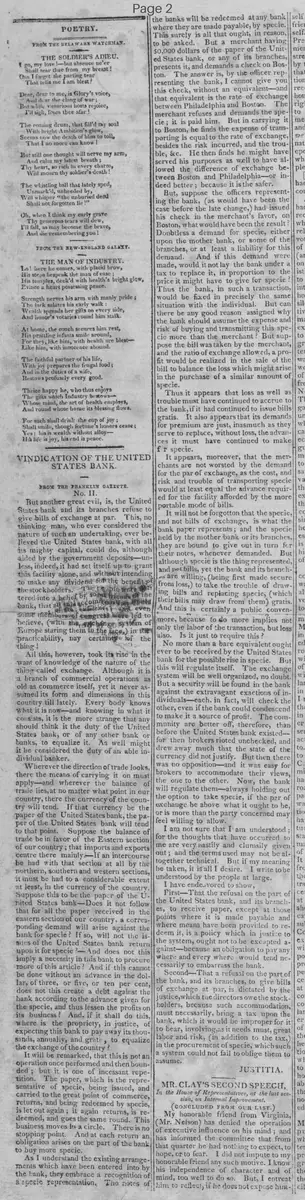
VINDICATION OF THE UNITED STATES BANK.
FROM THE FRANKLIN GAZETTE.
No. II.
But another great evil, is, the United States bank and its branches refuse to give bills of exchange at par. This, no thinking man, who ever considered the nature of such an undertaking, ever believed the United States bank, with all its mighty capital, could do, although aided by the government deposits—unless, indeed, it had set itself up to grant this facility alone, and without intending to make any dividend for the benefit of the stockholders. The people were led into a belief by some friends of the bank that its existence, and even some members of congress were led to believe, (with the exchange system of Europe staring them in the face,) in the practicability, nay certainty of the thing!
All this, however, took its rise in the want of knowledge of the nature of the thing called exchange. Although it is a branch of commercial operations as old as commerce itself, yet it never assumed its form and dimensions in this country till lately. Every body knows what it is now—and knowing in what it consists, it is the more strange that any should think it the duty of the United States bank, or of any other bank or banks, to equalize it. As well might it be considered the duty of an able individual banker.
Wherever the direction of trade looks, there the means of carrying it on must apply—and wherever the balance of trade lies, at no matter what point in our country, there the currency of the country will tend. If that currency be the paper of the United States bank, the paper of the United States bank will tend to that point. Suppose the balance of trade be in favor of the Eastern section of our country; that imports and exports centre there mainly.—If an intercourse be had with that section at all by the northern, southern and western sections, it must be had to a considerable extent at least, in the currency of the country. Suppose this to be the paper of the United States bank—Does it not follow that for all the paper received in the eastern section of our country, a corresponding demand will arise against the bank for specie? If so, will not the issues of the United States bank return upon it for specie?—And does not this imply a necessity in this bank to procure more of this article? And if this cannot be done without an advance in the dollar, of three, or five, or ten per cent, does not this create a debt against the bank according to the advance given for the specie, and thus lessen the profits on its business? And, if it shall do this, where is the propriety, in justice, of expecting this bank to pay away its thousands, annually, and gratis, to equalize the exchange of the country?
It will be remarked, that this is not an operation once performed and then bounded; but it is one of incessant repetition. The paper, which is the representative of specie, being issued, and carried to the great point of commerce, returns, and being redeemed by specie, is let out again; it again returns, is redeemed, and goes the same round. This business moves in a circle. There is no stopping point. And at each return an obligation arises on the part of the bank to buy more specie.
As I understand the existing arrangements which have been entered into by the bank, they embrace a recognition of a specie representation. The notes of the banks will be redeemed at any bank where they are made payable, by specie. This surely is all that ought, in reason, to be asked. But a merchant having 50,000 dollars of the paper of the United States bank, or any of its branches, presents it, and demands a check on Boston. The answer is, by the officer representing the bank, I cannot give you this check, without an equivalent—and that equivalent is the rate of exchange between Philadelphia and Boston. The merchant refuses and demands the specie; it is paid him. But in carrying it to Boston, he finds the expense of transporting is equal to the rate of exchange, besides the risk incurred, and the trouble, &c. He then finds he might have served his purposes as well to have allowed the difference of exchange between Boston and Philadelphia—or indeed better; because it is the safer.
But, suppose the officers representing the bank, (as would have been the case before the late change,) had issued his check in the merchant's favor, on Boston, what would have been the result? Doubtless a demand for specie, either upon the mother bank, or some of the branches, or at least a liability for this demand. And if this demand were made, would it not lay the bank under a tax to replace it, in proportion to the price it might have to give for specie? Thus the bank, in such a transaction, would be fixed in precisely the same situation with the individual. But can there be any good reason assigned why the bank should assume the expense and risk of buying and transmitting this specie more than the merchant? But suppose the bill was taken by the merchant, and the ratio of exchange allowed, a profit would be realized in the sale of the bill to balance the loss which might arise in the purchase of a similar amount of specie.
Thus it appears that loss as well as trouble must have continued to accrue to the bank, if it had continued to issue bills gratis. It also appears that its demands for premium are just, inasmuch as they serve to replace, without loss, the advances it must have continued to make for specie.
It appears, moreover, that the merchants are not worsted by the demand for the par of exchange, as the cost, and risk and trouble of transporting specie would at least equal the advance required for the facility afforded by the more portable mode of bills.
It will not be forgotten that the specie, and not bills of exchange, is what the bank paper represents: and the specie held by the mother bank or its branches, they are bound to give out in turn for their notes, whenever demanded. But although specie is the thing represented, and not bills, yet the bank and its branches are willing, (being first made secure from loss,) to take the trouble of drawing bills and replacing specie, (which their bills may draw from them) gratis. And this is certainly a public convenience more, because to do more implies not only the labor of the transaction, but loss also. Is it just to require this? No more than a bare equivalent ought ever to be received by the United States bank for the possible rise in specie. But this will regulate itself. The exchange system will be well organized, no doubt. But a security will be found in the bank against the extravagant exactions of individuals—each, in fact, will check the other even if the bank could condescend to make it a source of profit. The community are better off, therefore, than before the United States bank existed—for then brokers rioted unchecked, and drew away much that the state of the currency did not justify. But then there was no opposition—and it was easy for brokers to accommodate their views, the one to the other. Now, the bank will regulate them—always holding out the option to take specie, if the par of exchange be above what it ought to be, or is more than the party concerned may feel willing to allow.
I am not sure that I am understood; for the thoughts that have occurred to me are very hastily and clumsily given out; and the terms used may not be altogether technical. But if my meaning be taken, it is all I desire. I write to be understood by the people at large.
I have endeavored to show,
First—That the refusal on the part of the United States bank, and its branches, to receive paper, except at those points where it is made payable and where means have been provided to redeem it, is a policy which in justice to the system, ought not to be excepted against—because an obligation to pay any where and every where would tend necessarily to embarrass the bank.
Second—That a refusal on the part of the bank, and its branches, to give bills of exchange at par, is dictated by the justice, which the directors owe the stockholders, because such accommodation, must necessarily, bring a tax upon the bank, which it would be improper for it to bear, involving, as it needs must, great labor and risk, (in addition to the tax,) in the procurement of specie, which such a system could not fail to oblige them to assume.
JUSTITIA.
FROM THE FRANKLIN GAZETTE.
No. II.
But another great evil, is, the United States bank and its branches refuse to give bills of exchange at par. This, no thinking man, who ever considered the nature of such an undertaking, ever believed the United States bank, with all its mighty capital, could do, although aided by the government deposits—unless, indeed, it had set itself up to grant this facility alone, and without intending to make any dividend for the benefit of the stockholders. The people were led into a belief by some friends of the bank that its existence, and even some members of congress were led to believe, (with the exchange system of Europe staring them in the face,) in the practicability, nay certainty of the thing!
All this, however, took its rise in the want of knowledge of the nature of the thing called exchange. Although it is a branch of commercial operations as old as commerce itself, yet it never assumed its form and dimensions in this country till lately. Every body knows what it is now—and knowing in what it consists, it is the more strange that any should think it the duty of the United States bank, or of any other bank or banks, to equalize it. As well might it be considered the duty of an able individual banker.
Wherever the direction of trade looks, there the means of carrying it on must apply—and wherever the balance of trade lies, at no matter what point in our country, there the currency of the country will tend. If that currency be the paper of the United States bank, the paper of the United States bank will tend to that point. Suppose the balance of trade be in favor of the Eastern section of our country; that imports and exports centre there mainly.—If an intercourse be had with that section at all by the northern, southern and western sections, it must be had to a considerable extent at least, in the currency of the country. Suppose this to be the paper of the United States bank—Does it not follow that for all the paper received in the eastern section of our country, a corresponding demand will arise against the bank for specie? If so, will not the issues of the United States bank return upon it for specie?—And does not this imply a necessity in this bank to procure more of this article? And if this cannot be done without an advance in the dollar, of three, or five, or ten per cent, does not this create a debt against the bank according to the advance given for the specie, and thus lessen the profits on its business? And, if it shall do this, where is the propriety, in justice, of expecting this bank to pay away its thousands, annually, and gratis, to equalize the exchange of the country?
It will be remarked, that this is not an operation once performed and then bounded; but it is one of incessant repetition. The paper, which is the representative of specie, being issued, and carried to the great point of commerce, returns, and being redeemed by specie, is let out again; it again returns, is redeemed, and goes the same round. This business moves in a circle. There is no stopping point. And at each return an obligation arises on the part of the bank to buy more specie.
As I understand the existing arrangements which have been entered into by the bank, they embrace a recognition of a specie representation. The notes of the banks will be redeemed at any bank where they are made payable, by specie. This surely is all that ought, in reason, to be asked. But a merchant having 50,000 dollars of the paper of the United States bank, or any of its branches, presents it, and demands a check on Boston. The answer is, by the officer representing the bank, I cannot give you this check, without an equivalent—and that equivalent is the rate of exchange between Philadelphia and Boston. The merchant refuses and demands the specie; it is paid him. But in carrying it to Boston, he finds the expense of transporting is equal to the rate of exchange, besides the risk incurred, and the trouble, &c. He then finds he might have served his purposes as well to have allowed the difference of exchange between Boston and Philadelphia—or indeed better; because it is the safer.
But, suppose the officers representing the bank, (as would have been the case before the late change,) had issued his check in the merchant's favor, on Boston, what would have been the result? Doubtless a demand for specie, either upon the mother bank, or some of the branches, or at least a liability for this demand. And if this demand were made, would it not lay the bank under a tax to replace it, in proportion to the price it might have to give for specie? Thus the bank, in such a transaction, would be fixed in precisely the same situation with the individual. But can there be any good reason assigned why the bank should assume the expense and risk of buying and transmitting this specie more than the merchant? But suppose the bill was taken by the merchant, and the ratio of exchange allowed, a profit would be realized in the sale of the bill to balance the loss which might arise in the purchase of a similar amount of specie.
Thus it appears that loss as well as trouble must have continued to accrue to the bank, if it had continued to issue bills gratis. It also appears that its demands for premium are just, inasmuch as they serve to replace, without loss, the advances it must have continued to make for specie.
It appears, moreover, that the merchants are not worsted by the demand for the par of exchange, as the cost, and risk and trouble of transporting specie would at least equal the advance required for the facility afforded by the more portable mode of bills.
It will not be forgotten that the specie, and not bills of exchange, is what the bank paper represents: and the specie held by the mother bank or its branches, they are bound to give out in turn for their notes, whenever demanded. But although specie is the thing represented, and not bills, yet the bank and its branches are willing, (being first made secure from loss,) to take the trouble of drawing bills and replacing specie, (which their bills may draw from them) gratis. And this is certainly a public convenience more, because to do more implies not only the labor of the transaction, but loss also. Is it just to require this? No more than a bare equivalent ought ever to be received by the United States bank for the possible rise in specie. But this will regulate itself. The exchange system will be well organized, no doubt. But a security will be found in the bank against the extravagant exactions of individuals—each, in fact, will check the other even if the bank could condescend to make it a source of profit. The community are better off, therefore, than before the United States bank existed—for then brokers rioted unchecked, and drew away much that the state of the currency did not justify. But then there was no opposition—and it was easy for brokers to accommodate their views, the one to the other. Now, the bank will regulate them—always holding out the option to take specie, if the par of exchange be above what it ought to be, or is more than the party concerned may feel willing to allow.
I am not sure that I am understood; for the thoughts that have occurred to me are very hastily and clumsily given out; and the terms used may not be altogether technical. But if my meaning be taken, it is all I desire. I write to be understood by the people at large.
I have endeavored to show,
First—That the refusal on the part of the United States bank, and its branches, to receive paper, except at those points where it is made payable and where means have been provided to redeem it, is a policy which in justice to the system, ought not to be excepted against—because an obligation to pay any where and every where would tend necessarily to embarrass the bank.
Second—That a refusal on the part of the bank, and its branches, to give bills of exchange at par, is dictated by the justice, which the directors owe the stockholders, because such accommodation, must necessarily, bring a tax upon the bank, which it would be improper for it to bear, involving, as it needs must, great labor and risk, (in addition to the tax,) in the procurement of specie, which such a system could not fail to oblige them to assume.
JUSTITIA.
What sub-type of article is it?
Economic Policy
Trade Or Commerce
What keywords are associated?
United States Bank
Bills Of Exchange
Specie Redemption
Exchange Rates
Banking Policy
Trade Balance
Stockholder Interests
What entities or persons were involved?
United States Bank
Stockholders
Merchants
Brokers
Congress Members
Editorial Details
Primary Topic
Vindication Of The United States Bank's Exchange Policy
Stance / Tone
Defensive Justification Supporting The Bank's Practices
Key Figures
United States Bank
Stockholders
Merchants
Brokers
Congress Members
Key Arguments
Bank Cannot Provide Bills Of Exchange At Par Without Incurring Losses On Specie Procurement
Exchange Follows Trade Balances, Leading To Constant Specie Demands On The Bank
Issuing Bills At Par Would Tax The Bank Unjustly, Reducing Stockholder Dividends
Merchants Face Equivalent Costs And Risks In Transporting Specie Themselves
Bank's Policy Regulates Exchange Better Than Unchecked Brokers Did Previously
Bank Redeems Notes In Specie At Payable Points, Which Is Sufficient Obligation