Thank you for visiting SNEWPapers!
Sign up free
The Massachusetts Spy
Worcester, Worcester County, Massachusetts
What is this article about?
A traveler visits the New Bethlehem Hospital (Bedlam) in Moorfields, London, finding it surprisingly cheerful and clean despite housing the insane. Describes facilities, a restrained murderer, delusional patients, criminal lunatics including Margaret Nicholson and Hatfield, and reflects on madness and providence.
Clipping
OCR Quality
Full Text
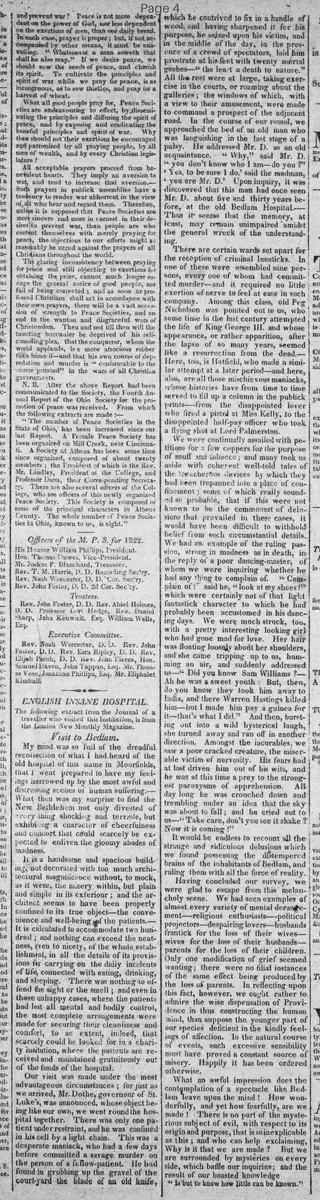
The following extract from the Journal of a traveller who visited this Institution, is from the London New Monthly Magazine.
Visit to Bedlam.
My mind was so full of the dreadful recollection of what I had heard of the old hospital of this name in Moorfields, that I went prepared to have my feelings harrowed up by the most awful and distressing scenes of human suffering.-- What then was my surprise to find the New Bethlehem not only divested of every thing shocking and terrible, but exhibiting a character of cheerfulness and comfort that could scarcely be expected to enliven the gloomy abodes of madness.
It is a handsome and spacious building, not decorated with too much architectural magnificence without, to mock, as it were, the misery within, but plain and simple in its exterior; and the architect seems to have been properly confined to its true object--the convenience and well-being of the patients.— It is calculated to accommodate two hundred; and nothing can exceed the neatness, even to nicety, of the whole establishment, in all the details of its provisions for carrying on the daily incidents of life connected with eating, drinking, and sleeping. There was nothing to offend the sight or the smell; and even in those unhappy cases, where the patients had lost all mental and bodily control, the most complete arrangements were made for securing their cleanliness and comfort, to an extent, indeed, that scarcely could be looked for in a charity institution, where the patients are received and maintained gratuitously out of the funds of the hospital.
Our visit was made under the most advantageous circumstances; for just as we arrived, Mr. Haslam, governor of St. Luke's, was announced, whose object being like our own, we went round the hospital together. There was only one patient under restraint, and he was confined in his cell by a light chain. This was a desperate maniac, who had a few days before committed a savage murder on the person of a fellow-patient. He had found in grubbing up the gravel of the court-yard the blade of an old knife, which he contrived to fix in a handle of wood, and having sharpened it for his purpose, he seized upon his victim, and in the middle of the day, in the presence of a crowd of spectators, laid him prostrate at his feet with twenty mortal gashes "the least a death to nature."
All the rest were at large, taking exercise in the courts, or roaming about the galleries; the windows of which, with a view to their amusement, were made to command a prospect of the adjacent road. In the course of our round, we approached the bed of an old man who was languishing in the last stage of a palsy. He addressed Mr. H. as an old acquaintance. "Why," said Mr. H. "you don't know who I am--do you?" "Yes, to be sure I do," said the madman, "you are Mr. H." Upon inquiry, it was discovered that this man had once seen Mr. H. about five and thirty years before, at the old Bedlam Hospital.--- Thus it seems that the memory, at least, may remain unimpaired 'amidst the general wreck of the understanding.
There are certain wards set apart for the reception of criminal lunaticks. In one of these were assembled nine persons, every one of whom had committed murder--and it required no little exertion of nerve to feel at ease in such company. Among this class, old Margaret Nicholson was pointed out to us, who some time in the last century attempted the life of King George III. and whose appearance, or rather apparition, after the lapse of so many years, seemed like a resurrection from the dead.- Here, too, is Hatfield, who made a similar attempt at a later period--and here, also, are all those mischievous maniacs, whose histories have from time to time served to fill up a column in the publick prints---from the disappointed lover who fired a pistol at Miss Kelly, to the disappointed half-pay officer who took a flying shot at Lord Palmerston.
We were continually assailed with petitions for a few coppers for the purpose of snuff and tobacco; and many took us aside with coherent well-told tales of the treacherous devices by which they had been trepanned into a place of confinement; some of which really sounded so probable, that if this were not known to be the commonest of delusions that prevailed in these cases, it would have been difficult to withhold belief from such circumstantial details.
We had an example of the ruling passion, strong in madness as in death, in the reply of a poor dancing-master, of whom we were inquiring whether he had any thing to complain of. "Complain of?" said he, "look at my shoes!" which were certainly not of that light fantastick character to which he had probably been accustomed in his dancing days. We were much struck, too, with a pretty interesting looking girl who had gone mad for love. Her hair was floating loosely about her shoulders, and she came tripping up to us, humming an air, and suddenly addressed us "Did you know Sam Williams? Ah he was a sweet youth: But, then, do you know they took him away to India, and there Warren Hastings killed him--but I made him pay a guinea for it--that's what I did." And then, bursting out into a wild hysterical laugh, she turned away and ran off in another direction. Amongst the incurables, we saw a poor cracked creature, the miserable victim of nervousness. His fears had at last driven him out of his wits, and he was at this time a prey to the strongest paroxysms of apprehension. All day long he was crouched down and trembling under an idea that the sky was about to fall; and he cried out to us--"Take care, don't you see it shake? Now it is coming!"
It would be endless to recount all the strange and ridiculous delusions which we found possessing the distempered brains of the inhabitants of Bedlam, and ruling them with all the force of reality. Having concluded our survey, we were glad to escape from this melancholy scene. We had seen examples of almost every variety of mental derangement--religious enthusiasts---political projectors--despairing lovers--husbands frantick for the loss of their wives— wives for the loss of their husbands-- parents for the loss of their children. Only one modification of grief seemed wanting; there were no filial instances of the same effect being produced by the loss of parents. In reflecting upon this fact, however, we ought rather to admire the wise dispensation of Providence in thus constructing the human mind, than suppose the younger part of our species deficient in the kindly feelings of affection. In the natural course of events, such excessive sensibility must have proved a constant source of misery. Happily it has been ordered otherwise.
What an awful impression does the contemplation of a spectacle like Bedlam leave upon the mind! How wonderfully, and yet how fearfully, are we made! There is no part of the mysterious subject of evil, with respect to its origin and purpose, that is so inexplicable as this; and who can help exclaiming, Why is it that we are made? But we are surrounded by mysteries on every side, which baffle our inquiries; and the result of our boasted knowledge "Is but to know how little can be known."
What sub-type of article is it?
What themes does it cover?
What keywords are associated?
What entities or persons were involved?
Where did it happen?
Story Details
Key Persons
Location
New Bethlehem Hospital, Moorfields, London
Story Details
A traveler, accompanied by Mr. Haslam, tours the clean and comfortable New Bedlam Hospital, observes a restrained murderer, various delusional patients including a lovesick girl and a nervous man fearing the sky's fall, visits criminal lunatics' ward with historical figures like Margaret Nicholson and Hatfield, and reflects on the varieties of mental derangement and divine providence in human sensibility.