Thank you for visiting SNEWPapers!
Sign up free
Story
October 10, 1811
Virginia Argus
Richmond, Virginia
What is this article about?
A personal observation of Napoleon Bonaparte's physical traits, solitary demeanor, indifference to others, and intense focus on personal glory, from his early days as an artillery officer to emperor.
Merged-components note: Image overlaps spatially with Bonaparte portrait story.
Clipping
OCR Quality
65%
Fair
Full Text
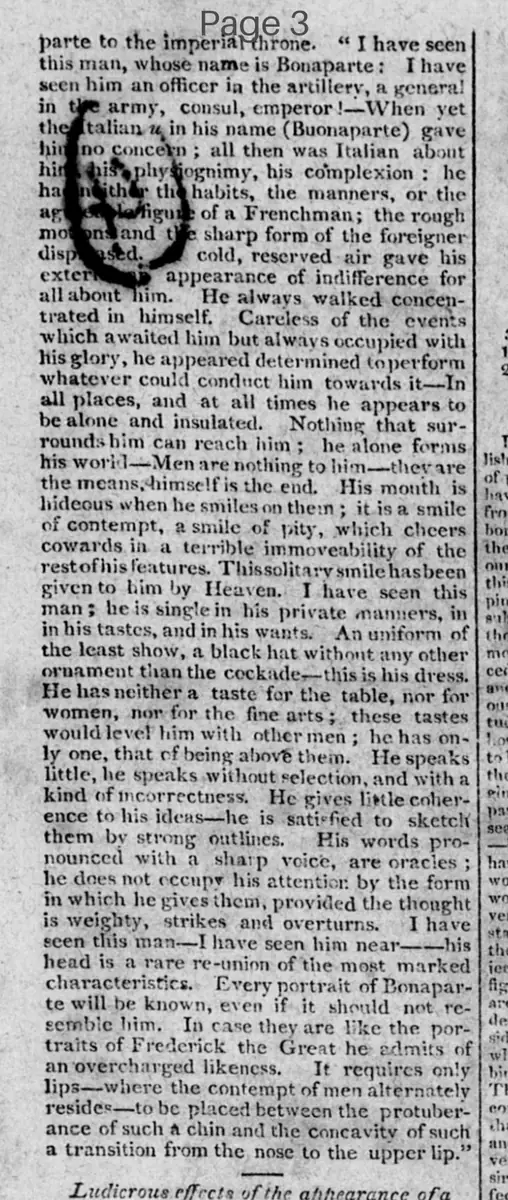
I have seen this man, whose name is Bonaparte; I have seen him an officer in the artillery, a general, consul, emperor!—When yet his name (Buonaparte), gave all then was Italian about him, his complexion: he had habits, the manners, or, the of a Frenchman; the rough, sharp form of the foreigner cold, reserved-air gave his appearance of indifference for all about him. He always walked concentrated in himself. Careless of the events which awaited him but always occupied with his glory, he appeared determined to perform whatever could conduct him towards it. In all places, and at all times he appears to be alone and insulated. Nothing that surrounds him can reach him: he alone forms his world—Men are nothing to him—himself is the end. His mouth is hideous when he smiles on them: it is a smile of contempt, a smile of pity, which cheers cowards in a terrible immoveability of the rest of his features. This solitary smile has been given to him by Heaven. I have seen this man; he is single in his private manners, in his tastes, and in his wants. An uniform of the least show, a black hat without any other ornament than the cockade—this is his dress. He has neither a taste for the table, nor for women, nor for the fine arts; these tastes would level him with other men: he has only one, that of being above them. He speaks little, he speaks without selection, and with a kind of incorrectness. He gives little coherence to his ideas—he is satisfied to sketch them by strong outlines. His words pronounced with a sharp voice, are oracles; he does not occupy his attention: by the form in which he gives them, provided the thought is weighty, strikes and overturns. I have seen this man—I have seen him near—his head is a rare re-union of the most marked characteristics. Every portrait of Bonaparte will be known, even if it should not resemble him. In case they are like the portraits of Frederick the Great he admits of an overcharged likeness. It requires only lips—where the contempt of men alternately resides—to be placed between the protuberance of such a chin and the concavity of such a transition from the nose to the upper lip.
What sub-type of article is it?
Biography
Curiosity
What themes does it cover?
Triumph
Social Manners
What keywords are associated?
Napoleon Bonaparte
Character Sketch
Personal Observation
Solitude
Ambition
Glory
What entities or persons were involved?
Bonaparte
Story Details
Key Persons
Bonaparte
Story Details
The narrator recounts observing Bonaparte's rise from artillery officer to emperor, describing his Italian complexion, French manners, solitary and indifferent nature, focus on glory, simple dress, lack of common tastes, abrupt speech, and distinctive facial features conveying contempt.