Thank you for visiting SNEWPapers!
Sign up free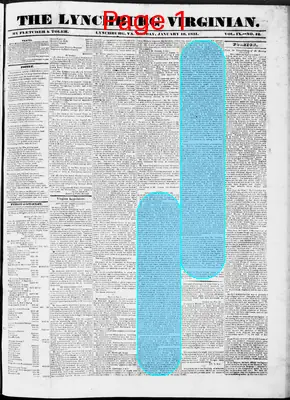
Lynchburg Virginian
Lynchburg, Virginia
What is this article about?
In the House of Delegates, A. Stuart, Jr. delivers a speech supporting a new election writ for Patrick County, citing unsworn commissioners and other irregularities akin to the Orange County case. He voluntarily relinquishes his seat, acknowledging the contestant's majority. The motion fails 30-71.
Clipping
OCR Quality
Full Text
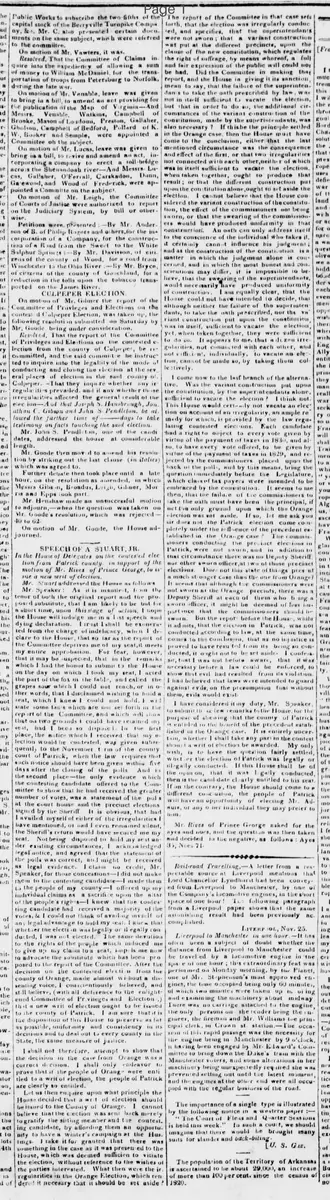
In the House of Delegates on the contested election from Patrick county, in support of the motion of Mr. Rives of Prince George, to issue a new writ of election.
Mr. Stuart addressed the House as follows:
Mr. Speaker: As it is manifest, from the tenor of both the original report and the proposed substitute, that I am likely to be but for a short time, upon this stage of action, I hope the House will indulge me in a last speech and dying declaration. I trust I shall be exonerated from the charge of indecency, when I declare to the House, that so far as the report of the Committee deprives me of my seat, it meets my entire approbation. For fear, however, that it may be suspected, that in the remarks which I had the honor to submit to the House on the day on which I took my seat, I acted the part of the fox in the fable, and called the grapes sour which I could not reach, or in other words, that I disclaimed wishing to hold a seat, which I knew I could not hold. I will state some facts which are not set forth in the report of the Committee, and which will show that on two grounds I could have secured my seat, had I been so disposed. In the first place, the notice which I received that my election would be contested, was given subsequently to the November term of the county court of Patrick, when the law requires that such notice should have been given within five days after the closing of the polls. And in the second place—the only evidence which the contesting candidate offered to the Committee to show that he had received the greater number of votes, was a statement of the polls at the court house and the precinct elections signed by the Sheriff. It is obvious, that had I availed myself of either of the irregularities I have mentioned, or had I even remained silent, the Sheriff's return would have secured me my seat. Not being disposed to hold my seat under existing circumstances, I acknowledged legal notice, and agreed that the statement of the polls was correct, and might be received as legal evidence. I claim no credit, Mr. Speaker, for those concessions—did not make them to the contesting candidate—I made them to the people of my county—I offered up my individual claims as a sacrifice upon the altar of the people's rights—I knew that the contesting candidate had received a majority of the votes, & I could not think of availing myself of any legal advantage to hold my seat. I knew that whether the election was legally or illegally conducted, I was not elected. The same devotion to the rights of the people which induced me to give up my claim to a seat, impels me now to advocate the substitute which has been proposed to the report of the Committee. After the decision on the contested election from the county of Orange, made almost without a dissenting voice, I conscientiously believed, and still believe, (with all deference to the enlightened Committee of Privileges and Election.) that a new writ of election ought to be issued to the county of Patrick. I am sure that it is the disposition of this House to preserve as far as possible, uniformity and consistency in its decisions and to deal out to every county in the State, the same measure of justice.
I shall not therefore, attempt to show that the decision in the case from Orange was an incorrect decision. I shall only endeavor to prove that if the people of Orange were entitled to a writ of election, the people of Patrick are clearly so entitled.
Let us then enquire upon what principle the House decided that a writ of election should be issued to the County of Orange. I cannot believe that the election was sent back merely to gratify the sitting member and the contesting candidate, by affording them an opportunity to have a winter's campaign at the hustings. I take it for granted that there was something in the case as it was presented to the House, which was deemed sufficient to vitiate the election, without reference to the wishes of the parties interested. What then were the irregularities in the Orange Election, which rendered it necessary that it should be set aside?
The report of the Committee in that case sets forth, that the election was irregularly conducted, and specifies, that the superintendents were not sworn: that a variant construction was put at the different precincts, upon the clause of the new constitution, which regulates the right of suffrage, by means whereof, a full and fair expression of the public will could not be had. Did the Committee in making that report, and the House in giving it its sanction, mean to say, that the failure of the superintendents to take the oath prescribed by law, was not in itself sufficient to vacate the election, but that in order to do so, the additional circumstance of the variant construction of the Constitution, made by the superintendents, was also necessary? If this be the principle settled in the Orange case, then the House must have come to the conclusion, either that the last mentioned circumstance was the consequence and effect of the first, or that two irregularities not connected with each other, neither of which was in itself sufficient to vacate the election, when taken together, ought to produce that result; or that the different construction put upon the constitution alone, ought to set aside the election. I cannot believe that the House considered the variant construction of the constitution, the effect of the commissioners not being sworn, or that the swearing of the commissioners would have produced uniformity in that construction. An oath can only address itself to the conscience of the individual who takes it, it certainly cannot influence his judgment: and as the construction of the constitution is a matter in which the judgment alone is concerned, and in which the most honest and conscientious may differ, it is impossible to believe, that the swearing of the superintendents would necessarily have produced uniformity of construction. I am equally clear, that the House could not have intended to decide, that although neither the failure of the superintendents to take the oath prescribed, nor the variant construction put upon the constitution was in itself, sufficient to vacate the election yet, when taken together, they were sufficient to do so. It appears to me, that a dozen irregularities, not connected with each other, and not sufficient, individually, to vacate an election, cannot be made so, by taking them collectively.
I come now to the last branch of the alternative. Was the variant construction put upon the constitution, by the superintendents alone, sufficient to vacate the election? I think not. This House would certainly not vacate an election on account of an irregularity, an ample remedy for which, is provided by the law regulating contested elections. Each candidate had a right to object to every vote given by virtue of the payment of taxes in 1830, and also, to have every vote offered, to be given by virtue of the payment of taxes in 1829, and rejected by the commissioners placed upon the back of the poll, and by this means, bring the question immediately before the Legislature, which class of tax payers were intended to be embraced by the constitution. It seems to me then, that the failure of the commissioners to take the oath must have been the principal, if not the only ground upon which the Orange election was set aside. If so, let me ask you sir does not the Patrick election come completely under the influence of the precedent established in the Orange case? The commissioners conducting the precinct elections in Patrick, were not sworn, and in addition to that circumstance there was no Deputy Sheriff, nor other sworn officer, at two of those precinct elections. Does not this state of things present a much stronger case than the one from Orange? It seems that although the commissioners were not sworn at the Orange precincts, there was a Deputy Sheriff at each of them who being a sworn officer, it might be deemed of less importance that the commissioners should be sworn. But the report before the House, while it admits, that the election in Patrick, was not conducted according to law, at the same time, comes to the conclusion, that as no injustice is proved to have resulted from its being so conducted, it ought not to be set aside. I confess, sir, that I was not before aware, that it was necessary before a law could be enforced, to show that evil had resulted from its violation. I had believed that laws were intended to guard against evils, on the presumption that without them, evils would exist.
I have considered it my duty, Mr. Speaker, to submit in so few remarks to the House, for the purpose of shewing that the county of Patrick is entitled to the benefit of the precedent established in the Orange case. It is entirely uncertain, whether I shall take any part in the contest should a writ of election be awarded. My only wish, is to have the question fairly settled, whether the election of Patrick was legally or illegally conducted. If this House shall be of the opinion, that it was legally conducted, then the sitting candidate is clearly entitled to his seat. If on the contrary, the House should come to a different conclusion, the people of Patrick will have an opportunity of electing Mr. Adams, or any other individual they may prefer to W.
Mr. Rives of Prince George asked for the ayes and noes, and the question was then taken and decided in the negative, as follows: Ayes 30. Noes 71.
What sub-type of article is it?
What themes does it cover?
What keywords are associated?
What entities or persons were involved?
Where did it happen?
Story Details
Key Persons
Location
House Of Delegates, Patrick County, Orange County
Story Details
A. Stuart, Jr. speaks in the House of Delegates advocating for a new election writ in Patrick County due to unsworn commissioners and lack of sworn officers at precincts, paralleling the Orange County precedent. He concedes his seat, admitting the contestant's majority despite legal technicalities favoring him, to uphold the people's rights. The motion fails.