Thank you for visiting SNEWPapers!
Sign up free
Literary
November 9, 1858
Mineral Point Tribune
Mineral Point, Iowa County, Wisconsin
What is this article about?
An essay by A. Wilson advocating practical, application-focused education over mere theory, critiquing cramming methods, praising inventors from practical backgrounds, proposing blended curricula, and urging improvements in schools including clergy involvement and playgrounds. Emphasizes industrious habits to prevent crime.
Clipping
OCR Quality
92%
Excellent
Full Text
CONTRIBUTED.
Practical Education.
An Essay Read Before the Teachers' Association.
BY A. WILSON.
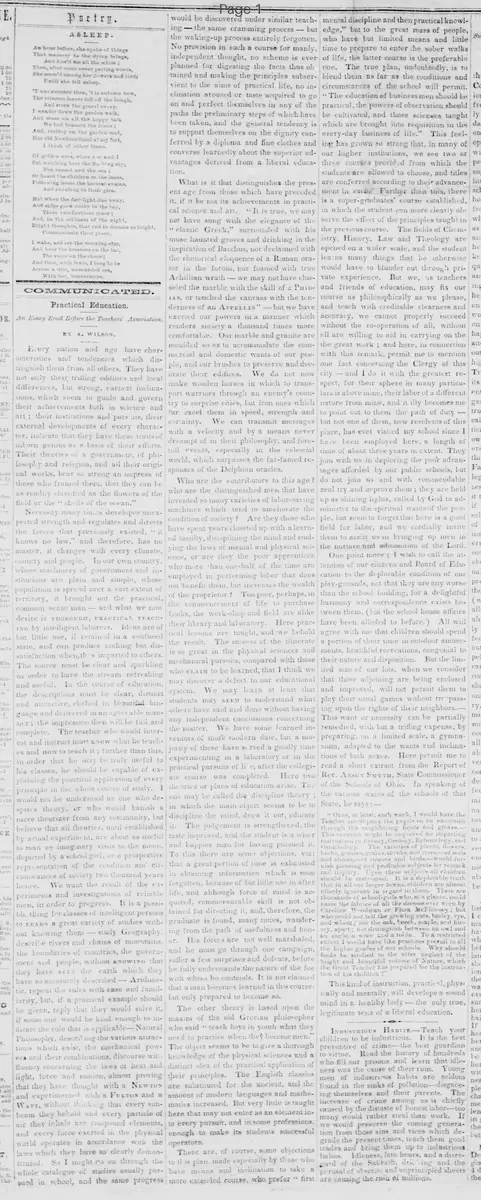
Every nation and age have characteristics and tendencies which distinguish them from all others. They have not only their trifling oddities and local differences, but strong, earnest inclinations, which seem to guide and govern their achievements both in science and art; their institutions and pursuits, their external developments of every character, indicate that they have these traits of internal genius as a basis of their efforts. Their theories of a government, of philosophy and religion, and all their original works, bear so strong an impress of those who framed them, that they can be as readily classified as the flowers of the field or the "shells of the ocean."
Necessity many times develops unexpected strength and regulates and directs the forces that previously existed, "it knows no law," and therefore, has no master, it changes with every climate, country and people. In our own country, whose machinery of government and institutions are plain and simple, whose population is spread over a vast extent of territory, it brought out the practical, common sense man - and what we now desire is THOROUGH, PRACTICAL TEACHING by intelligent laborers. Ideas are of but little use, if retained in a confused state, and can produce nothing but dissatisfaction when thus imparted to others. The source must be clear and sparkling in order to have the stream refreshing and useful. In the course of education, the descriptions must be clear, distinct and attractive, clothed in beautiful language and delivered in an agreeable manner; the impression then will be full and complete. The teacher who would interest and instruct must know what he teaches and how to teach it; further than this, in order that he may be truly useful to his classes, he should be capable of explaining the practical application of every principle in the whole course of study. I would not be understood as one who despises theory, or who would banish a mere theorizer from any community, but believe that all theories, until established by actual experiment, are about as useful to man as imaginary visits to the moon, depicted by a school girl, or a prospective representation of the condition and circumstances of society two thousand years hence. We want the result of the experiments and investigations of reliable men, in order to progress. It is a possible thing for classes of intelligent persons to learn a great variety of studies without knowing them - study Geography descriptive rivers and chains of mountains, the boundaries of countries, the government and people, without knowing that they have seen the earth which they have so accurately described - Arithmetic- repeat the rules with ease and familiarity, but, if a practical example should be given, reply that they would solve it, if some one would be kind enough to indicate the rule that is applicable - Natural Philosophy, describing the various attractions which exist, the mechanical powers and their combinations, discourse with fluency concerning the laws of heat and light, force and motion, almost proving that they have thought with a Newton and experimented with a Fulton and a Watt, without thinking that every sun-beam they behold and every particle of air they inhale are compound elements, and every force exerted in the physical world operates in accordance with the laws which they have so clearly demonstrated. So I might go on through the whole catalogue of studies usually pursued in school, and the same progress would be discovered under similar teaching -the same cramming process -- but the waking-up process entirely forgotten. No provision in such a course for manly, independent thought, no scheme is ever planned for digesting the facts thus obtained and making the principles subservient to the aims of practical life, no inclination aroused or taste acquired to go on and perfect themselves in any of the paths the preliminary steps of which have been taken, and the general tendency is to support themselves on the dignity conferred by a diploma and fine clothes and converse learnedly about the superior advantages derived from a liberal education.
What is it that distinguishes the present age from those which have preceded it, if it be not its achievements in practical science and art. "It is true, we may not have sung with the elegance of the "classic Greek," surrounded with his muse haunted groves and drinking in the inspiration of Bacchus, nor declaimed with the rhetorical eloquence of a Roman orator in the forum, nor foamed with true Achillian wrath - we may not have chiseled the marble with the skill of a Phidias, or touched the canvass with the tenderness of an Apelles" - but we have exerted our powers in a manner which renders society a thousand times more comfortable. Our marble and granite are moulded so as to accommodate the commercial and domestic wants of our people, and our brushes to preserve and decorate their edifices. We do not now make wooden horses in which to transport warriors through an enemy's country to surprise cities, but iron ones which far excel them in speed, strength and certainty. We can transmit messages with a velocity and by a means never dreamt of in their philosophy, and foretell events, especially in the celestial world, which surpasses the far-famed responses of the Delphian oracles.
Who are the contributors to this age? who are the distinguished men that have invented so many varieties of labor-saving machines which tend to ameliorate the condition of society? Are they those who have spent years closeted up with a learned faculty, disciplining the mind and studying the laws of mental and physical science, or are they the poor apprentices who more than one-half of the time are employed in performing labor that does not benefit them, but increases the wealth of the proprietor? Too poor, perhaps, in the commencement of life to purchase books, the work-shop and field are alike their library and laboratory. Here practical lessons are taught, and we behold the result. The success of the illiterate is so great in the physical sciences and mechanical pursuits, compared with those who claim to be learned, that I think we may discover a defect in our educational system. We may learn at least that students may seek to understand what others have said and done without having any independent conclusions concerning the matter. We have some learned inventors of more modern date, but a majority of these have served a goodly time experimenting in a laboratory or in the practical pursuits of life, after the collegiate course was completed. Here two theories or plans of education arise. The one may be called the discipline theory: in which the main object seems to be to discipline the mind, draw it out, educate it. The judgment is strengthened, the taste improved, and the student is a wiser and happier man for having pursued it. To this there are some objections, viz: that a great portion of time is exhausted in obtaining information which is soon forgotten, because of but little use in after life, and although force of mind is acquired, commensurable skill is not obtained for directing it, and, therefore, the graduate is found, many times, wandering from the path of usefulness and honor. His forces are not well marshaled, and he must go through one campaign, suffer a few surprises and defeats, before he fully understands the nature of the foe with whom he contends. It is not claimed that a man becomes learned in this course, but only prepared to become so.
The other theory is based upon the maxim of the old Grecian philosopher who said "teach boys in youth what they need to practice when they become men." The object seems to be to give a thorough knowledge of the physical sciences and a distinct idea of the practical application of their principles. The English classics are substituted for the ancient, and the amount of modern languages and mathematics increased. But very little is taught here that may not enter as an element into every pursuit, and in some professions, enough to make its students successful operators.
There are, of course, some objections to this plan, made especially by those who have means and inclination to take a more extended course, who prefer "first mental discipline and then practical knowledge," but to the great mass of people who have but limited means and little time to prepare to enter the sober walks of life, the latter course is the preferable one. The true plan, undoubtedly, is to blend them as far as the conditions and circumstances of the school will permit. "The education of business men should be practical, the powers of observation should be cultivated, and those sciences taught which are brought into requisition in the every-day business of life." This feeling has grown so strong that, in many of our higher institutions, we see two or three courses provided from which the students are allowed to choose, and titles are conferred according to their advancement in each. Farther than this, there is a super-graduates' course established, in which the student can more clearly observe the effect of the principles taught in the previous course. The fields of Chemistry, History, Law and Theology are opened on a wider scale, and the student learns many things that he otherwise would have to blunder out through private experience. But we, as teachers and friends of education, may fix our course as philosophically as we please, and teach with creditable clearness and accuracy, we cannot properly succeed without the co-operation of all, without all are willing to aid in carrying on the great work; and here, in connection with this remark, permit me to mention one fact concerning the Clergy of this city —and I do it with the greatest respect, for their sphere is many particulars above mine, their labor of a different nature from mine, and it ill becomes me to point out to them the path of duty - but not one of them, now residents of this place, has ever visited my school since I have been employed here, a length of time of about three years in extent. They join with us in deploring the poor advantages afforded by our public schools, but do not join us and with commendable zeal try and improve them; they are held up as shining lights, called by God to administer to the spiritual wants of the people, but seem to forget that here is a good field for labor, and we cordially invite them to assist us in bringing up men in the nurture and admonition of the Lord.
One point more; I wish to call the attention of our citizens and Board of Education to the deplorable condition of our play-grounds, not that they are any worse than the school building, for a delightful harmony and correspondence exists between them, (but the school house affairs have been alluded to before.) All will agree with me that children should spend a portion of their time in out-door amusements, healthful recreations, congenial to their nature and disposition. But the limited size of our lots, when we consider that those adjoining are being enclosed and improved, will not permit them to play their usual games without trespassing upon the rights of their neighbors. This want or necessity can be partially remedied, with but a trifling expense, by preparing, on a limited scale, a gymnasium, adapted to the wants and inclinations of both sexes. Here permit me to read a short extract from the Report of Rev. Anson Smyth. State Commissioner of the Schools of Ohio. In speaking of the various wants of the schools of that State, he says:-
"Once, at least, each week, I would have the Teacher accompany the pupils on an excursion through the neighboring fields and groves— This occasion might be improved for imparting Instruction in Botany, Geology, Entomology, and Ornithology. The varieties of plants, flowers, herbs, grasses, grains shrubs, and trees -of soils and stones,-of insects and birds,—would furnish pleasing and profitable subjects for remark and inquiry. Upon these subjects all children should be instructed. It is a deplorable truth that in all our larger towns, children are almost utterly ignorant in regard to them. Here are thousands of school-girls who, at a glance, could name the fabrics of all the dresses ever worn by Caroline Woodman or Flora McFlimsey; but who could not tell the growing oats, barley, rye, and wheat: nor the oak, beech, maple, and hickory, apart; nor distinguish between an owl and an eagle, a wren and a robin. To a restricted extent I would have like practices prevail in all the higher grades of our schools. Why should books be studied to the utter neglect of the bright and beautiful volume of Nature, which the Great Teacher has prepared for the instruction of his children?
This kind of instruction, practical, physically and mentally, will develope a sound mind in a healthy body- the only true, legitimate test of a liberal education.
Industrious Habits.-Teach your children to be industrious. It is the best preventive of crime-the best guardian to virtue. Read the history of hundreds who fill our prisons, and learn that idleness was the cause of their ruin. Young men of industrious habits are seldom found in the sinks of pollution--disgracing themselves and their parents. The increase of crime among us is chiefly caused by the distaste of honest labor-too many would rather steal than work. If we would preserve the coming generation from those sins and vices which degrade the present times, teach them good trades and bring them up to industrious habits. Idleness, late hours, and a disregard of the Sabbath, drinking and the perusal of obscene and unprincipled sheets are causing the ruin of millions,
Practical Education.
An Essay Read Before the Teachers' Association.
BY A. WILSON.
Every nation and age have characteristics and tendencies which distinguish them from all others. They have not only their trifling oddities and local differences, but strong, earnest inclinations, which seem to guide and govern their achievements both in science and art; their institutions and pursuits, their external developments of every character, indicate that they have these traits of internal genius as a basis of their efforts. Their theories of a government, of philosophy and religion, and all their original works, bear so strong an impress of those who framed them, that they can be as readily classified as the flowers of the field or the "shells of the ocean."
Necessity many times develops unexpected strength and regulates and directs the forces that previously existed, "it knows no law," and therefore, has no master, it changes with every climate, country and people. In our own country, whose machinery of government and institutions are plain and simple, whose population is spread over a vast extent of territory, it brought out the practical, common sense man - and what we now desire is THOROUGH, PRACTICAL TEACHING by intelligent laborers. Ideas are of but little use, if retained in a confused state, and can produce nothing but dissatisfaction when thus imparted to others. The source must be clear and sparkling in order to have the stream refreshing and useful. In the course of education, the descriptions must be clear, distinct and attractive, clothed in beautiful language and delivered in an agreeable manner; the impression then will be full and complete. The teacher who would interest and instruct must know what he teaches and how to teach it; further than this, in order that he may be truly useful to his classes, he should be capable of explaining the practical application of every principle in the whole course of study. I would not be understood as one who despises theory, or who would banish a mere theorizer from any community, but believe that all theories, until established by actual experiment, are about as useful to man as imaginary visits to the moon, depicted by a school girl, or a prospective representation of the condition and circumstances of society two thousand years hence. We want the result of the experiments and investigations of reliable men, in order to progress. It is a possible thing for classes of intelligent persons to learn a great variety of studies without knowing them - study Geography descriptive rivers and chains of mountains, the boundaries of countries, the government and people, without knowing that they have seen the earth which they have so accurately described - Arithmetic- repeat the rules with ease and familiarity, but, if a practical example should be given, reply that they would solve it, if some one would be kind enough to indicate the rule that is applicable - Natural Philosophy, describing the various attractions which exist, the mechanical powers and their combinations, discourse with fluency concerning the laws of heat and light, force and motion, almost proving that they have thought with a Newton and experimented with a Fulton and a Watt, without thinking that every sun-beam they behold and every particle of air they inhale are compound elements, and every force exerted in the physical world operates in accordance with the laws which they have so clearly demonstrated. So I might go on through the whole catalogue of studies usually pursued in school, and the same progress would be discovered under similar teaching -the same cramming process -- but the waking-up process entirely forgotten. No provision in such a course for manly, independent thought, no scheme is ever planned for digesting the facts thus obtained and making the principles subservient to the aims of practical life, no inclination aroused or taste acquired to go on and perfect themselves in any of the paths the preliminary steps of which have been taken, and the general tendency is to support themselves on the dignity conferred by a diploma and fine clothes and converse learnedly about the superior advantages derived from a liberal education.
What is it that distinguishes the present age from those which have preceded it, if it be not its achievements in practical science and art. "It is true, we may not have sung with the elegance of the "classic Greek," surrounded with his muse haunted groves and drinking in the inspiration of Bacchus, nor declaimed with the rhetorical eloquence of a Roman orator in the forum, nor foamed with true Achillian wrath - we may not have chiseled the marble with the skill of a Phidias, or touched the canvass with the tenderness of an Apelles" - but we have exerted our powers in a manner which renders society a thousand times more comfortable. Our marble and granite are moulded so as to accommodate the commercial and domestic wants of our people, and our brushes to preserve and decorate their edifices. We do not now make wooden horses in which to transport warriors through an enemy's country to surprise cities, but iron ones which far excel them in speed, strength and certainty. We can transmit messages with a velocity and by a means never dreamt of in their philosophy, and foretell events, especially in the celestial world, which surpasses the far-famed responses of the Delphian oracles.
Who are the contributors to this age? who are the distinguished men that have invented so many varieties of labor-saving machines which tend to ameliorate the condition of society? Are they those who have spent years closeted up with a learned faculty, disciplining the mind and studying the laws of mental and physical science, or are they the poor apprentices who more than one-half of the time are employed in performing labor that does not benefit them, but increases the wealth of the proprietor? Too poor, perhaps, in the commencement of life to purchase books, the work-shop and field are alike their library and laboratory. Here practical lessons are taught, and we behold the result. The success of the illiterate is so great in the physical sciences and mechanical pursuits, compared with those who claim to be learned, that I think we may discover a defect in our educational system. We may learn at least that students may seek to understand what others have said and done without having any independent conclusions concerning the matter. We have some learned inventors of more modern date, but a majority of these have served a goodly time experimenting in a laboratory or in the practical pursuits of life, after the collegiate course was completed. Here two theories or plans of education arise. The one may be called the discipline theory: in which the main object seems to be to discipline the mind, draw it out, educate it. The judgment is strengthened, the taste improved, and the student is a wiser and happier man for having pursued it. To this there are some objections, viz: that a great portion of time is exhausted in obtaining information which is soon forgotten, because of but little use in after life, and although force of mind is acquired, commensurable skill is not obtained for directing it, and, therefore, the graduate is found, many times, wandering from the path of usefulness and honor. His forces are not well marshaled, and he must go through one campaign, suffer a few surprises and defeats, before he fully understands the nature of the foe with whom he contends. It is not claimed that a man becomes learned in this course, but only prepared to become so.
The other theory is based upon the maxim of the old Grecian philosopher who said "teach boys in youth what they need to practice when they become men." The object seems to be to give a thorough knowledge of the physical sciences and a distinct idea of the practical application of their principles. The English classics are substituted for the ancient, and the amount of modern languages and mathematics increased. But very little is taught here that may not enter as an element into every pursuit, and in some professions, enough to make its students successful operators.
There are, of course, some objections to this plan, made especially by those who have means and inclination to take a more extended course, who prefer "first mental discipline and then practical knowledge," but to the great mass of people who have but limited means and little time to prepare to enter the sober walks of life, the latter course is the preferable one. The true plan, undoubtedly, is to blend them as far as the conditions and circumstances of the school will permit. "The education of business men should be practical, the powers of observation should be cultivated, and those sciences taught which are brought into requisition in the every-day business of life." This feeling has grown so strong that, in many of our higher institutions, we see two or three courses provided from which the students are allowed to choose, and titles are conferred according to their advancement in each. Farther than this, there is a super-graduates' course established, in which the student can more clearly observe the effect of the principles taught in the previous course. The fields of Chemistry, History, Law and Theology are opened on a wider scale, and the student learns many things that he otherwise would have to blunder out through private experience. But we, as teachers and friends of education, may fix our course as philosophically as we please, and teach with creditable clearness and accuracy, we cannot properly succeed without the co-operation of all, without all are willing to aid in carrying on the great work; and here, in connection with this remark, permit me to mention one fact concerning the Clergy of this city —and I do it with the greatest respect, for their sphere is many particulars above mine, their labor of a different nature from mine, and it ill becomes me to point out to them the path of duty - but not one of them, now residents of this place, has ever visited my school since I have been employed here, a length of time of about three years in extent. They join with us in deploring the poor advantages afforded by our public schools, but do not join us and with commendable zeal try and improve them; they are held up as shining lights, called by God to administer to the spiritual wants of the people, but seem to forget that here is a good field for labor, and we cordially invite them to assist us in bringing up men in the nurture and admonition of the Lord.
One point more; I wish to call the attention of our citizens and Board of Education to the deplorable condition of our play-grounds, not that they are any worse than the school building, for a delightful harmony and correspondence exists between them, (but the school house affairs have been alluded to before.) All will agree with me that children should spend a portion of their time in out-door amusements, healthful recreations, congenial to their nature and disposition. But the limited size of our lots, when we consider that those adjoining are being enclosed and improved, will not permit them to play their usual games without trespassing upon the rights of their neighbors. This want or necessity can be partially remedied, with but a trifling expense, by preparing, on a limited scale, a gymnasium, adapted to the wants and inclinations of both sexes. Here permit me to read a short extract from the Report of Rev. Anson Smyth. State Commissioner of the Schools of Ohio. In speaking of the various wants of the schools of that State, he says:-
"Once, at least, each week, I would have the Teacher accompany the pupils on an excursion through the neighboring fields and groves— This occasion might be improved for imparting Instruction in Botany, Geology, Entomology, and Ornithology. The varieties of plants, flowers, herbs, grasses, grains shrubs, and trees -of soils and stones,-of insects and birds,—would furnish pleasing and profitable subjects for remark and inquiry. Upon these subjects all children should be instructed. It is a deplorable truth that in all our larger towns, children are almost utterly ignorant in regard to them. Here are thousands of school-girls who, at a glance, could name the fabrics of all the dresses ever worn by Caroline Woodman or Flora McFlimsey; but who could not tell the growing oats, barley, rye, and wheat: nor the oak, beech, maple, and hickory, apart; nor distinguish between an owl and an eagle, a wren and a robin. To a restricted extent I would have like practices prevail in all the higher grades of our schools. Why should books be studied to the utter neglect of the bright and beautiful volume of Nature, which the Great Teacher has prepared for the instruction of his children?
This kind of instruction, practical, physically and mentally, will develope a sound mind in a healthy body- the only true, legitimate test of a liberal education.
Industrious Habits.-Teach your children to be industrious. It is the best preventive of crime-the best guardian to virtue. Read the history of hundreds who fill our prisons, and learn that idleness was the cause of their ruin. Young men of industrious habits are seldom found in the sinks of pollution--disgracing themselves and their parents. The increase of crime among us is chiefly caused by the distaste of honest labor-too many would rather steal than work. If we would preserve the coming generation from those sins and vices which degrade the present times, teach them good trades and bring them up to industrious habits. Idleness, late hours, and a disregard of the Sabbath, drinking and the perusal of obscene and unprincipled sheets are causing the ruin of millions,
What sub-type of article is it?
Essay
What themes does it cover?
Moral Virtue
Political
Social Manners
What keywords are associated?
Practical Education
Thorough Teaching
Industrious Habits
Educational Reform
Moral Instruction
What entities or persons were involved?
By A. Wilson.
Literary Details
Title
Practical Education. An Essay Read Before The Teachers' Association.
Author
By A. Wilson.
Subject
Read Before The Teachers' Association
Key Lines
Every Nation And Age Have Characteristics And Tendencies Which Distinguish Them From All Others.
We Want The Result Of The Experiments And Investigations Of Reliable Men, In Order To Progress.
What Is It That Distinguishes The Present Age From Those Which Have Preceded It, If It Be Not Its Achievements In Practical Science And Art.
The True Plan, Undoubtedly, Is To Blend Them As Far As The Conditions And Circumstances Of The School Will Permit.
This Kind Of Instruction, Practical, Physically And Mentally, Will Develope A Sound Mind In A Healthy Body The Only True, Legitimate Test Of A Liberal Education.